
For years, local search performance has been framed around a deceptively simple question: "Do we rank well in this city?"
For small and mid-sized businesses, answering "yes" to that question was often good enough. But for enterprise brands, especially those operating hundreds or thousands of locations across diverse markets, city-level rankings are no longer an accurate or actionable way to understand local visibility.
Enterprise businesses don't compete city by city. They compete market by market, trade area by trade area, and increasingly, experience by experience across Google Search, Maps, and other local discovery surfaces, from Apple Maps to AI search platforms.
As local search has matured, so has the way enterprise organizations need to measure success. The focus is shifting away from isolated rankings toward trade area visibility saturation, a more realistic, strategic view of how well a brand dominates the geographic areas that actually drive customer demand.
The Limits of City-Level Rankings at Enterprise Scale
City-based rankings became popular because they were easy to understand and easy to report on. Pick a city name, track a handful of keywords, and monitor movement over time.
But that model breaks down quickly at enterprise scale.
Cities are administrative boundaries. Customers don't experience them that way. A single "city" search can represent dozens of distinct neighborhoods, suburbs, and commercial zones, each with different competitive dynamics and different levels of demand.
For enterprises, relying on city-level rankings as the main performance metric introduces several problems:
- False confidence: Strong visibility in a city center can mask weak or nonexistent coverage in surrounding high-value areas.
- Blind spots: Peripheral neighborhoods, new developments, and commuter corridors are often ignored entirely.
- Averaging hides risk: Aggregated metrics smooth out volatility and conceal underperforming pockets.
- Inconsistent benchmarks: Not all cities are comparable in size, density, or customer behavior.
The result is a reporting model that looks clean on paper but offers very little insight into how well an enterprise is actually capturing local demand.
What Trade Areas Really Represent
To understand why trade area visibility matters, it's important to define what a trade area actually is in business terms.
A trade area represents the geographic zone from which a location realistically draws customers. It is shaped by factors such as:
- Population density
- Commuting patterns
- Road networks and accessibility
- Competitive proximity
- Consumer behavior and intent
Trade areas rarely align neatly with city boundaries. They often overlap. They vary significantly by location, even within the same brand. And for enterprises, they are where revenue is actually won or lost.
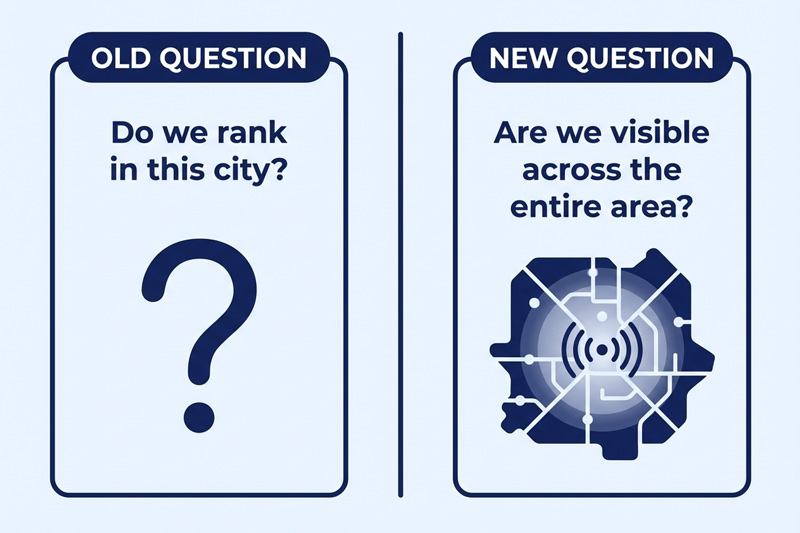
When visibility is evaluated through a trade area lens, the question changes from "Do we rank in this city?" to "How consistently visible are we across the entire area where customers are likely to find and choose us?"
From Rankings to Visibility Saturation: A Shift in Measurement
Traditional rank tracking treats visibility as a binary outcome: you either rank, or you don't. At enterprise scale, that framing is insufficient.
Trade area visibility saturation, on the other hand, looks at visibility as a distribution, not a single data point.
Instead of asking where a brand ranks at a single location or centroid, trade area saturation-focused measurement examines:
- How far visibility extends from each physical location
- Where visibility is strong, moderate, or weak across the trade area
- How evenly coverage is distributed
- Where competitors are gaining or losing ground geographically
This granular approach reveals patterns that city-level rankings simply cannot show.
For example:
- A location may rank well downtown but disappear entirely five miles out.
- Two locations in the same city may have radically different visibility footprints.
- A competitor may be quietly dominating suburban zones while your brand focuses on urban cores.
At enterprise scale, these patterns matter far more than individual ranking positions.
Why Enterprises Need a Visibility Distribution Model
Enterprise organizations are built to manage complexity. They operate across regions, brands, markets, and customer segments. Yet many still rely on local SEO metrics designed for single-location businesses.
A visibility distribution model aligns local search measurement with how enterprises actually operate by enabling teams to:
- Identify coverage gaps within priority markets
- Detect early competitive encroachment before it impacts revenue
- Compare performance location vs. location and market vs. market
- Assess footprint integrity across overlapping trade areas
- Allocate budget based on geographic opportunity, not assumptions
This turns local visibility from a tactical SEO metric into a form of strategic market intelligence.
The Challenge of Measuring Trade Area Saturation at Scale
Understanding trade area visibility is one thing. Measuring it consistently across hundreds or thousands of locations is another.
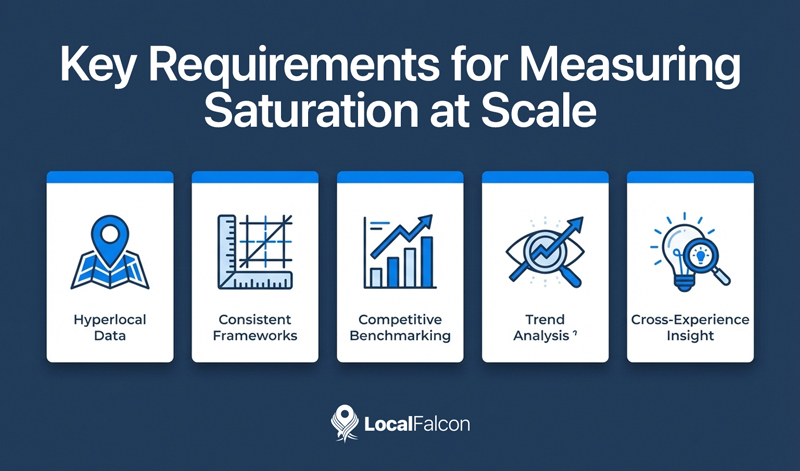
To do this effectively, enterprises need:
- Hyperlocal geographic data that reflects real-world search behavior
- Consistent measurement frameworks across all locations and markets
- Competitive benchmarking within the same geographic context
- Trend analysis that shows how visibility evolves over time
- Cross-experience insight, including traditional and AI-driven local search
This is where traditional rank trackers fall short. They are built to monitor keywords, not markets. They capture snapshots rather than providing granular spatial intelligence.
Local Falcon and the Rise of Visibility Intelligence
As enterprise local search has evolved, so have the tools required to support it.
Platforms like Local Falcon are increasingly used by enterprise brands and agencies not as simple rank trackers, but as enterprise visibility intelligence tools — built specifically to analyze and optimize geographic coverage, competitive overlap, and visibility saturation at scale.
Reframing local visibility as a geographic footprint rather than a single ranking allows enterprises to see:
- Where they truly dominate a market
- Where visibility drops off unexpectedly
- How competitors' footprints intersect with their own
- How changes to Google Business Profiles, locations, or strategies impact real coverage
This type of intelligence supports not only SEO teams, but also broader stakeholders across marketing, operations, and strategy.
Trade Area Saturation as a Strategic Advantage
When enterprises understand and manage trade area saturation, local search becomes a strategic asset rather than a reactive channel.
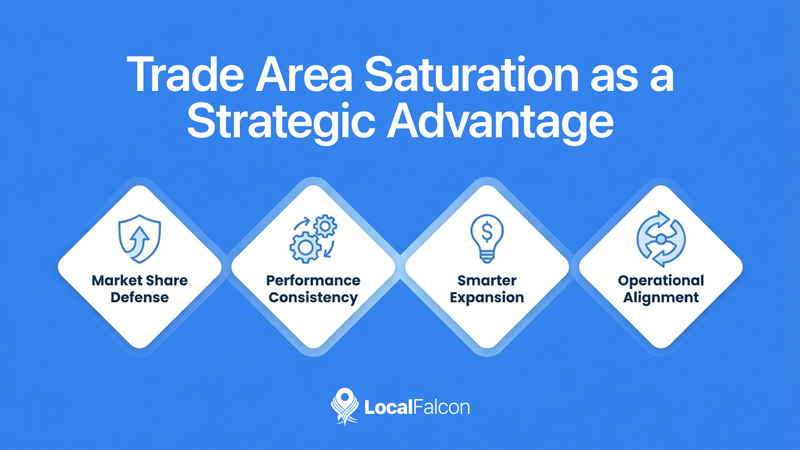
High visibility saturation supports:
- Market share defense: Maintaining dominance where competitors are actively expanding
- Performance consistency: Reducing variability across locations and regions
- Smarter expansion planning: Identifying underserved areas before opening new locations
- Operational alignment: Ensuring brand presence reflects real customer access
Instead of chasing rankings, enterprises begin managing visibility as a controllable market coverage system.
Moving Beyond "Are We Ranking?" To "Are We Visible?"
The most important shift enterprises can make is conceptual.
Local search success is no longer about answering "Are we ranking well?", but rather "Are we visible everywhere our customers expect to find us?"
That requires:
- A trade area mindset
- A saturation-based measurement model
- Enterprise-grade visibility intelligence
City rankings may still have a place in reporting, but they are no longer the metric of success. They are, at best, a starting point.
The Future of Enterprise Local Visibility
As search experiences diversify and customer journeys become more complex, enterprises that actively map, monitor, and optimize their visibility across every trade area will gain a decisive advantage.
Trade area visibility saturation reflects how customers actually search, move, and choose. Measuring it accurately requires tools and frameworks built for enterprise complexity, not small-business simplicity.
At enterprise scale, local search success doesn't just mean ranking somewhere. It means being consistently visible everywhere that matters, across trade areas and search experiences.