
One of the most useful features of Google Search Console for SEO professionals is the ability to see which queries are driving visibility and traffic for a website. But manually filtering and comparing queries by keyword, a necessity if you want to really understand search intent and plan content around it, can be time consuming and messy.
That's why Google has introduced a new feature called "Query groups" to the Insights section of Search Console.
What Are Query Groups in Google Search Console?
Google Search Console Query groups, like the feature's name implies, group similar search queries together by topic, showing you clusters of queries with similar search intent instead of a long list of individual queries that you have to manually sort through. These groups are automatically created by AI, providing a high-level overview of your site's search queries and the search intent driving performance.
Since most SEO professionals already filter queries in Google Search Console to create and analyze their own groups, this new feature will be a welcome addition to Search Console Insights for many.
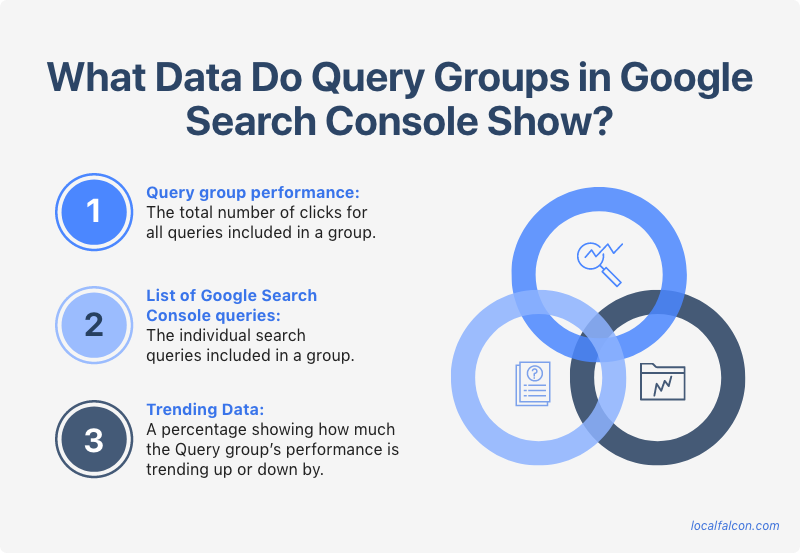
Users can see the following data for each AI-computed group of Google Search Console queries:
- Query group performance: The total number of clicks for all queries included in a group.
- List of Google Search Console queries: The individual search queries included in a group.
- Trending data: A percentage showing how much the Query group's performance is trending up or down by.
Users can also sort Query groups by Top (highest number of clicks), Trending up (groups where clicks increased the most compared to the previous period), and Trending down (groups where clicks decreased the most compared to the previous period), as well as click on any group to see individual performance metrics for each query contained within it, allowing for deeper analysis without the need to sift through cluttered query lists.
Why This Matters for Local SEO
For local SEO professionals, Query groups open up a new way to understand and leverage user search intent on a more strategic level.
Traditionally, identifying high-performing local keywords in Google Search Console meant manually sorting terms. Now, with Query groups, you can instantly see how Google's AI understands the relationships between these terms and use that insight to help guide your content strategy.
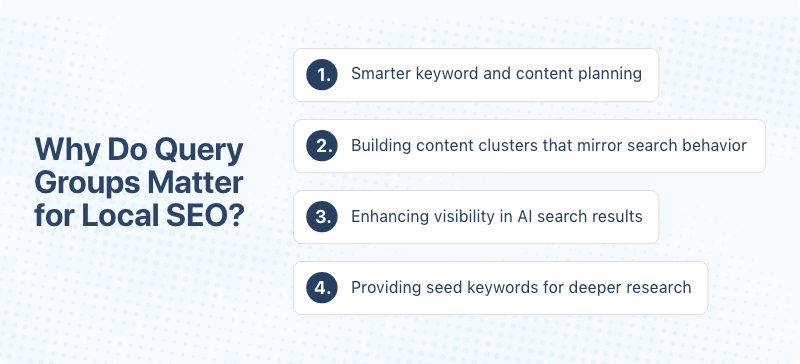
Here are a few key benefits for local SEO:
1. Smarter keyword and content planning
Query groups act as built-in keyword research clusters, highlighting how different queries connect to broader topics. All the related queries in a group can be used for subtopics, FAQs, or supporting blog posts that reinforce your authority around topics related to specific search intents.
2. Building content clusters that mirror search behavior
For local search success, organizing your website around thematic content clusters is a proven strategy. Query groups make this much easier by showing you which search queries Google already sees as connected. The Query group name can serve as your central "pillar" topic, while the included queries become your "spokes," or related content pieces that link back to the main page.
This structured approach not only strengthens topical authority but also creates a more intuitive site structure for both users and search engines.
3. Enhancing visibility in AI search results
As AI Overviews and other AI-generated answers slowly but steadily become a primary discovery channel, structured, intent-aligned content has become more valuable than ever.
AI models rely on clear topical relationships when deciding what to reference and cite. Aligning your local SEO content with the logical groupings Google's own AI recognizes can potentially increase the likelihood that your content will be featured in AI-powered search results.
4. Providing seed keywords for deeper research
Query groups are also a great source of seed keywords, the foundational terms you can plug into keyword research tools, like Local Falcon's Local Keyword Research Tool, to uncover even more specific opportunities.
Because Query groups cluster related search phrases automatically, each group represents a concentrated snapshot of how users are searching around a particular topic or intent. Those terms give you an instant list of seed keywords.
From there, you can input these keywords into Local Falcon to generate more localized variations, long-tail ideas, and related AI-style search phrases, based on real-world proximity and search volume data. This bridges the gap between Google's AI-generated intent groupings and the hyperlocal, data-driven insights that power effective local SEO content planning.
FAQs on Google Search Console Query Groups
Can anyone access Query groups in Google Search Console?
Google has stated that Query groups are only available for properties with larger query volumes. Sites with fewer queries won't see this feature because automatic grouping provides less meaningful data at smaller scales.
Where can you find Google Search Console Query groups?
If your site is eligible, you'll find Query groups displayed as a new version of the "Queries leading to your site" card in the Insights section of Search Console. Expanding the card opens a longer list of Google Search Console queries where you can explore the top, trending up, or trending down groups and see the individual queries that make up each one.
Do Query groups affect search rankings?
No. Query groups are purely a reporting and analysis feature. Google has stated they have no direct impact on your website's rankings and that they're designed to help you better understand performance trends and user intent, not to influence them. That being said, they can definitely help you improve your rankings through a better content strategy.
How should I use Query groups for local SEO content planning?
Use Query groups to inspire and organize your content clusters. Treat each group as a potential hub topic, with the included search queries guiding your related articles, FAQs, or local landing pages. This approach helps ensure your content reflects how users and Google already see topic relationships.
Can I create or edit my own Query groups?
Not currently. Query groups are automatically generated by Google's AI, and there's no manual control over how queries are grouped. However, you can still use these insights to create your own topic clusters or compare them against the keyword groupings you've already built using a tool like Local Falcon's Local Keyword Tool.
Will Query groups replace traditional keyword reports?
No. Query groups complement your existing Search Console performance reporting. You'll still want to analyze individual queries for precise tracking and ranking purposes. Query groups simply add another layer of high-level insight into related Google Search Console queries and their performance.
Final thoughts
Google Search Console's new Query groups feature represents a subtle but meaningful shift in how we can analyze search data. Instead of manually filtering queries in Search Console and analyzing individual keyword performance, SEOs can now instantly see connections between and performance data for related searches.
For local SEO professionals, that means more efficient local keyword research, faster topic discovery, and smarter content planning, all aligned with Google's increasingly AI-driven understanding of search intent.
Whether you're targeting a single metro area or hundreds of local markets, using Query groups to guide your content clusters can help you improve your local visibility in traditional and AI-generated search results alike.