
If you've ever experimented with asking AI tools like ChatGPT, Claude, or one of Google's AI search options for business recommendations, you may have noticed something interesting: ask the same question twice, and you're likely to get a different answer each time.
For local businesses and marketers, that raises a serious question: If AI-generated recommendation lists almost never repeat, how can you measure whether your business is actually visible in AI search results?
Same Prompt, Different Answers (Almost Every Time)
In a recent test, 600 volunteers ran 12 identical prompts through ChatGPT, Claude, and Google's AI (AI Overviews and AI Mode) nearly 3,000 times in total. The prompts were consistent. The platforms were the same. The instructions didn't change. But the results did.
Researchers compared the lists of business recommendations generated by AI, looking for:
- Overlap (which brands appeared across multiple results)
- Order (where brands were positioned in answers, i.e., their sequence of mention)
- Exact repetition (whether the same list appeared more than once)
Here's what they found:
- The exact same list of brands (regardless of order) appeared only about 1% of the time.
- The exact same list in the exact same order appeared about 0.1% of the time.
- List length varied widely — sometimes they included just 2 or 3 brands, other times 10 or more.
In other words, AI-generated business recommendation lists are almost never identical. Considering the nature of generative AI — or Large Language Model (LLMs) algorithms — that's not as surprising as you might think.
Why AI Lists Are So Inconsistent
Traditional search engines and their algorithms were originally built to retrieve and rank webpage results based on keywords. With the evolution of local search over the years, search engine results page (SERP) functionality expanded to include business listings and map-based results, such as Google's local pack.
Generative AI models, whether we're talking about ChatGPT, Google AI Overviews, or any of the others out there, are built to understand, generate, and respond to human language, making them far more dynamic and less predictable than traditional search algorithms.
When you perform a local search on a traditional search engine like Google or Bing, the algorithm is designed to return a ranked, consistent list of results within a specific framework (the SERP) based on three main local ranking factors:
- Relevance (business categories and service offerings that match keywords)
- Proximity (distance to the searcher or the geo-modified keywords used)
- Prominence (trust and authority signals, especially reviews)
Generative AI tools, on the other hand, don't operate like this. They are probabilistic language models. Their goal isn't to provide a stable, ranked list within a SERP that displays a set number of results. AI's goal is instead to generate a helpful, conversational response.
That means:
- Different phrasing can drastically shift results, regardless of keywords.
- Slight variations in context can change outputs.
- Even the same prompt can (and most often does) produce different recommendations.
- List length is fluid.
- The order of mention is fluid.
- Inclusion at all is fluid.
So if the outputs are so variable, how can businesses measure AI search visibility?
The Problem: You Can't Track "Rank" in AI
In traditional local SEO, businesses track their local rankings, especially Google Business Profile rankings.
If you want to know where you rank on Google Search and Maps, you can plug a range of keywords related to your services and locations into a Google Maps rank tracker like Local Falcon, and see exactly where you appear in a list of business results.
Sure, local rankings vary according to proximity, time of day (whether your business is open or not), competition, and other factors, but they remain relatively stable and predictable.
For example, your business is almost always going to rank in position 1 if someone searches for a service you offer from right outside your front door. Rankings tend to decrease the further away you get from the business.
That predictability doesn't translate to AI-generated responses because:
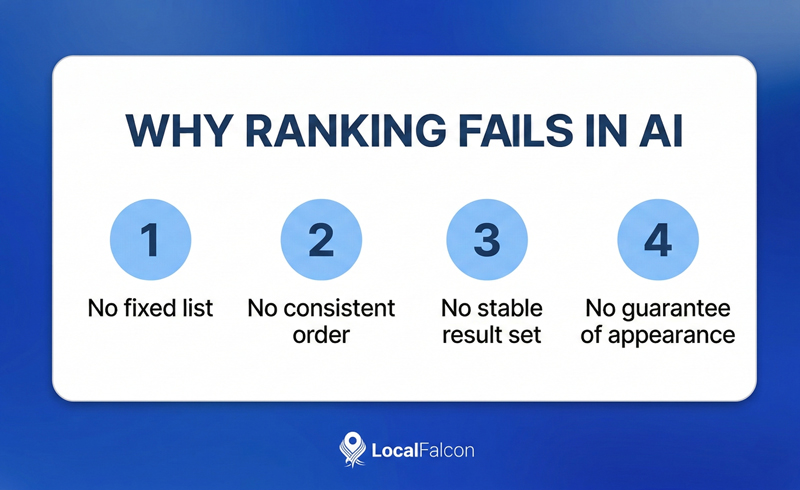
- There is no fixed list.
- There is no consistent order.
- There is no stable result set.
- There is no guarantee the same brands will even appear.
So trying to assign a precise, traditional "rank" inside AI recommendations simply doesn't work. And yet visibility still matters, which is where an important new AI visibility metric comes in.
Meet Share of AI Voice (SAIV)
If AI responses vary dramatically from query to query, the right way to measure visibility isn't by rank. It's by frequency of inclusion.
Share of AI Voice (SAIV) measures the percentage of AI-generated answers in which your brand is mentioned across a defined set of prompts.
So, instead of asking: "What position am I in?," you're asking: "How often am I included?"
For example, if 100 AI-generated recommendation lists are analyzed and your business appears in 42 of them, your SAIV is: 42. That's it. And suddenly, you have something measurable and actionable.
How SAIV Works in Practice
Imagine running a geo-grid AI visibility scan across a 9x9 grid in a neighborhood one of your business locations serves. That's 81 data points, meaning 81 of the same AI prompt executed from slightly different locations within your service area.
If your business appears in:
- 10 out of 81 responses, your SAIV = 12.3%
- 30 out of 81 responses, your SAIV = 37%
- 60 out of 81 responses, your SAIV = 74%
In other words, the higher your SAIV, the more frequently AI systems include your brand in their recommendations.
That gives you:
- A baseline
- A benchmark
- A KPI to improve
- An AI visibility metric to compare against competitors
Even though you can't predict inclusion in a single AI-generated response, you can measure inclusion across many responses to get a strong idea of how visible you are in AI search overall.
Why SAIV Is More Reliable Than Trying to Track AI "Rank"
Because AI outputs vary so much, attempting to track a fixed position is unreliable. You could be mentioned first in one response, third in another, and not mentioned at all in the next, even for the same exact prompt.
SAIV smooths out the randomness. Instead of focusing on a single output, it evaluates performance across a large sample size. It answers important questions like:
- Are you consistently recognized?
- Are you frequently recommended?
- Are you becoming more visible over time?
- Are competitors appearing more often than you?
In the highly probabilistic environment AI search tools operate in, frequency is the only stable signal.
The Competitive Factor: Why Industry Density Matters
It's important to understand that, just like Local Falcon's Share of Local Voice (SoLV) score for traditional local rank tracking, SAIV doesn't exist in a vacuum. Your achievable Share of AI Voice is heavily influenced by your specific competition.
Consider these two examples:
Example 1: Plumber in a Major City
A plumber operating in a dense urban area might be competing against dozens or even hundreds of other plumbers that potential customers could choose from for the same services.
In this setting, generative AI tools also have many viable businesses to choose from when recommending local solutions to users.
That makes it statistically harder for any single business to dominate AI-generated recommendations. Depending on just how many choices there are, a 25% SAIV in that environment might actually be impressive.
Example 2: Plumber in a Small Town
Now imagine a small town with only five plumbing companies. Both customers and AI have fewer options. Inclusion in AI answers becomes easier. A business might realistically achieve 70% or higher SAIV.
The key takeaway here is that, as with other local SEO KPIs, SAIV should always be interpreted relative to:
- Market size
- Business category
- Competitor density
- Geographic scope
While getting your Share of AI Voice to 100 would always be ideal, it's not always going to be realistic, especially in highly competitive business categories and markets. So, rather than chasing inclusion in 100% of AI-generated local business recommendations, it's better to focus on improving your position within your specific competitive landscape.
An effective way to do this is by looking at your top competitors' Share of AI Voice to get an idea of what you might be able to achieve. For instance, if the competitor above you has a SAIV score of 92, and your SAIV is 74, you know you can potentially boost your inclusion in AI answers by 19% to be more visible than your competitor in AI search.
What About Order of Mention?
Even though AI platforms don't produce stable rankings, there's still value in tracking mention sequence.
We can assign a sort of pseudo "average rank" based on where your business appears within the responses analyzed. This gives you an idea of whether you:
- Are frequently mentioned first
- Often appear in the middle
- Are usually near the bottom
This should never be confused with traditional local search rankings, like Google's local pack or Google Maps rankings, but looking at trends over time can still give you some directional insight into how prominently your business appears in the responses where it is mentioned.
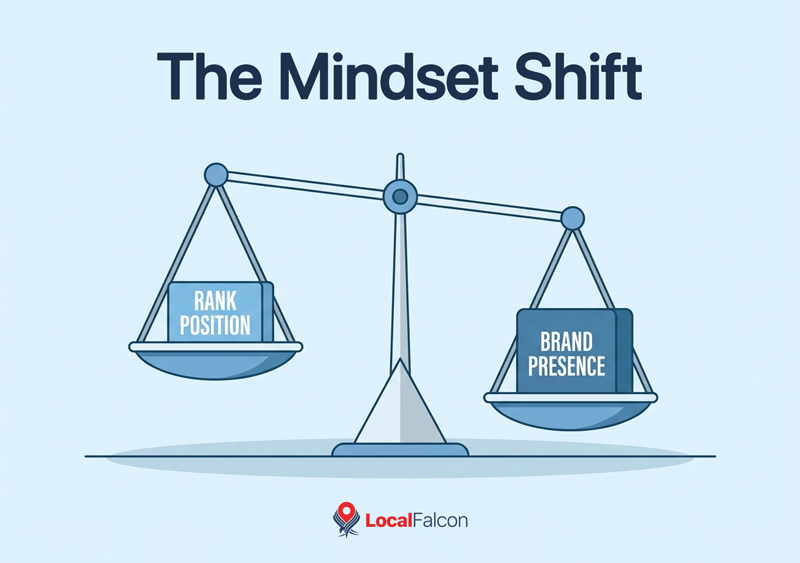
Shifting the Mindset: From Position to Presence
The shift from traditional search to AI recommendations represents a fundamental change in local visibility measurement philosophy.
The old mindset of "how high do I rank?" is still important, but it's not everything anymore.
Shifting to the new mindset of "how often am I mentioned?" is becoming more important every day, as more potential customers turn to AI for business recommendations and solutions to their problems.
One way to help yourself or your clients understand this shift is by framing it as something similar to brand awareness measurement in traditional advertising.
When measuring brand awareness, companies don't ask: "Was our brand ranked #1 in someone's memory?" They ask: "How often do consumers recall my brand?"
AI visibility works much the same way — you can think of Share of AI Voice as a way to measure AI's awareness of your brand and, by extension, how visible it is to potential customers in AI-generated answers.
What This Means for Businesses
- Single-query checks are meaningless. Asking ChatGPT for recommendations once or twice and checking whether your business is mentioned tells you nothing. Sure, seeing your business included in a conversational answer certainly feels nice, but it doesn't tell you how visible you are across AI tools and prompts at scale.
- You need aggregate data. One AI output doesn't show you anything meaningful. Fifty outputs start to show trends. Eighty outputs show reliable patterns. And so on — the more queries you track, the more platforms and locations you monitor, and the longer you do it, the better you can understand your overall local AI search visibility.
- Consistency over time matters. Tracking SAIV regularly can reveal trends and provide direction, answering questions like:
- Are you gaining traction in AI search?
- Are competitors overtaking you?
- Is market competition increasing?
- Optimization becomes measurable. You have proof of impact if your SAIV improves after:
- Strengthening online authority
- Increasing review volume and quality
- Expanding content footprint
- Improving citations
- Doing digital PR
The Future of AI Visibility Measurement
As generative AI continues to become more deeply integrated within search experiences and consumer discovery journeys, visibility inside AI responses will become just as important as traditional search rankings.
This is why it's so crucial to measure AI visibility correctly from the start. Trying to force conversational AI inclusion into the old ranking framework will only create confusion. Instead:
- Accept variability.
- Embrace probabilistic outputs.
- Measure inclusion frequency with Share of AI Voice.
- Benchmark against competitors.
- Optimize for higher SAIV over time.
Final Thoughts
Because AI-generated responses are inherently variable, evaluating your visibility based on a single answer simply doesn't provide meaningful insight. The same prompt can produce different businesses, different list lengths, and different orders of mention from one query to the next. That level of variability makes traditional ranking-style measurement unreliable in the context of generative AI.
What is reliable, however, is aggregated performance. When you analyze inclusion across hundreds or thousands of AI-generated responses, patterns begin to emerge. Share of AI Voice gives you a structured way to quantify those patterns, turning a fluid and probabilistic environment into something measurable and actionable.
As AI continues to influence how consumers discover local businesses, understanding your true local visibility means businesses need to evaluate how frequently they are recommended by AI overall, how that frequency compares to competitors, and how it changes over time.
In short, tracking Share of AI Voice allows you to see the bigger picture and make informed decisions based on consistent data rather than anecdotal impressions.