
Enterprise SEO success has long been defined by strength in traditional search results. Rankings, backlinks, domain authority, and local pack visibility were the benchmarks that determined whether a brand was "winning" in search. For a long time, that framework worked, but local search has fundamentally changed.
Today, even the strongest enterprise SEO teams are discovering a new reality: ranking well on Google alone is no longer enough to dominate local search or protect market share.
Enterprises that rely solely on traditional SEO strength may appear prominently in Google's local pack and blue-link results, yet remain invisible across a growing ecosystem of alternative search surfaces, especially AI-powered search experiences.
This shift marks the beginning of a new era in local search — one where system-wide local authority, not just SEO strength, determines which enterprise brands win visibility, trust, and demand at scale.
The Limitations of Traditional SEO Strength in a Fragmented Local Search Ecosystem
Enterprise organizations tend to be exceptionally good at building traditional SEO strength. They often invest heavily in:
- Technical SEO infrastructure
- Scalable location pages
- Content governance and internal linking
- Citation consistency
- Review acquisition programs
- Local rank tracking and reporting
As a result, many Fortune 500 brands rank extremely well across thousands of locations in Google Search and Google Maps.
But that success can be misleading.
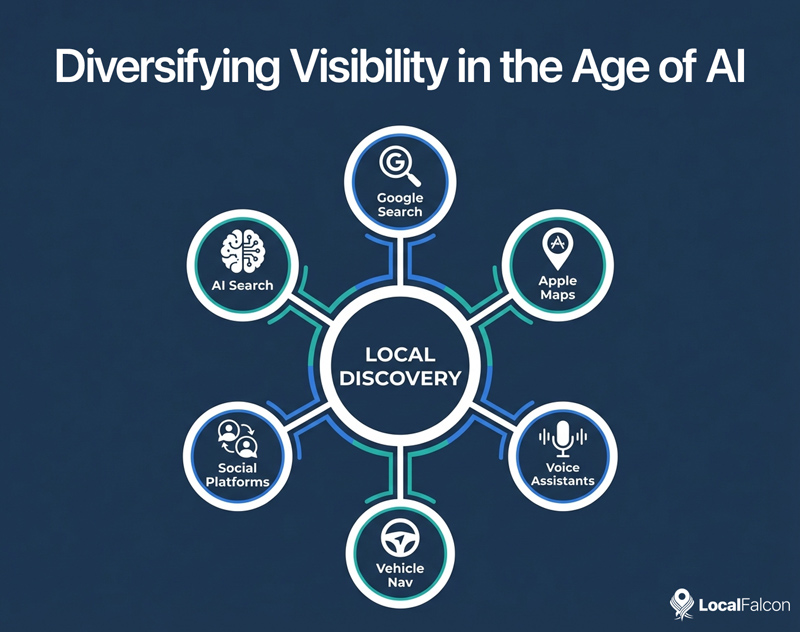
Modern consumers no longer rely on a single search interface. They discover local businesses across a fragmented, multi-surface search ecosystem, including:
- Google Search and Google Maps
- Apple Maps and Siri
- Other voice assistants
- Navigation systems in vehicles
- Social and review platforms
- AI-powered search and answer engines
When visibility is measured only through Google rankings, enterprise brands may believe they have strong local coverage everywhere, while in reality, their total system visibility is incomplete or uneven.
SEO strength may still win individual rankings, but it does not guarantee authority across the entire search ecosystem where local discovery now happens.
The Rise of AI Search and the Visibility Gap for Enterprise Brands
The most disruptive change in local search is the rapid adoption of AI-powered search experiences.
Google AI Overviews and AI Mode, plus tools like ChatGPT, Gemini, Grok, and other conversational search platforms are increasingly shaping how consumers ask questions, evaluate options, and make local decisions. These systems do not simply replicate traditional rankings. Instead, they synthesize information from multiple sources and determine which brands are included in the conversation at all.
This creates a new risk for enterprises.
A Fortune 500 brand may:
- Rank in the local pack
- Appear prominently in blue-link results
- Have strong domain authority
Yet still be underrepresented or completely excluded from AI-generated local answers.
In practical terms, this means an increasing share of consumers may never encounter the brand when using AI to search for nearby services, compare providers, or evaluate options within a trade area.
This is not a hypothetical future problem. It is already happening.
AI search surfaces prioritize consistency, prominence, and authority across systems, not just isolated ranking performance. Enterprises that lack system-wide local authority may find themselves invisible in precisely the environments where discovery is accelerating fastest.
From Rankings to Reach: Why Enterprises Must Rethink Local Search Strategy
To compete effectively, enterprise organizations must shift their mindset.
Traditional SEO strength is still essential. Rankings still matter. Local pack visibility still drives traffic. Blue-link results still convert.
But SEO strength is now foundational, but not sufficient on its own.
Winning enterprises are expanding their focus from rankings to reach; from individual results to total market presence.
This means asking new questions, such as:
- Where does our brand appear across all major local search surfaces?
- Are we visible in every market, everywhere customers are searching, not just on Google?
- Do AI systems recognize our locations as authoritative local entities?
- Is our brand footprint consistent and complete across trade areas?
These questions cannot be answered with traditional rank tracking alone.
What System-Wide Local Authority Really Means
System-wide local authority refers to a brand's aggregate visibility, credibility, and prominence across the full local search ecosystem, rather than just one or two platforms.
It is built through:
- Consistent and accurate location data across all major platforms
- Strong entity signals that AI systems can understand and trust
- Broad geographic coverage within trade areas
- Reinforced prominence through reviews, content, and engagement
- Presence in both traditional and AI-driven search experiences
Unlike traditional SEO metrics, system-wide authority reflects how often and how reliably a brand appears wherever local intent exists.
For enterprise organizations managing hundreds or thousands of locations, this is not a matter of optimization at the page level. It is a system-level challenge that requires visibility into performance at scale.
The Role of Comprehensive Local Visibility Intelligence
To build and protect system-wide local authority, enterprises need a new kind of intelligence: comprehensive local visibility intelligence.
This goes beyond tracking individual keyword rankings or average position. It allows organizations to understand:
- How visible each location is across multiple search platforms
- How visibility differs by trade area, market, and region
- Where competitors are gaining system-level exposure
- Where AI-driven experiences are excluding or underrepresenting the brand
Granular visibility intelligence reveals blind spots that traditional SEO reporting cannot.
An enterprise may discover that:
- Certain regions have strong Google visibility but weak Apple Maps presence
- Some locations dominate local packs but fail to surface in AI-generated responses
- Competitors are achieving broader system coverage
Without this intelligence, enterprises risk optimizing in isolation, improving metrics like organic rankings that no longer reflect how customers actually discover local businesses.
From Insight to Action: Optimizing for System-Wide Authority
Visibility intelligence is the foundation for smarter optimization in the new era of local search.
When enterprise organizations understand their full system visibility, they can take targeted action to strengthen authority where it matters most.
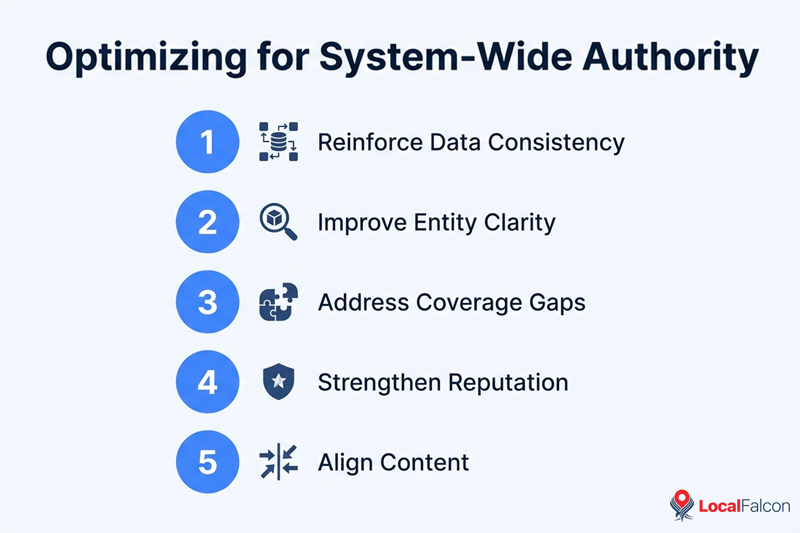
This may include:
- Reinforcing location data consistency across platforms
- Improving entity clarity so AI systems can confidently surface locations
- Addressing gaps in trade area coverage
- Strengthening review and reputation signals in underperforming markets
- Aligning content, listings, and engagement to reinforce local relevance
The goal is not to chase every new search experience independently. It's to build a resilient, authoritative local presence that translates across systems, whether the user is searching on Google, navigating via Apple Maps, or asking an AI assistant for recommendations.
Protecting Brand Footprint Integrity at Enterprise Scale
For enterprise organizations, brand integrity is inseparable from local visibility.
When some locations appear prominently while others disappear from key search surfaces, the brand experience becomes fragmented. Customers receive inconsistent signals about availability, quality, and trustworthiness, even within the same market.
System-wide local authority helps enterprises maintain brand footprint integrity, ensuring that every location contributes to a unified, authoritative presence across the entire local search ecosystem.
This is especially critical as AI search experiences increasingly push traditional search interfaces out of sight. When local answers are highly dynamic, rather than predictably ranked, only brands with strong system-level signals are consistently included in the conversation.
The Future of Local Search Is Systemic, Not Singular
Local search is no longer defined by a single search engine, a single user interface, or a single ranking position.
It is defined by systems of interconnected platforms, data sources, and AI-driven experiences that collectively shape how consumers discover local brands.
Enterprises that continue to measure success solely through traditional SEO strength risk falling behind, even if their rankings remain strong.
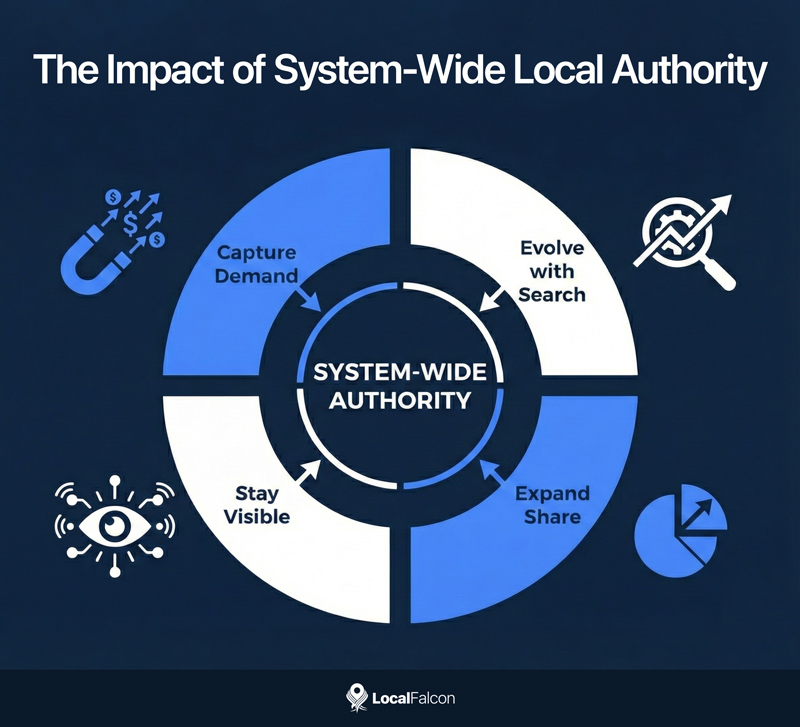
Those that invest in system-wide local authority, supported by comprehensive visibility intelligence, will be positioned to:
- Capture demand wherever it emerges
- Stay visible as search behavior evolves
- Protect and expand market share across trade areas
- Ensure their brand remains part of the conversation, whether human or AI-driven
In the modern era of local search, winning is no longer about ranking higher in one place. It's about establishing system-wide local authority to ensure your brand footprint reaches everywhere your potential customers are searching.