
Geo-grid rank tracking has historically been one of the easiest ways to explain local SEO and actually show its impact to clients. However, with the rise of Google AI Overviews, AI visibility, and now AI-powered local packs, local rankings are more complex than ever.
That being said, geo-grid rank tracking is still the best way to show clients what their AI visibility, or Share of AI Voice (SAIV), looks like, but it's important to clarify why it looks so different from traditional rankings (i.e., Google Search and Maps visibility).
What Are AI-Powered Local Pack Results?
When a user performs a local-intent query, especially using more long-tail, conversational keywords, it's highly likely that they'll see a Google AI Overview above the traditional local pack (Google Maps) results. But not every AI Overview looks the same.
When it comes to AI-powered local search results on Google, an AI Overview might either display a conversational summary that mentions and lists local businesses or show an AI-generated local pack, complete with a "ranked" list and an embedded map with location pins.
However, it's important to understand that even though these AI-powered local packs look an awful lot like a traditional Google 3-Pack, they can show completely different results. In other words, it's entirely possible for a business to rank well in the 3-Pack, but not in an AI Overview local pack, and vice versa.
Because of how variable these results are, geo-grid visibility reports for AI-powered local packs look a lot different from traditional Google Business Profile ranking reports. Understanding what causes the drastic difference in appearance, and knowing how to explain it to business owners, is key to keeping clients informed and happy in the AI era.
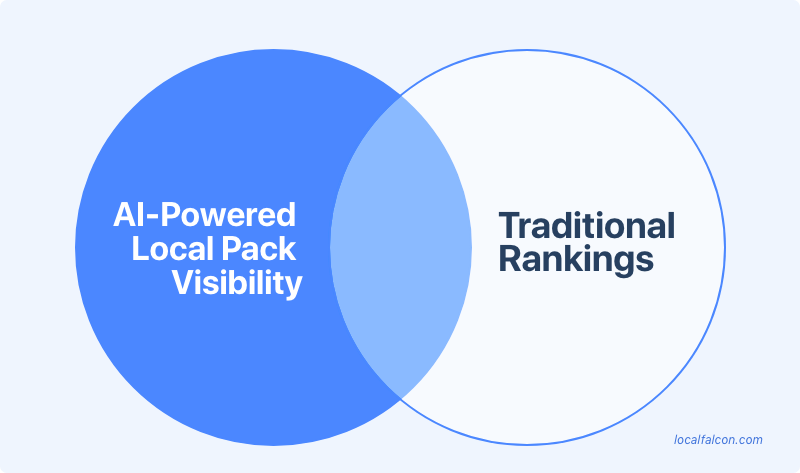
AI-Powered Local Packs vs Traditional 3-Packs: Understanding Geo-Grid Differences and Avoiding Client Confusion
How Traditional Google Business Profile Rankings Look vs How AI Overview Rankings Look
In a traditional Google Business Profile geo-grid rank tracking report, rankings follow a somewhat predictable pattern, with the strongest position almost always being right at the business's location.
When a business is performing well in local search, they'll continue to appear in the 3-Pack near the business location and maybe up to a couple miles or more away, depending on the local area and competition, with rankings gradually dropping off the further away from the business location you get.
What this results in is a geo-grid heat map with lots of green data points clustered around the business, then more yellow and orange points a little further out, and finally red points around the edges of the service area. Of course, there's a lot of variability in this depending on local market conditions and the business's local SEO, but this is the general pattern.
Now, for AI-powered local pack visibility, the geo-grid results can look a lot more confusing. For example, there might be red data points all around a business location, meaning it's not getting surfaced in AI Overviews near the physical location. Then there might be a handful of green data points spread seemingly randomly across the geo-grid heat map, signifying that the business is getting mentioned in an AI-generated summary or included in an AI-powered local pack for those areas.
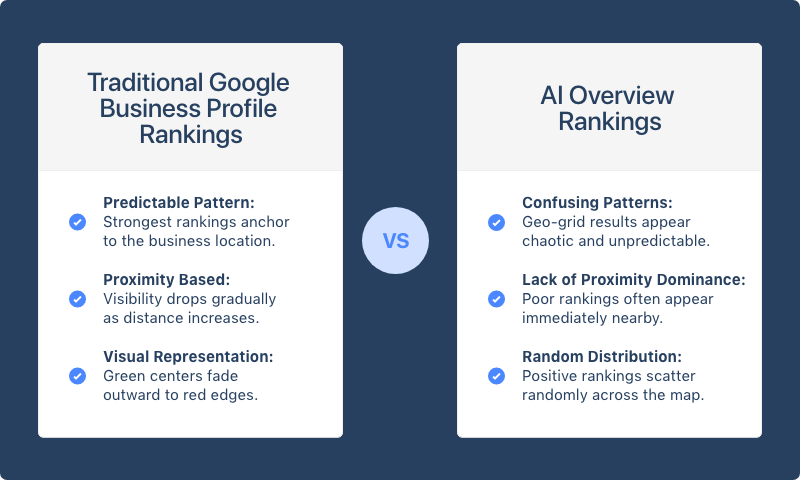
Traditional Local Pack Performance vs AI-Generated Local Pack Performance: Visibility Goals
Since AI Overviews don't "rank" businesses in the same way traditional local pack results do, improving AI visibility revolves around increasing Share of AI Voice, or the overall number of times a business is surfaced (mentioned in a summary or included in an AI-powered local pack) by AI. In contrast, improving traditional local rankings revolves around increasing Share of Local Voice (SoLV), or how often the business ranks in the top 3 results (the Google 3-Pack).
Explaining this distinction is crucial to avoiding client confusion when it comes to AI-powered local pack vs traditional local pack rankings. Clients need to understand that it's normal for geo-grid AI visibility reports to look a little more "patchy" compared to traditional GBP rank tracking reports, and that as long as SAIV is going up, the business is becoming more visible in local search.
The ultimate goal is to increase a brand's visibility wherever users are searching, but tracking Google Business Profile performance improvements looks different than tracking Google AI Overviews visibility.
Once clients understand this, it's much easier to report on local SEO across both traditional and AI-powered search. Clients won't panic if they see an AI Overviews visibility report that has red near the business location, as long as the SAIV is increasing or holding steady.
Traditional Local Pack vs AI Overviews Local Pack Visibility
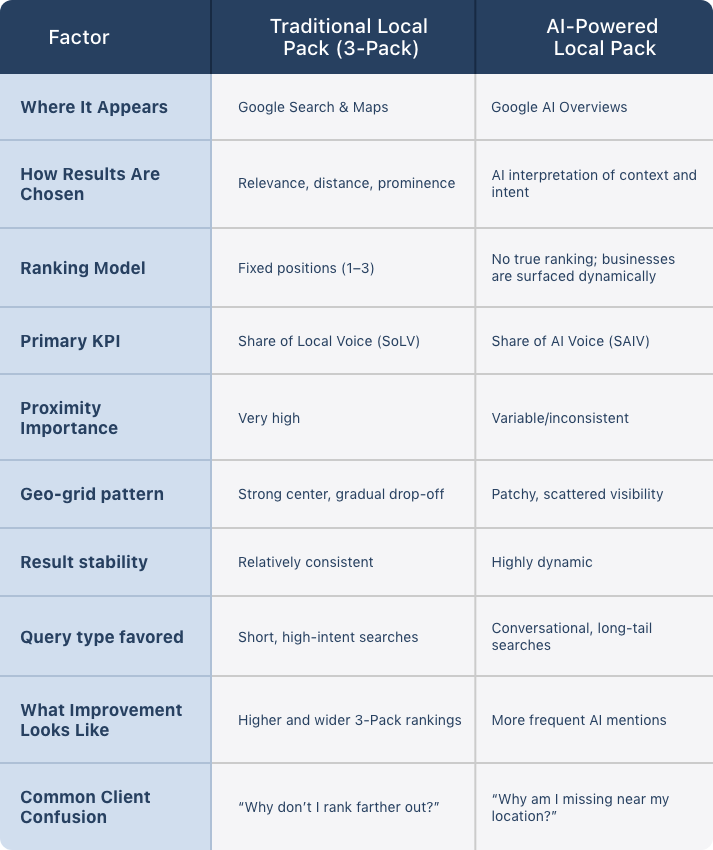
Key Takeaway: Traditional local rank tracking measures where you rank, while AI-powered local visibility tracking measures where AI chooses to talk about you.
Wrapping Up
AI-powered local packs aren't fully replacing traditional local rankings, but rather they're adding a new layer of visibility that needs to be measured and explained differently.
While Google Business Profile rankings still follow relatively predictable, proximity-driven patterns, AI Overviews surface businesses based on contextual relevance and perceived usefulness, which naturally produces more scattered and less intuitive geo-grid results.
The key to avoiding client confusion is setting the right expectations. Traditional local SEO performance should be evaluated through Share of Local Voice, while AI visibility should be measured through Share of AI Voice. When clients understand that AI visibility is about how often a business is surfaced, instead of where it ranks, reporting becomes clearer and results are easier to trust.
Ultimately, the goal hasn't changed: maximize visibility wherever users are searching. Success now means tracking and optimizing for both traditional local packs and AI-powered local results, and knowing how to clearly communicate the difference between the two.