
Gemini and ChatGPT are two of the most widely used generative AI platforms in the world, and when it comes to local business recommendations specifically, they've become go-to tools for users looking for everything from the nearest coffee shop to the best-reviewed contractor in town. But while both can provide local business recommendations, they don't do so in exactly the same way.
ChatGPT vs Gemini: How Each Platform Finds Local Business Information
The most important thing to understand about Gemini and ChatGPT is that they don't pull local business data from exactly the same places, and that can change how a particular business shows up in each Gemini vs ChatGPT.
On the one hand, Gemini is deeply integrated with Google's ecosystem. When a user asks for a local business recommendation, Gemini draws on Google's search index, which includes Google Business Profile (GBP) data, Google Maps listings, and Google Reviews in addition to third-party sites indexed on Google.
This means the business name, address, phone number, hours, photos, review ratings, and other details a business has carefully maintained in GBP are likely to feed directly into Gemini's responses.
Since the vast majority of local businesses already prioritize their GBP as a foundational part of their local SEO strategy, Gemini tends to have access to rich, up-to-date, and structured business information.
ChatGPT, on the other hand, is powered by OpenAI's GPT AI models and, when performing a search, retrieves information from Bing's index rather than Google's. This means that business details surfaced by ChatGPT more closely reflect what's available through Bing's crawl of the web, which may include Bing Places listings, business websites, directories, and other publicly accessible sources.
The exact blend of sources ChatGPT draws local business info from isn't fully transparent; it isn't limited strictly to Bing Places data and pulls from a broader range of web content indexed by Bing. Still, the key point stands: Gemini is Google-native and ChatGPT is Bing-native, and that distinction plays a big role in how they choose which local businesses to recommend.
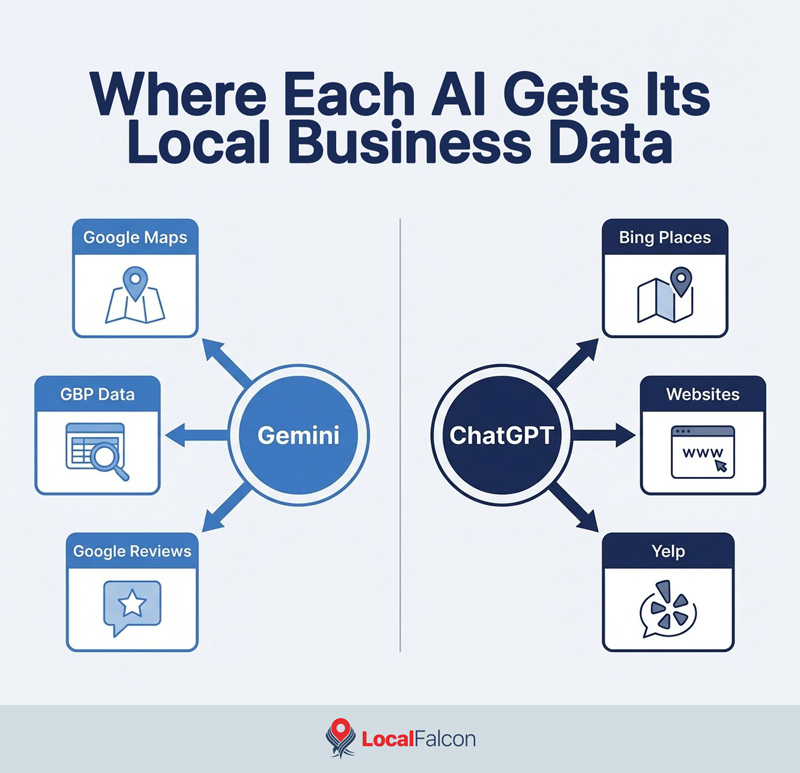
How Gemini finds local business info:
- Pulls from Google's index, including GBP data, Google Maps, and Google Reviews
- Links results directly to GBP/Google Maps listings for easy verification
- Shows review ratings sourced from Google
How ChatGPT finds local business info:
- Pulls from Bing's index, including Bing Places and broader web sources
- Links to business websites rather than listing pages
- May pull reviews from Yelp or cite no source
Gemini vs ChatGPT: Which One Is Better for Local Searches?
On the surface, both platforms can produce surprisingly similar-looking results. You'll often get a map view, a list of businesses with key details like name, address, and phone number, and a conversational summary explaining why a particular business might be worth choosing. For the average user, the experience can feel nearly identical at a glance. However, the differences between ChatGPT and Gemini for local searches become clearer when you look more closely.
Gemini links local results directly to Google Business Profile and Google Maps listings, so users can click through and explore full business details straight from the source. ChatGPT tends to link to business websites instead, which can be useful but puts more legwork on the user to verify details.
When it comes to reviews, Gemini pulls ratings directly from Google, which is far and away the most widely used and trusted business review platform. ChatGPT may surface review information from Yelp or cite no source at all, making it harder for users to gauge how reliable or representative those ratings actually are.
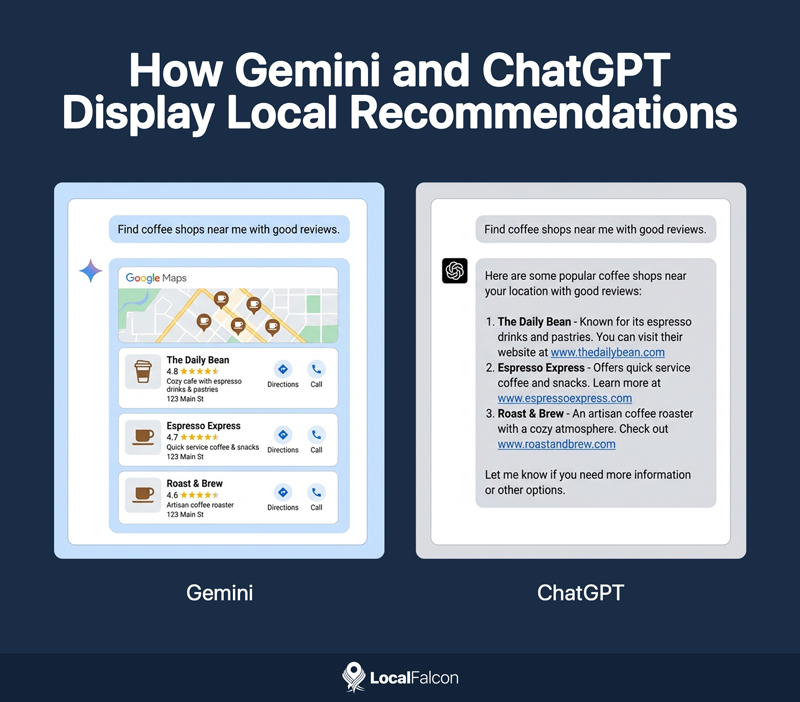
Ultimately, which platform a user gravitates toward comes down largely to personal preference. People already living in the Google ecosystem will often reach for Gemini naturally, while others prefer ChatGPT's style or simply use it because they're already there for other tasks.
The bottom line is that neither is going away, and both have large, growing audiences actively using them for local business discovery.
It's also worth noting that the line between "using Gemini" and "doing a Google search" is increasingly blurring. Google's AI Mode integrates Gemini's capabilities directly into Google Search, meaning local business recommendations powered by Gemini aren't limited to the standalone Gemini platform. For businesses, this makes visibility in Gemini's ecosystem even more important, as it can mean increased visibility across Google's AI-powered search features.
Why Businesses Should Track Visibility on Both Gemini and ChatGPT
This is why it's a mistake to think about AI visibility as a single, monolithic thing: optimizing for one platform doesn't guarantee visibility on the other.
A business with a flawless GBP may show up consistently in Gemini but have limited presence in ChatGPT responses if its broader web footprint, including website content, directory citations, and third-party reviews, is thin. The reverse is also possible.
As AI-assisted local search continues to grow, tracking how and where your business appears across both ChatGPT and Gemini is becoming an essential part of a comprehensive local visibility strategy.
Knowing whether you're showing up, how you're being described, and where there are gaps gives you the information you need to optimize effectively, whether that means doubling down on GBP, building out your web presence, generating more reviews across multiple platforms, or creating content that gives AI models more to work with.
Gemini and ChatGPT are two of the most widely used AI search platforms in the world, and an increasing number of potential customers are using one or both to find local businesses. Understanding how each one works and making sure your business shows up well in both is simply a new best practice in local search.
How Local Businesses Can Track Visibility on Gemini and ChatGPT
Knowing that being visible on both ChatGPT and Gemini matter is one thing, but actually measuring your presence on each is another.
Local Falcon's AI visibility scans let businesses track their Share of AI Voice (SAIV) across both Gemini and ChatGPT on an ongoing basis, giving you a clear picture of how often each platform is surfacing your business when potential customers ask for local recommendations.
But visibility alone only tells part of the story. Because Gemini and ChatGPT draw from different data sources, what each platform actually says about your business can differ in meaningful ways, and that matters just as much as whether you're showing up at all.
Local Falcon's AI visibility reports also include brand sentiment analysis, so you can see not just how frequently your business is mentioned, but how it's being described and whether that language is likely to drive someone through your door.
Tracking both visibility and brand sentiment is crucial because a business might have strong SAIV and sentiment on Gemini but fewer, weaker, and less persuasive mentions on ChatGPT, or vice versa, simply because the two platforms are working from different inputs.
By tracking visibility and sentiment across the best AI for local business recommendations, you can identify those gaps and take targeted action, whether that means strengthening your GBP to improve Gemini performance or building out your broader web presence to influence ChatGPT. The goal is to move from simply appearing in AI responses to being recommended in a way that actually converts.