
Alongside a recent update on Google's AI Mode and intelligent Search box features, the company announced that it will be launching Search agents, a new agentic way to gather and act on information via Google Search.
These Google Search agents will provide users with a more proactive, hands-off way to search, with major implications for local search especially, since an agent will be able to take care of the transactional part of many local-intent searches as well.
What Can a Google Search Agent Do?
Google's agentic Search announcement stated that the first type of Google Search agent available would be "information agents." Capable of operating in the background 24/7, these agents are intended to help users find exactly what they need at exactly the right time.
A Google Search agent will be able to intelligently scan everything across the web, including sources like blogs, news sites, and social media, in real time, monitoring for changes and the latest information related to a specific query. It will automatically send synthesized updates with the option to take action whenever possible.
Google gives an example use case of apartment hunting: the user instructs the agent to search for apartments that meet their exact requirements around the clock and send them an automated update any time it finds a new one. Depending on what actions are available via the site the agent finds the apartment listed on, the user could then potentially schedule a viewing or at least fill out a contact form.
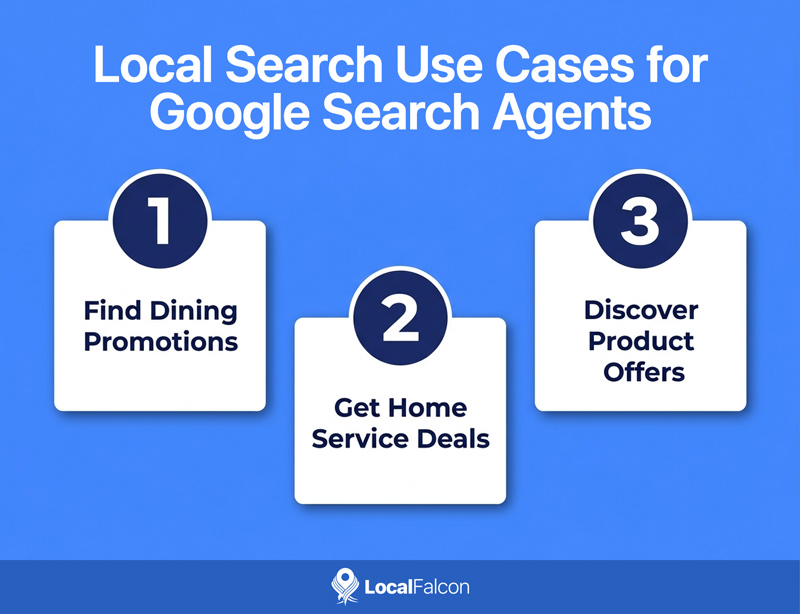
The possible use cases for this type of agentic Google Search experience are virtually endless. Let's consider a few examples of how Google Search agents might work for local search specifically:
- Finding affordable dining experiences: You could instruct the AI to search for nearby restaurants offering promotions and send you an update whenever it finds any, potentially saving tons of money on dining out or ordering takeout.
- Getting the best deal on home services: You might tell Google's agentic information agent to keep an eye out for deals on local home services, such as yard care, window cleaning, house painting, or other non-urgent but much-needed maintenance.
- Discovering deals on specific products: You could tell your Google Search agent to find the best deals on products you're looking to purchase locally, perhaps seasonal products like new lawn furniture or camping gear to get you ready for the summer.
This type of always-on searching has the potential to benefit both local businesses and their customers, helping the customer find the combination of price and provider that's best for them, while exposing businesses to more potential customers through greater AI search visibility.
In the announcement about Google's AI search agents, Google also highlighted that it would be expanding agentic booking capabilities for local experiences and services in Search, allowing users to complete booking directly with a provider through a Google Search agent.
Think about how this might look for the local search examples above:
- You discover a 2-for-1 deal from a nearby Indian restaurant for Friday evening and instantly order for delivery or takeout through Google's agentic Search experience.
- You see a local landscaper offering a Saturday-only special for lawn mowing and yard cleanup, and schedule the service right away through your Search agent.
- You get a great deal on a new tent and camping chairs from a local hardware store that's having a clearance sale and order them for pickup or delivery through the Google Search agent.
What Do AI Agents Mean for Google Search Overall?
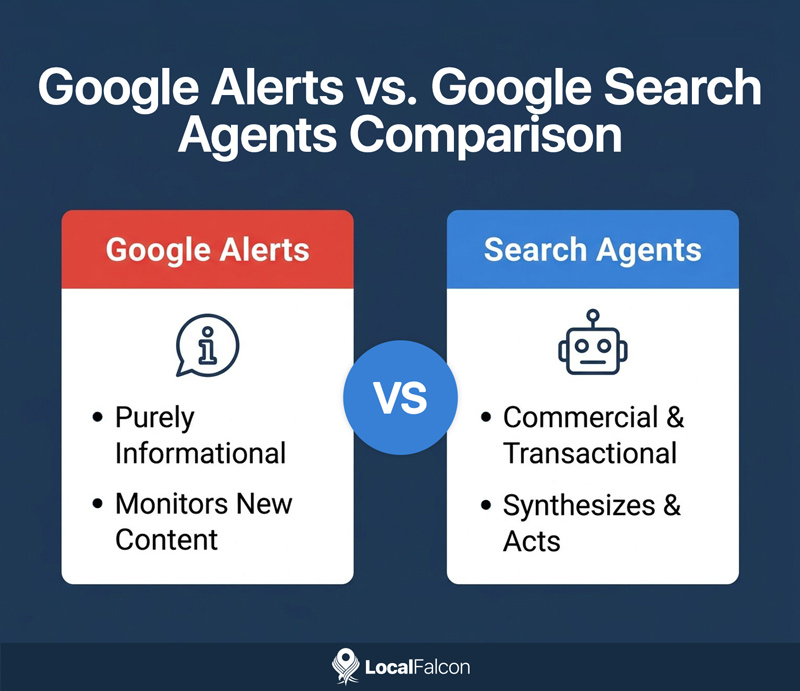
Google Search agents are not intended to replace traditional one-off Google searches, but rather to provide users with a new way to stay updated on topics of interest, kind of like Google Alerts, but with way more advanced capabilities.
Whereas Google Alerts let you know whenever a new piece of content related to a topic of interest appears on the web, allowing you to visit the URL to learn more, Google's information agents will monitor absolutely everything, share synthesized updates with conversational context, and give you the option to actually act on those updates, beyond simply reading something like a news story or blog post. In other words, Search agents have major commercial and transactional potential, whereas Alerts are purely informational.
Keep in mind that these Search agents are also separate from Google's other ongoing AI integrations, which are rapidly changing the default Google Search experience. Ultimately, users are going to have an increasing number of ways to search Google using different AI features, so they'll be able to choose the best option for their specific context and goals.
What Can Local Businesses and Agencies Do To Prepare for Agentic Google Search?
Google's first-ever guide to optimizing websites for generative AI features on Google Search included a brief section on optimizing for agentic search experiences.
The section recommended that businesses for which agentic search is relevant, so definitely local businesses, review Google's developer guide to building agent-friendly websites. Some key technical takeaways from that guide include:
- All necessary actions (i.e., that a human or agent could take) should be clearly reflected in the site's interface
- A stable layout is required
- Avoid hiding interactive elements (e.g., with "ghost" elements or transparent overlays)
- Actionable elements should be designed with semantic HTML
- Signal cursor actionability by setting cursor: pointer in CSS
- Link tags to inputs with the for attribute to indicate the purpose of fields for agents
- All interactive elements should be visible in an area larger than 8 square pixels
All of these technical guidelines are essentially to ensure AI agents can successfully navigate and take action on a website, as they rely on HTML, visual, and accessibility tree analysis to do so.
The guide closes by saying that everything you do to prepare a site for agents also makes it better for humans. Google states: "Making websites AI agents-friendly is an incentive to recommit to its foundational principles of building well-structured, accessible, and semantic websites."
Final Thoughts on Google Search Agent Experiences
Google's informational Search agents, as well as expanded agentic booking experiences, will be rolling out in summer of 2026. This is on top of the other generative AI Search features that Google is expanding on, adding, and updating.
It's still early days and, like all things AI, Google's Search agent capabilities are sure to evolve rapidly, but the potential use cases for local search are certainly something exciting to keep an eye on and optimize for.
Local businesses should definitely ensure their sites are agent-friendly going forward to maximize conversions through agentic search.