
It's undeniable that generative AI has allowed brands to push out content like never before. This has been especially beneficial for many of the local businesses that were not previously able to engage in content marketing at a high enough level to impact rankings. However, it's also given rise to concerns about the quality and authenticity of many brands' content.
The problem for local businesses now is that anything your potential customers perceive as inhuman or inauthentic can drive them away, ultimately into the open arms of your competitors.
So, how can local brands remain authentic and maintain trust and authority, without turning their backs on the potential AI has to help scale content marketing efforts that align with local SEO? The answer lies in understanding a simple truth: authenticity builds trust with both people and search systems.
Why Authenticity Matters in Local Search
When someone performs a search with local intent, they're often looking for "right now" solutions and making fast, emotional decisions about who to call, visit, or hire.
Authenticity matters in local SEO because it is synonymous with trust and authority, and the local businesses seen as most authentic — those with genuine reviews, real photos, and helpful, locally relevant content — are the ones most likely to get chosen in these moments.
Coincidentally (or perhaps not-so-coincidentally), many of these trust signals are also the same ones that traditional local search algorithms, and now AI search platforms, look at to determine which businesses to surface in local search results.
When content feels overly generic, it creates friction, leading humans and machines alike to question how trustworthy and authoritative it is. On the other hand, when it clearly has that human touch and feels real, it builds confidence, leading to better performance in local search and on the ground.
Purely AI-generated content often fails local businesses not because it's AI-generated, but because it lacks lived experience. It reads like it could belong to any plumbing company, dentist, or HVAC contractor in any city. And when everything sounds the same, localized differentiation disappears.
Authenticity, on the other hand, reinforces:
- Topical authority (clear, consistent messaging about what you actually do)
- Geographic relevance (specific local signals)
- Brand trust (human connection and credibility)
- Conversion rates (because people trust people)
In other words, there's nothing wrong with using AI to help achieve content marketing goals, but it's important to guide it with real-world inputs.
How Can Local Businesses Create Authentic Content?
1. Mirror the Way Your Customers Talk
Local keyword research is important, but even more so is speaking your customers' language, especially now that they're talking directly to AI to find local businesses and service providers.
When you interview real customers — or even just review recorded sales calls, support tickets, and Google reviews — you uncover language patterns that no AI model can invent with precision. You'll hear:
- The exact way customers describe their problems
- The fears and objections they have before calling
- The local references they casually mention
- The outcomes they care about most
This language becomes your differentiation layer, providing specificity that does two powerful things:
- Improves relevance signals for traditional and AI search.
- Immediately resonates with local readers who recognize the scenario.
AI can help structure and scale content — but the raw material must come from your customers and their pain points.
Pro Tip: Competitor reviews can be a gold mine of customer sentiment that you can use to gain a local marketing advantage. Local Falcon's AI Reviews Analysis tool can instantly analyze your top competitors' Google Reviews and extract insights for you.
2. Create Related Content Across Platforms
Local brands often struggle with consistency, not creativity. One strong idea can — and should — be adapted across platforms.
For example, if you create a blog post answering a common local question, that single concept can be repurposed into:
- A Google Business Profile post
- A short educational Instagram Reel
- A Facebook post featuring a team member explaining the issue
- A quick TikTok tip filmed onsite
- A YouTube video
Each platform rewards different storytelling formats, but the core message remains consistent. That repetition strengthens your authority signals.
From an SEO standpoint, reinforcing accurate, specific information about your services across your website and profiles helps local search algorithms and AI better understand what you do. From a human standpoint, consistent messaging builds familiarity and confidence.
3. Add Locally Relevant Details
As we touched on earlier, generic content is the fastest way to erode local trust. Luckily, local businesses have a powerful advantage when it comes to personalizing content: place-based knowledge. References to regional weather patterns, neighborhood quirks, local building codes, seasonal issues, or community events create immediate credibility.
Consider the difference between these two sentences:
- "Winter can damage your roof."
- "After the freeze-thaw cycles we get every February here, shingles often crack along the east-facing slopes."
The second example signals lived experience.
Search engines also rely on contextual geographic signals. Mentions of nearby landmarks, service areas, and local concerns contribute to topical and geographic relevance. But the key is authenticity — forced or excessive city mentions can feel manipulative.
The best local content reads like it was written by someone who actually works there. Because it was (or the content writer at least had local input). AI can draft structure, but you must layer in real local insight. Without it, you risk sounding like everyone else.
4. Show the Humans Behind the Brand
Trust in local SEO is personal. People want to know who will show up at their home. Who will answer the phone. Who will stand behind the service.
Featuring real team members — through photos, short bios, quotes, or behind-the-scenes content — anchors your business in reality. It reassures both customers and search systems that you are a legitimate, established operation.
From a user perspective, this humanization reduces uncertainty. From a search perspective, it contributes to E-E-A-T signals (Experience, Expertise, Authoritativeness, and Trustworthiness).
When your site and profiles include:
- Real staff photos (not stock images)
- Named experts contributing to blog posts
- Clear "About" pages with history and credentials
- Consistent branding across platforms
You create a cohesive digital footprint.
AI can help polish a team bio. It should not fabricate one.

5. Highlight What Makes You Different
One of the most overlooked elements of authenticity is repetition of meaningful differentiators.
Local businesses often bury what makes them unique. Maybe it's:
- A 40-year family history in the area
- Specialization in historic homes
- 24/7 emergency service with real technicians on call (not call centers)
- Spanish-speaking staff
- Specialized certifications
When these details are mentioned once, they're forgettable. When they're consistently reinforced across your website, GBP, service pages, and content, they become strong brand signals.
Search systems learn from patterns. If your business repeatedly and clearly emphasizes a specialization, it becomes easier for algorithms to associate you with that service category. Customers also learn from repetition, and familiarity builds confidence.
Using AI as an Assistant, Not a Replacement
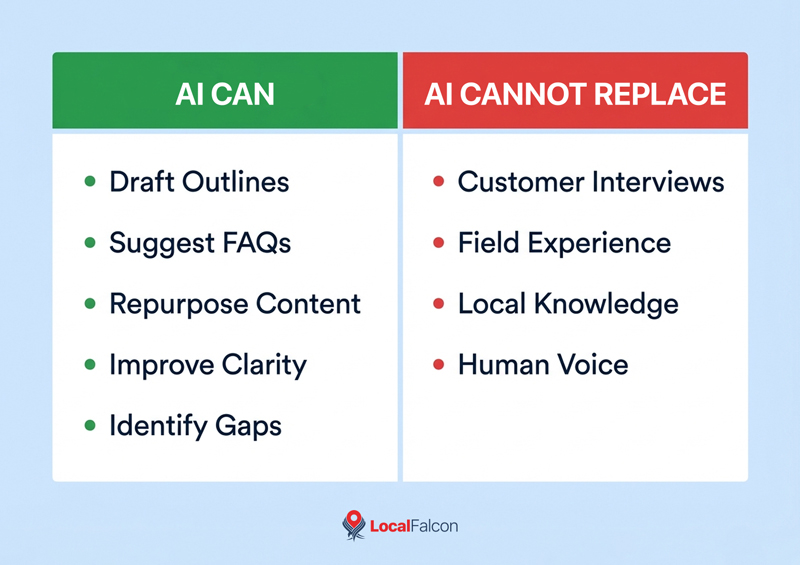
AI works best as a force multiplier, not a substitute for experience.
It can:
- Draft outlines
- Suggest FAQs
- Repurpose content
- Improve clarity
- Identify gaps
But it cannot replace:
- Customer interviews
- Field experience
- Local knowledge
- Human voice
The local brands that win in the AI era won't be the ones producing the most content. They'll be the ones producing the most grounded, authentic content — content rooted in real conversations, real places, and real people.
Authenticity as a Competitive Advantage
As more businesses adopt generative AI into their marketing stacks, sameness becomes the real risk.
When every competitor publishes polished but generic content, the brand that sounds human stands out. The brand that references local realities stands out. The brand that consistently reinforces who they are and what they do stands out.
Authenticity is no longer just a branding concept. It's an SEO strategy.
- It builds trust with users.
- It sends clearer signals to search systems.
- It strengthens differentiation.
- It improves conversions.
In short, local businesses don't need to avoid AI. They need to ground it in reality. Because in local search, trust is the ultimate ranking factor — and trust begins with being unmistakably human.