
If you've read our breakdown of what query fan-out is, you already understand the core concept: when someone types a question into an AI search tool, the system breaks it apart into multiple related sub-queries, researches them in parallel, and synthesizes a single response.
What that means for your business is this: you can rank well in traditional search and still be completely invisible in AI-generated answers. Closing that gap requires reevaluating how your content is structured and optimized. To show up across the full range of sub-queries AI platforms generate, you need a different approach to content creation altogether.
Why Traditional SEO Content Falls Short in AI Search
Classic SEO content strategy is built around a one-to-one model: one page, one focus keyword, one search intent targeted. This approach works well for traditional search, where individual pages are ranked for specific short- and long-tail keywords and users click through to the result that best matches their query. But AI search doesn't work that way.
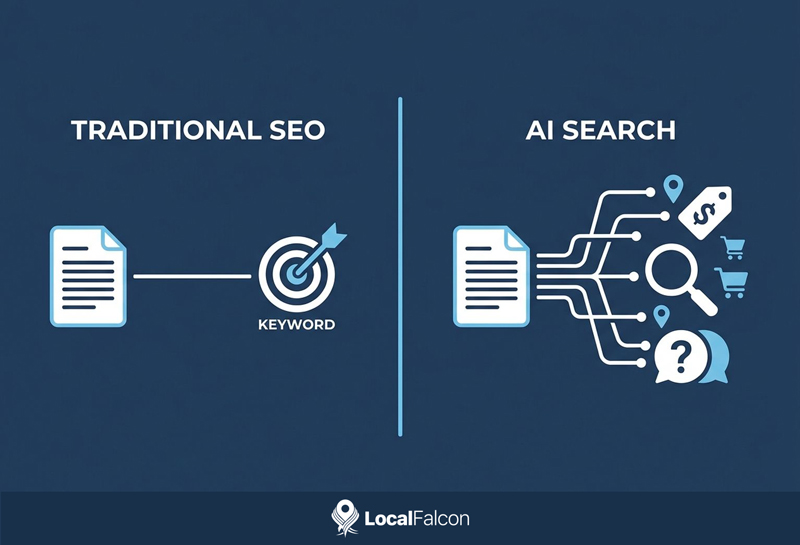
The traditional hub-and-spoke model, or creating one primary page targeting a main keyword, supported by separate pages for each subtopic, all linked together, is designed for a world where pages are evaluated individually. In that model, spreading information across many different URLs makes sense.
However, this approach doesn't translate directly to AI search visibility, more specifically, it doesn't optimize for query fan-out behavior.
When a query fans out, the AI doesn't navigate your internal links and evaluate each page separately. Instead, it assesses whether a single source can support multiple aspects of a question at once. Thus, a business whose content is fragmented across many thin pages may find that no single page is useful enough for AI to confidently cite, even if the information technically exists on the site somewhere.
When it comes to earning AI visibility, the goal for any one page is semantic completeness: each page should be able to explain its topic clearly and from multiple relevant angles, on its own, without relying on other pages to fill critical gaps.
How To Optimize Local Business Content for Fan-Out Queries and AI Visibility: Step by Step
Step 1: Identify the Sub-Queries Around Your Core Topic
The starting point for any query fan-out optimization effort is mapping the questions AI is likely to generate when your topic is searched.
There are at least eight distinct angles from which AI models tend to expand a query, with the exact number varying according to who you ask. Thinking through each one will give you a comprehensive picture of the sub-query landscape you need to address. Here's how a recent article from Search Engine Land on how to optimize for query fan-out breaks it down:
|
Fan-Out Type |
What It Looks Like |
|
Equivalent |
Alternative ways of phrasing the same question ("dentist near me" → "dental clinic [city]") |
|
Follow-up |
Questions that naturally come after the initial search ("laser hair removal [city]" → "how much does laser hair removal cost") |
|
Generalization |
Broader versions of the query that place it in wider context |
|
Specification |
Narrower versions with added constraints — audience, format, location |
|
Entailment |
Questions that logically follow from, or are implied by, the original query |
|
Clarification |
Disambiguation queries when the original could be interpreted multiple ways |
|
Canonicalization |
Standardized or normalized phrasings of colloquial queries |
|
Comparative |
How your business, service, or product stacks up against available alternatives |
For a local business, working through this framework for each core service is a productive exercise. Take "emergency plumber in [city]" and you'll quickly surface sub-queries about response times, pricing, after-hours availability, what to do while you wait, how to compare plumbers, and more. These are the questions your content needs to try and answer on individual pages.
Free tools exist to help with this process. Running your page URL or primary keyword through a fan-out query generator will produce a list of synthetic sub-queries approximating what AI systems are likely to generate, and many will tell you which of those queries your existing content already addresses.
Local Falcon's free local keyword research tool can generate lists of related AI-style search phrases based on the seed keywords you input. It also classifies these keywords according to intent and assigns them a proprietary WYN score, which helps you prioritize targeting according to highest potential business value.
Step 2: Cover Multiple Intents Within a Single Page
Once you have a map of your sub-queries, the next step is integrating them into your content; not by targeting each one with a separate page, but by addressing them all within a single, self-contained piece. This is the core structural shift that fan-out optimization requires.
AI search frequently collapses what we used to think of as the marketing funnel. A single query can trigger informational, evaluative, and transactional sub-queries simultaneously. The system isn't retrieving these sequentially, but rather it's pulling them in parallel and synthesizing a combined response. Content that only addresses one intent level may be accurate, but it becomes easy to replace as the fan-out widens.
Effective fan-out-optimized content accounts for this by covering a topic across multiple intent layers within the same page:
- Foundational understanding: what the service is, how it works, what it involves
- Evaluative context: pricing, comparisons, what to look for when choosing a provider
- Practical specifics: process, timing, what happens next, common questions
For a local business, this might mean a service page that doesn't just describe what you do, but also addresses what it costs, how long it takes, how you compare to alternatives, and what customers frequently ask. That depth of coverage is what allows a single page to remain relevant as queries fan out in multiple directions.
A useful QA step after writing or revising any page is to go through your mapped sub-queries again and ask honestly: does my content answer this? Gaps are your next editing priority.
Step 3: Write With Precision and Factual Clarity
Fan-out retrieval increases the scrutiny your content faces. When AI systems are researching a topic, they compare answers across multiple sources before deciding what to cite. Content that contains vague claims, internal contradictions, or unverifiable statements is easier to discard during that process.
Content that is specific, accurate, and clearly reasoned is easier to cite and more likely to be reused across multiple sub-queries.
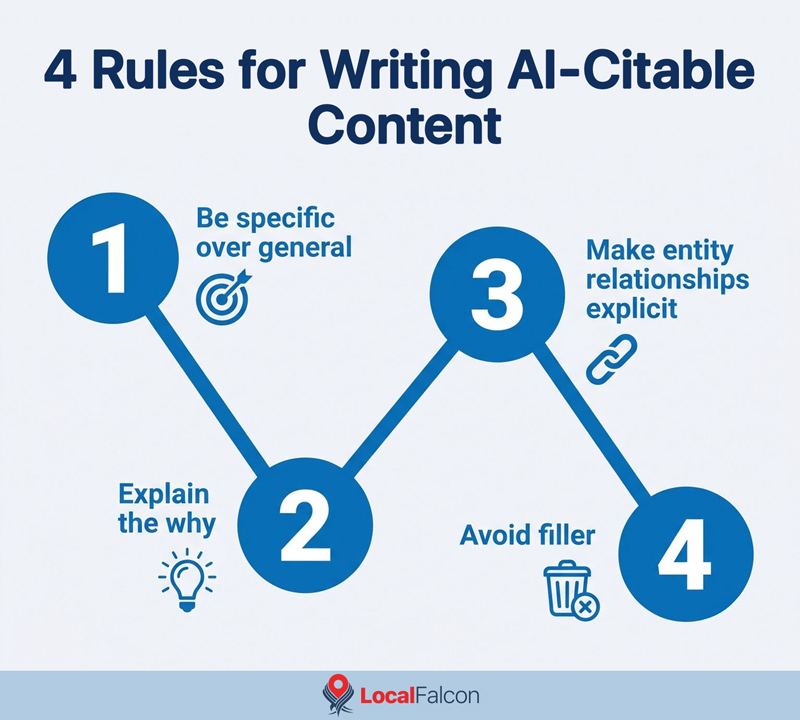
In practical terms, this means you should:
- Be specific over general: "We typically respond within two hours for emergency calls in the downtown core" is more useful to an AI model than "We have fast response times." The first statement can satisfy a sub-query about response times. The second cannot.
- Explain the why, not just the what: AI systems favor content that demonstrates subject matter understanding. A page that explains why a particular approach is recommended (not just that it is) signals genuine expertise and is more likely to be treated as reliable reference material.
- Make entity relationships explicit: AI systems identify concepts and evaluate how they relate to one another. Writing that makes these connections clear and direct, using subject–predicate–object structures rather than implied relationships, is easier for AI to interpret and reuse consistently across related queries.
- Avoid filler: Marketing language that doesn't convey specific, verifiable information dilutes the factual content AI systems are actually looking for. Every section should deliver something concrete.
This precision also reinforces E-E-A-T signals, or experience, expertise, authoritativeness, and trustworthiness, which affect how consistently AI platforms treat your content as a reliable source across the full spread of fan-out sub-queries.
Step 4: Structure Your Content So AI Can Extract It
Detailed content that's poorly organized is still hard for AI to use. The structure of your page directly affects how well AI systems can identify what each section covers and match it to the right sub-queries.

Use clear, descriptive headings
Headings act as retrieval anchors. Each section should have a heading that clearly signals what it covers. Question-based headings work especially well because they mirror the format of fan-out sub-queries directly. For instance, "How much does [service] cost in [city]?" is more useful than "Pricing."
Vague or overloaded headings make it harder for AI systems to map sub-queries to the right part of a page. When headings are unclear, sections that contain good answers can still go uncited.
Lead each section with the answer
State the main point in the opening sentence of each section. Rather than building towards an answer, lead with it and then provide supporting context. This structure aligns with how AI systems identify passages that satisfy a query directly, and it makes content more scannable for human readers as well.
Use structured formats where they fit
Lists, tables, and other highly structured formats reduce ambiguity. They make it easier for AI to parse and reuse information, and they're especially effective for comparisons, service summaries, step-by-step processes, and FAQ-style content, all of which map closely to common fan-out sub-query types.
Break content into logically complete chunks
Long, dense paragraphs are harder to extract information from. Keeping paragraphs focused on a single idea and making each section self-contained enough to stand on its own makes the page easier for AI to navigate and cite selectively as different sub-queries arise.
Add an FAQ section
One of the most reliable structural moves for fan-out optimization is adding an FAQ section to key pages. When some sub-queries don't fit naturally into the main body of a page, a dedicated FAQ block lets you address them directly, worded as the questions AI is likely to generate. This is a practical way to close coverage gaps without disrupting the flow of the main content.
Step 5: Keep Content Fresh
AI models frequently append the current year to sub-queries or actively seek recently updated information, treating freshness as a signal of reliability. A page that hasn't been touched in two years may rank adequately in traditional search, but it sends weaker signals in AI-driven results.
For local businesses, this means:
- Refresh service pages when your offerings, pricing, or processes change, and don't let outdated information sit
- Revisit core pages seasonally to ensure nothing has become stale or inaccurate
Keeping content current signals to AI platforms that your business is active and that your information can be trusted, which matters most in local contexts where specific, accurate details directly affect recommendations.
Step 6: Track AI Visibility, Not Just Rankings
Perhaps the most important operational shift fan-out optimization requires is in how you measure results. Traditional rank tracking won't tell you how your business is performing in AI-generated answers.
Real-world testing has shown that optimizing local business content for fan-out queries can significantly increase the number of times your content is cited in AI responses, but the relationship isn't always linear or predictable. Citation counts can fluctuate significantly in short periods, sometimes due to your own content improvements, sometimes due to platform-level changes in how AI tools handle responses that are entirely outside your control, or sometimes due to shifts in the competition and their query fan-out optimization efforts. This makes consistent AI visibility tracking incredibly important in the modern era of local search.
The metrics that matter for AI visibility are different from traditional local SEO metrics. Rather than telling you how often your business appears in Google's 3-Pack, AI visibility tracking tells you how often AI mentions your business.
AI visibility tracking tools like Local Falcon also show you which sources (i.e., URLs) AI cites when it mentions either you or your competitors, so you can factor those into your query fan-out optimization efforts.
Without this kind of granular AI visibility tracking, it's very difficult to know whether your content efforts are actually moving the needle in AI search, or where the gaps are that competitors might be filling.
Local Falcon's AI visibility Scan Reports give local businesses a clear view of where they're appearing in AI-driven results, which queries they're being cited for, and where the coverage gaps are.
Putting It All Together
Fan-out query optimization is a different way of thinking about content. The core principle is straightforward: stop building pages to answer one question (e.g., targeting one primary keyword), and start building pages that hold up as the questions multiply.
Here's a quick checklist of the steps to take:
- Map the sub-queries across all possible fan-out angles for each core topic or service
- Cover multiple intents, including informational, evaluative, and transactional, within a single page
- Write with precision: specific, factual, clearly reasoned content is easier for AI to cite
- Structure for extractability: clear headings, direct answers, structured formats, self-contained sections
- Keep content current: recency is an active signal in AI fan-out behavior
- Monitor AI visibility with the right tools, not traditional rank trackers
Businesses that make these adjustments now are positioning themselves to appear in AI-generated responses, overviews, and recommendations that competitors who are still optimizing for traditional search alone simply won't.
Want to see where your business currently stands in AI-generated local search results? Run a Local Falcon AI visibility scan to find the gaps before a competitor does.