
Google has released its first-ever official guide to optimizing websites for generative AI features on Google Search. A lot of this was already known or speculated, but having it confirmed directly by Google is useful, as it clarifies exactly what Google's AI does and does not care about, and debunks some advice that has been circulating online.
Before diving in, keep in mind that these recommendations apply directly to Google's own AI search features, including AI Overviews, AI Mode, and Gemini. They may also offer some useful direction for getting your brand cited by third-party AI tools like ChatGPT or Perplexity, but those platforms may conduct searches slightly differently and results won't always translate directly.
Regardless, Google's guidance on optimizing for generative AI features on Google Search is still a reasonable starting point for thinking about AI visibility more broadly.
First, How Google's AI Search Actually Works
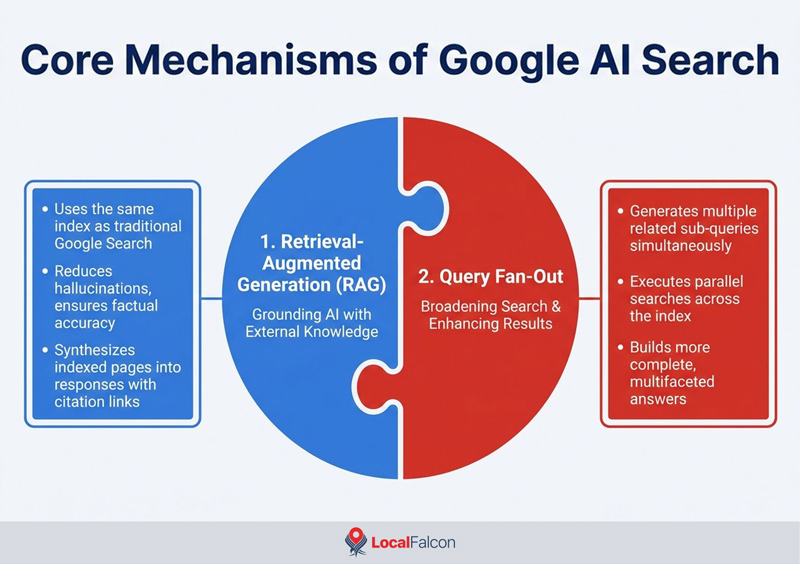
To understand how to optimize for Google AI search, you need to first understand the two core mechanisms at play across Google's generative AI search features:
- Retrieval-Augmented Generation (RAG): Google's AI does not pull from a separate AI search index. It uses the same index that powers traditional results, retrieving relevant pages in real time via RAG and synthesizing them into a response with clickable citation links back to your site. If you are not in the Google Search index, you are not going to appear in any AI-generated responses.
- Query Fan-Out: When a user asks a question, the AI typically generates several related sub-queries simultaneously to build a more complete answer. This behavior is known as query fan-out. For example, "how to fix a lawn full of weeds" might trigger concurrent searches for "best herbicides," "remove weeds without chemicals," and "weed prevention tips." Your content could surface across multiple of these threads.
From Google's Perspective, "AEO" and "GEO" Are Synonymous with SEO
The new guide has made it clear where Google stands on the matter of whether Google AI search optimization and traditional Google SEO are different.
According to Google, Answer Engine Optimization (AEO) and Generative Engine Optimization (GEO) are not separate disciplines from SEO. Optimizing for Google's AI search features starts with the same fundamentals that have always driven Google Search performance.
What Google Wants You To Do To Earn AI Visibility
We've summed up some of the key takeaways from Google's guide to optimizing websites for generative AI features on Google Search below, turning them into actionable steps you can take towards improving your brand's Google AI search visibility right now.
1. Create Non-Commodity Content
This is Google's biggest emphasis throughout the guide. The difference between commodity and non-commodity content comes down to providing unique, helpful, and people-centric insights, rather than generic content full of common knowledge.
Google gives a clear example: "7 Tips for First-Time Homebuyers" is commodity content. "Why We Waived the Inspection and Saved $12K: A Look Inside Our Sewer Line Decision" is not. The latter reflects real experience, a specific perspective, and information that cannot be found elsewhere.
2. Demonstrate E-E-A-T
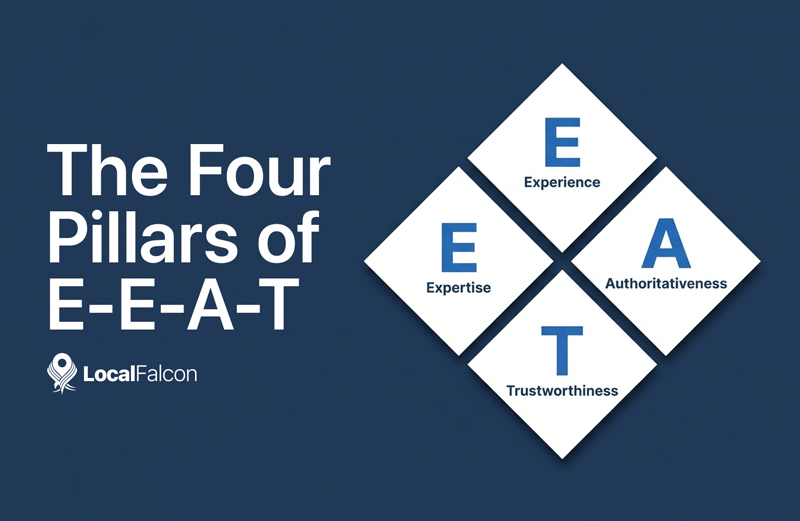
Experience, Expertise, Authoritativeness, and Trustworthiness remain important ranking factors for Google's AI search experiences. Google wants content that shows who wrote it, what firsthand experience they bring, and what evidence supports the claims.
The new guide specifies that you should not just recycle content that exists elsewhere or upload something that generative AI could easily produce (read: don't use 100% AI-generated content).
For further reading on these first two steps, check out Google's guide to creating helpful content.
3. Ensure Your Content Is Crawlable and Indexable
Content must be publicly accessible and crawlable to appear in Google's generative AI features, just like it needs to be in order to rank in traditional search results. In other words, the technical path to AI visibility runs through conventional rankability.
For large or frequently updated sites, Google recommends reviewing your crawl budget. If your site uses JavaScript heavily, follow JavaScript SEO best practices to ensure content is fully processable.
4. Maintain Strong Page Experience
Core web vitals, load times, mobile usability, and overall user experience remain important when it comes to optimizing for generative AI features on Google Search. The same things that help users help Google's AI.
5. Reduce Duplicate Content
Duplicate and near-duplicate content dilutes your site's ranking signals for both traditional and AI search. Consolidate where possible, ensure canonical tags are correct, and strive for quality over quantity going forward. This provides a better user experience and improves long-term visibility in both traditional and AI search.
6. Add High-Quality Images and Video
Google's generative AI search features can surface relevant images and video, creating additional opportunities to appear beyond web page links. Following existing Google image and video SEO best practices covers this.
What the Google AI Search Features Optimization Guide Says to Ignore
Some of the most useful parts of this guide are the things Google explicitly says are unnecessary. Several Google AI search feature optimization tactics that have circulated widely are directly contradicted here.
Google's guide states that you do NOT need to:
- Create a separate llms.txt file
- Add new machine-readable AI files
- Use special schema.org or other structured data specifically for AI (though the guide states it's still beneficial for overall SEO, especially for appearing in rich results on Google Search)
- "Chunk" your content in a particular way (not to say that content chunking doesn't improve readability, just that it doesn't specifically impact Google AI search visibility)
- Create separate content for every possible long-tail keyword/fan-out query variation (instead, try to cover different angles within the same content in a way that helps your target audience)
Note: Google's guidance states that it's perfectly fine to create and maintain llms.txt or similar files if you want to, as they could potentially impact AI search visibility on other platforms, just that they don't have any impact (positive or negative) on AI visibility in Google Search. It just ignores them.
What the Guide Says About Ecommerce and Local Businesses
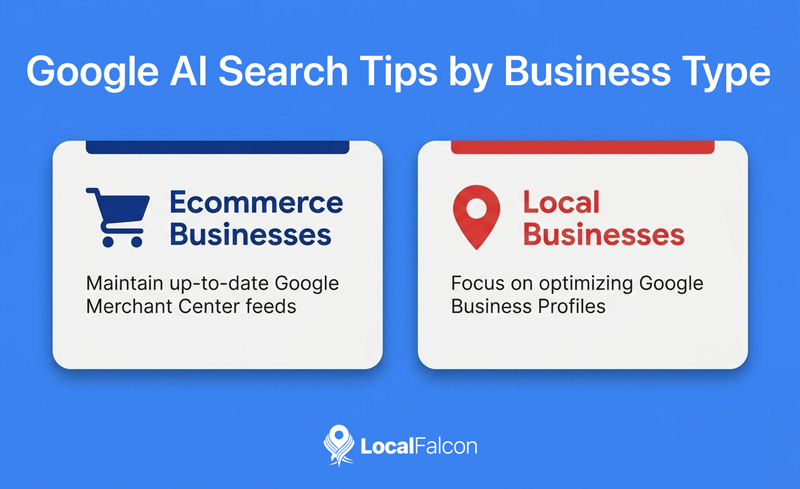
According to the guide, ecommerce businesses should maintain up-to-date Google Merchant Center feeds and local businesses should focus on optimizing their Google Business Profiles, as these feed directly into Google's AI-generated responses for product-related and local queries. These best practices can help products and services be more visible across both traditional and AI search results.
A Note on Optimizing for Agentic Experiences
Optimizing for agentic AI experiences is covered in a dedicated section of Google's guide to optimizing for generative AI features on Google Search. This inclusion in the guide foreshadowed Google's announcement that it would be adding Search agents to its suite of AI search features.
Google describes AI agents as autonomous systems that can perform tasks on behalf of users, such as booking reservations or comparing products.
Agent-friendly sites are described as those with strong fundamentals: clear structure, accessible content, and good usability. The Universal Commerce Protocol (UCP) is mentioned as an emerging standard to watch.
Google recommends staying up-to-date on emerging technologies that allow agents to interact with your site, giving the examples of browser agents and new protocols.
Measuring Performance in Google's Generative AI Features
AI feature traffic is reported in Google Search Console in the standard Performance report. There is currently no separate AI search performance dashboard.
Google recommends tracking conversion-oriented metrics beyond clicks, noting that visitors arriving via AI Overviews tend to be more engaged than those from standard results.
If you want to see exactly how your brand appears in Google AI Overviews, AI Mode, and Gemini, you can also run AI visibility scans for specific keywords using Local Falcon.
Tracking your Share of AI Voice (SAIV) and brand sentiment over time using Local Falcon's AI visibility reports gives you a good idea of how your optimization efforts are working, while also allowing you to directly compare visibility and sentiment to competitors.
The Bottom Line on Google AI Search Optimization
The core message of this new Google AI search optimization guide is that there is no separate playbook from traditional Google SEO. Google's AI features run on the same index, follow the same spam rules, and respond to the same quality signals that have always mattered. Strong content, technical accessibility, and demonstrated expertise are still the foundation of visibility.
If you're ever unsure whether a piece of content is worth publishing, ask yourself whether a visitor would leave your page feeling like they actually got what they came for. If the answer is yes, there's a good chance that Google's AI will agree and thus be more likely to surface that content in AI-generated search results.
FAQs on Optimizing for Generative AI Features on Google Search
Do I need to do anything special to appear in AI Overviews or AI Mode?
No. Google states there are no additional requirements beyond standard SEO best practices.
Is AI-generated content allowed on Google?
Yes, but it must meet the same quality and helpfulness standards as any other content, with human oversight applied.
Does structured data help with appearing in Google's AI Search features?
No special schema or other structured data is needed for Google's AI features specifically. Existing structured data that supports your regular SEO remains useful overall.
Will optimizing for Google's AI features help with other AI visibility?
The principles of quality, authority, and crawlability are broadly applicable, but other AI tools may retrieve information differently, so results will not always transfer directly.
Where can I track how my site performs in Google's AI features?
In Google Search Console, AI feature appearances are included in overall search traffic. You can track your AI visibility more precisely across Google AI Overviews, AI Mode, and Gemini with Local Falcon.
What is the single most important factor for Google AI search visibility?
Creating genuinely unique, helpful, non-commodity content. Google calls this out explicitly as the highest-impact factor in the guide.