
With the proliferation of AI in digital marketing, agency professionals have been divided into two camps: those who view AI as a threat that will eventually replace human marketers altogether, and those who view it as a valuable tool for marketing campaign execution.
However, the reality is that most businesses now expect their agency partners to implement AI-powered marketing. And most agencies are recognizing the potential AI has to reshape marketing.
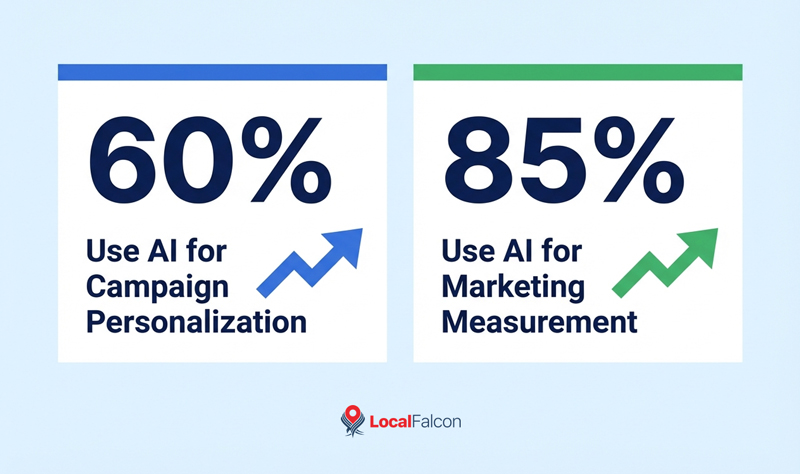
According to Nielsen, nearly 60% of global marketers are using AI for campaign personalization and optimization, with that percentage rising to 85% for marketing measurement. In other words, AI-powered marketing has become the new norm, and agencies that fail to deliver this will struggle to maintain strong brand-agency partnerships in the new era of AI-driven marketing campaign execution.
What Brand-Agency Partnerships Look Like in the Era of AI-Powered Marketing
While the demand for AI-driven marketing campaign execution is high across the board, what this looks like in practice can vary. What exactly a company wants from their agency partners in terms of AI-powered execution is heavily influenced by the size and scale of their business.
Enterprise Companies Often Need Campaign Execution-Only Agency Partners
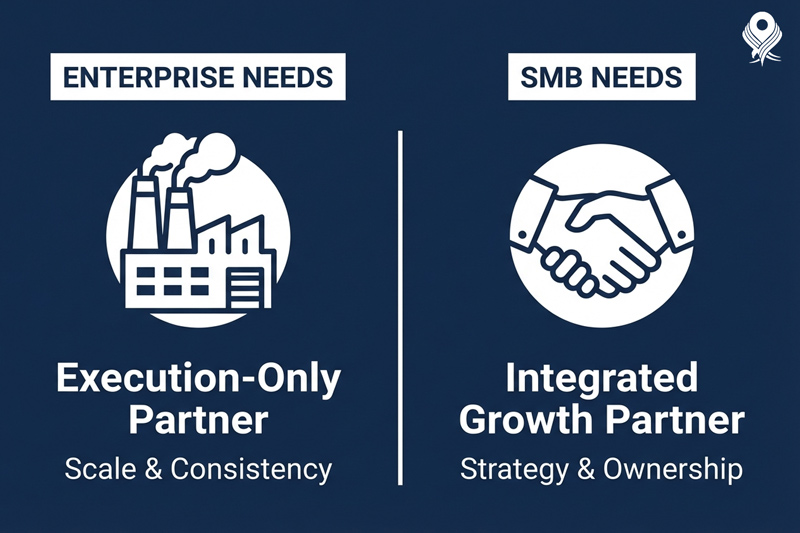
Enterprise companies with multiple locations, hundreds of employees, and tens of millions of dollars in annual revenue typically have established, experienced internal marketing teams that build marketing campaigns, defining the overall strategy and tactics, but they often lack the scale necessary to execute them effectively.
This is where an AI-savvy agency partner comes in to execute, following the roadmap internal teams have already drawn up. AI enables agency partners to execute at the scale and consistency enterprise brands require, without adding operational overhead to internal teams.
Agencies can use AI-powered marketing tools to deploy campaigns across hundreds or thousands of locations simultaneously, monitor performance in near real time, and quickly identify where adjustments are needed. This automation streamlines all areas of campaign execution, freeing agency teams to focus on optimization rather than manual execution.
Beyond campaign execution, AI is critical for performance analysis and strategic feedback. Enterprise brands expect their agency partners to provide clear, actionable insights that inform future decisions. AI-driven analytics allow agencies to surface patterns across markets, uncover underperforming locations, and benchmark performance against competitors.
Tools like Local Falcon play a key role here, giving agencies access to enterprise-level visibility intelligence that shows how a brand appears in local search across specific geographic grids. This granular spatial data allows agencies to prove the impact of localized campaign execution, highlight competitive threats, and recommend precise optimizations, strengthening trust and long-term brand-agency partnerships.
SMBs Frequently Want Fully Integrated Growth Partners
Businesses with fewer locations, smaller teams, and limited in-house expertise often lack the resources needed to plan and execute effective marketing campaigns on their own. As a result, SMBs frequently look for agency partners that can fully integrate into their organization and take ownership of growth initiatives. This includes everything from selecting the right tools, including AI-powered marketing platforms, to building cross-channel strategies, executing campaigns, and measuring results.
Agencies that embrace AI-powered digital marketing execution are uniquely positioned to meet these expectations. AI allows agencies to deliver enterprise-grade capabilities to SMBs, such as faster testing, smarter optimization, and more transparent performance reporting, without the cost or complexity of large internal teams. By handling strategy, execution, and ongoing optimization through AI-driven processes, agencies move beyond tactical support and become true integrated growth partners.
Why AI-Powered Campaign Execution Became the Baseline
The shift toward AI-powered marketing didn't happen in a vacuum. Businesses didn't suddenly become fascinated with artificial intelligence; rather, their expectations were shaped by the platforms they use every day.
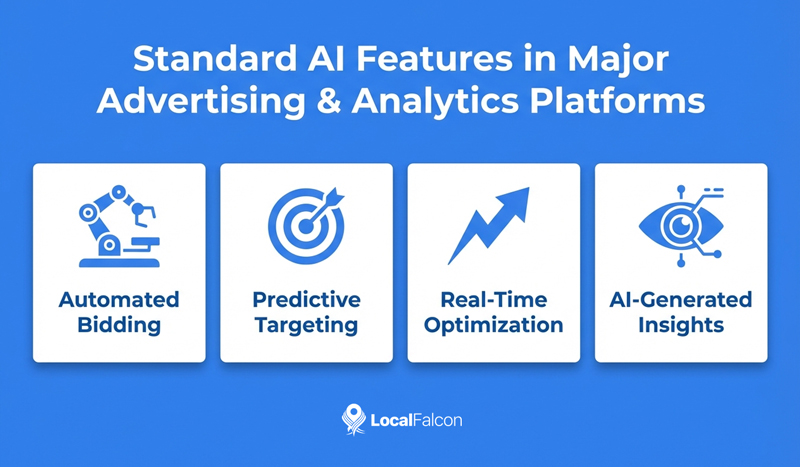
Google, Meta, and other major advertising and analytics platforms have embedded AI deeply into their products. Automated bidding, predictive targeting, real-time optimization, and AI-generated insights are now standard features. As a result, businesses assume their agencies are operating at the same level of sophistication.
Speed has also become a defining factor. Clients no longer accept long feedback cycles or delayed insights. They expect rapid iteration, frequent reporting, and continuous optimization. Manual execution models struggle to keep pace with these expectations, especially across multiple locations or markets.
Transparency is another driving force. AI-powered systems make it easier to surface data, visualize performance, and explain outcomes. Agencies that rely on opaque processes or high-level summaries increasingly feel out of step with client expectations.
In this environment, AI-powered campaign execution isn't seen as innovative, but rather as necessary.
What AI-Powered Marketing Campaign Execution Looks Like in Practice
AI-powered marketing campaign execution doesn't mean removing humans from the process. Instead, it changes how agency teams spend their time and where they deliver value.
AI excels at processing large volumes of data, identifying patterns, and flagging anomalies. This allows agencies to focus less on collecting information and more on interpreting it. Campaign execution becomes faster, more consistent, and more responsive.
In practice, this means agencies use AI to:
- Identify where campaigns are underperforming before issues escalate
- Allocate budget more efficiently based on real-time performance signals
- Test variations more quickly and learn faster
- Measure impact at a more granular level
Importantly, AI supports decision-making rather than replacing it. Strategy, prioritization, and creative judgment remain human-driven. AI simply provides the clarity and scale needed to execute those decisions effectively.
Why Measurement and Visibility Matter More Than Ever
As AI accelerates campaign execution, it also raises expectations around measurement. Businesses don't just want campaigns to run. They want to understand what's working, where it's working, and why.
This has made visibility a core component of modern agency value. Clients increasingly expect insight at the location level, market level, and competitive level. Aggregated metrics alone are no longer sufficient, particularly for businesses with physical locations.
Granular visibility data across both traditional and AI search helps agencies explain performance, justify decisions, and guide optimization efforts. It also allows them to proactively identify risks, such as competitors gaining traction in specific areas, before those shifts impact revenue.
Agencies that can provide this level of insight strengthen their role as strategic partners rather than execution vendors.
The Risk of Ignoring AI-Powered Execution
Agencies that delay AI adoption are unlikely to lose clients immediately. However, the long-term risk is very real.
Without AI-powered execution and insight, agencies can quickly become reactive rather than proactive. Reporting becomes slower, recommendations become less precise, and conversations shift from strategy to justification. Over time, this erodes perceived value.
Clients may continue the relationship, but the agency's influence diminishes. Eventually, execution becomes commoditized, and strategic control moves elsewhere, often to internal teams or more data-driven partners.
Final Thoughts
AI-powered marketing is no longer optional, and it's no longer a selling point on its own. Businesses assume it's part of the agency operating model. What differentiates agencies today is not whether they use AI, but how effectively they use it to execute campaigns, surface insights, and drive results.
Agencies that embrace AI as an enabler, rather than seeing it as a threat, will be better equipped to meet rising expectations, build stronger partnerships, and remain relevant in an increasingly automated digital marketing ecosystem.