
When you're trying to grow local visibility, the question often comes down to one thing: should you invest more in SEO or paid ads? Both can drive valuable traffic and conversions, but knowing which one (and where) to prioritize can be tricky. Local visibility is rarely uniform across a city, and what works on one side of town might not move the needle on the other.
That's where data visualization can make all the difference. With the Local Falcon Competitor Report, you can see exactly how your business ranks across a geographic area alongside where your competitors' physical locations are. This view gives you clarity on why certain areas are difficult to rank in organically and where it might make more sense to allocate paid advertising budget instead.
Overlaying your visibility data with competitor locations helps you quickly spot patterns and identify what's holding your local rankings back. Maybe you dominate one part of the map organically but barely appear in another. Instead of sinking time and money into an uphill SEO battle, you can use that insight to shift tactics, investing in ads where you're blocked by proximity while strengthening your organic visibility where you already have traction.
How To Use Local Falcon's Competitor Report To Balance SEO and Paid Ads
Start by opening a Competitor Report in your Local Falcon dashboard. The geo-grid gives you a visual representation of your visibility across your chosen service area. Each pin shows how your business ranks for a given search point. Green means you're ranking highly, yellow and orange indicate moderate visibility, and red means your business isn't appearing in the local pack at all for that query in that area.
Next, look for areas where most or all of the data points are red. These are the parts of town where your business simply isn't visible in local search results. Once you've identified a red zone, use the Competitor Report's view selection buttons to layer business locations over your scan results. This lets you see where other competing businesses are physically located within the grid.
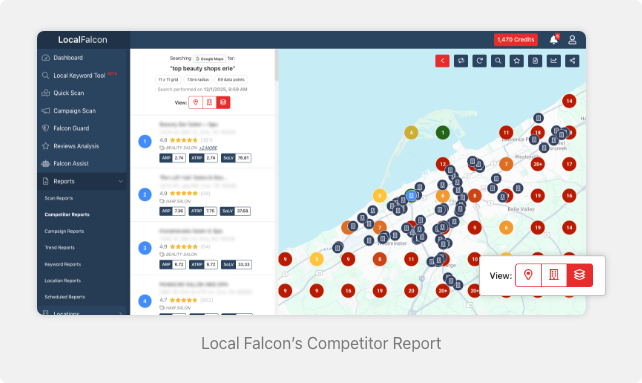
If you notice a cluster of competitor locations inside that red area, you've likely found the reason for your lack of visibility. Local SEO is heavily influenced by proximity. The closer a searcher is to a business's verified location, the more likely that business is to appear in the local results. When several competitors have storefronts or offices in an area, their proximity advantage creates a kind of invisible barrier that's very difficult to overcome with SEO alone. In these cases, even strong optimization will not outweigh the proximity signal those competitors benefit from.
Instead of trying to push through that wall, a better move is to use paid advertising to reach those searchers. Platforms such as Google Ads and Local Services Ads (LSAs) allow you to target specific areas with precision, including displaying local search ads on Google Maps. Directing ad spend toward the regions where your organic visibility is limited helps you maintain a presence in those markets without wasting SEO effort where it's unlikely to pay off.
Meanwhile, focus your SEO efforts on the areas where you already have some visibility. If your grid shows yellow or orange pins, those are your best opportunities to move up through targeted optimization and ongoing local content updates. And where you already have green pins, work to maintain and reinforce your position. This is your "free" visibility, the kind you don't have to pay for once you've earned it.
The result is a balanced, data-informed marketing strategy. You're not guessing where to spend or stretching your SEO team too thin. Instead, you're using the Competitor Report to make evidence-based decisions about local SEO vs paid ads: directing advertising where organic ranking is blocked by competitor density, and concentrating SEO efforts where they can actually move the needle. Over time, this approach maximizes both your ad budget and your organic footprint, ensuring you're visible across your entire target market no matter how the competition is distributed.
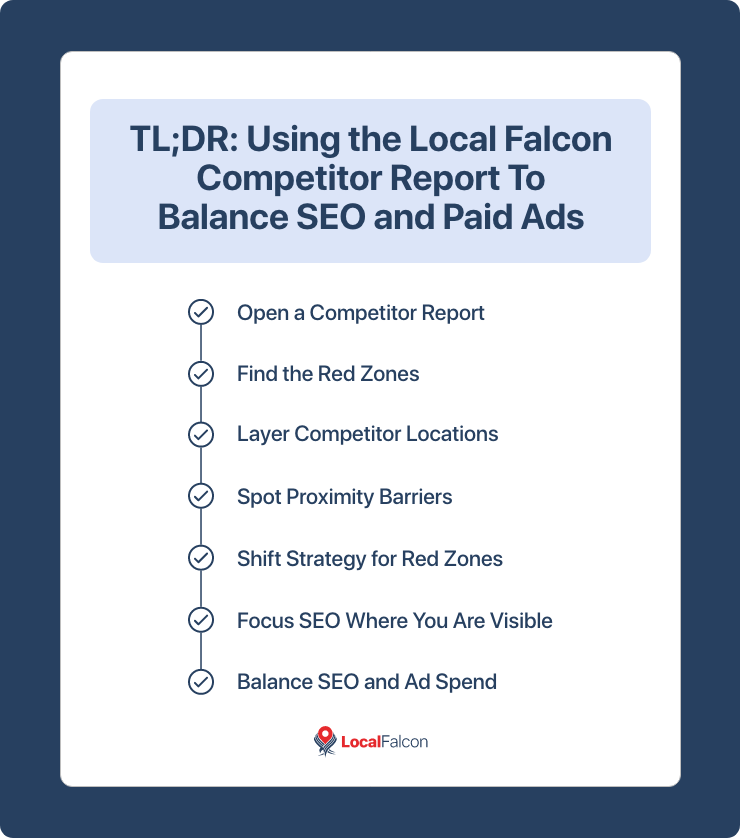
TL;DR: Using the Local Falcon Competitor Report To Balance SEO and Paid Ads
- Open a Competitor Report
View your geo-grid to see where your business ranks across your service area. Green means strong visibility, yellow and orange mean moderate visibility, and red means not visible. - Find the Red Zones
Identify areas on the map where your business is mostly invisible in local search results. - Layer Competitor Locations
Turn on business location markers to see where competing businesses are clustered within the red areas. - Spot Proximity Barriers
If many competitors are located in the red zones, they likely dominate those searches because of proximity, which is one of the strongest local ranking factors. - Shift Strategy for Red Zones
Instead of trying to compete with SEO, target those areas with Google Ads, Maps Search Ads, or Local Services Ads (LSAs) for paid visibility. - Focus SEO Where You Are Visible
Work on improving yellow and orange zones through GBP optimization, review management, and content updates, and maintain your green zones where you already have strong organic visibility. - Balance SEO and Ad Spend
Use these insights to spend more effectively, investing in ads where SEO can't make big enough gains and growing organic visibility where it can.
Turning Insights Into Action With Competitor Reports
The true power of the Local Falcon Competitor Report is in its ability to turn data into actionable marketing decisions. A clear understanding of where your business is visible and where competitors dominate helps you allocate your resources more effectively. Instead of guessing which neighborhoods to target with SEO or ads, you can make informed choices based on real visibility patterns.

So, make Competitor Reports part of your regular workflow. Run scans monthly or even bi-weekly, especially after making changes to your SEO strategy or adjusting ad targeting. This allows you to monitor shifts in your local visibility, identify new opportunities, and catch areas where competitors may be gaining ground. Over time, this continuous feedback helps ensure your marketing efforts are always focused where they will have the greatest impact.
For agencies and marketing teams, these insights are also a powerful way to demonstrate value to clients and stakeholders. Competitor Reports provide clear visual evidence showing why you prioritize certain areas for SEO and others for paid campaigns. This transparency not only builds trust but also helps clients understand the reasoning behind your strategy.
Ultimately, using the Competitor Report to guide both paid and organic campaigns helps you maximize the return on every marketing dollar spent. Target ads where SEO is unlikely to move the needle, and invest in organic optimization where it can generate lasting organic visibility. The result is a balanced, data-driven approach that ensures your business is seen across your entire service area, regardless of how competitive the local market may be.