
Generative AI has become a legitimate productivity tool for marketing teams, and local businesses stand to gain a lot from using it strategically. But there's a catch: the same technology that helps you produce content faster is also flooding the web with generic, undifferentiated writing.
The businesses crushing content marketing, especially in local search, are the ones using AI to enhance SEO and content marketing strategies and scale their output without sacrificing the human expertise that makes content worth reading.
This guide covers how local businesses can put AI to practical use for content creation, while keeping quality and authenticity front and center.
Use AI to Build Content Frameworks, Not Finished Products
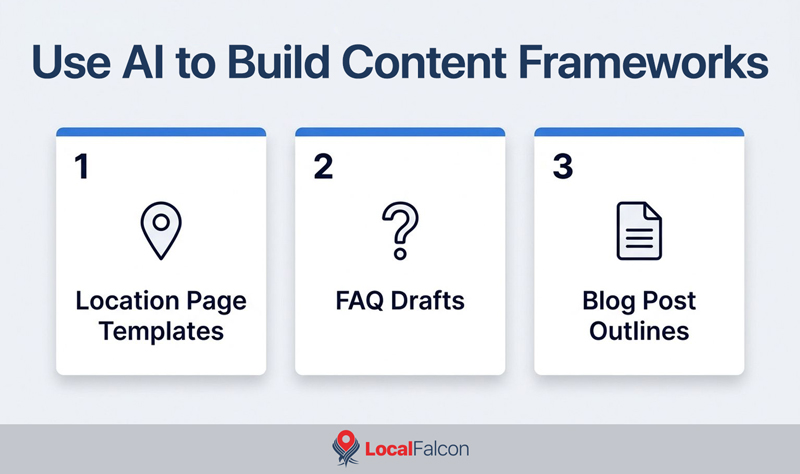
The most effective way to think about AI in your content workflow is as a first-draft machine, not a finished-product machine. It's fast, consistent, and tireless, which makes it ideal for creating the structural scaffolding your human writers then bring to life.
Here are a few places where this works especially well:
Location page templates
Multi-location businesses often struggle to produce unique content for every location or service-area page without turning to copy-paste with a few word swaps, which does nothing for SEO.
AI can generate a structured template with clearly labeled placeholders, prompting your team to fill in neighborhood-specific details, references to local landmarks, community references, staff names, or regional service nuances. The template handles consistency; the human fills in the substance.
FAQ drafts
Ask an AI tool to generate a list of frequently asked questions around a given service or topic, and it will return a solid starting point in seconds.
Your team's job is to edit those questions to reflect what your actual customers ask, and to flesh out answers based on your own expertise and what your business specifically does, rather than what a generic service provider might do.
Blog post outlines and first drafts
Local businesses often have content ideas sitting unused because no one has time to write them up.
AI can take a topic, like "What to expect during your first HVAC tune-up" or "How to choose a family dentist in [city]," and produce a workable draft quickly. The draft needs human editing, but it removes the hardest part of content creation: starting from nothing.
AI as a Research and Ideation Partner
Beyond outlining and drafting content, generative AI is useful for identifying content angles your team might not have considered. You can prompt AI to brainstorm blog topics based on common customer pain points in your industry, generate variations of a headline to see what resonates, or outline a content calendar built around seasonal demand or trends in your local market.
This is where AI genuinely saves time without compromising quality, because the output is being used to inform your team's thinking, not replace it. The actual writing, and the expertise behind it, still comes from people who know the business and its customers.
Keeping the Human Touch
Here's where many businesses get this wrong: they assume AI-generated content is "good enough" and publish it with minimal editing. For local SEO, this is a risky approach, and Google has made its position on this increasingly clear.
In May 2026, Google published its first official guide to optimizing websites for generative AI features in Search. One of its central points is the importance of what Google calls non-commodity content.
Google distinguishes between commodity content, such as a generic list of tips based on common knowledge, and non-commodity content that provides unique expert-sourced perspectives that go beyond what could be easily produced by a generative AI model alone.
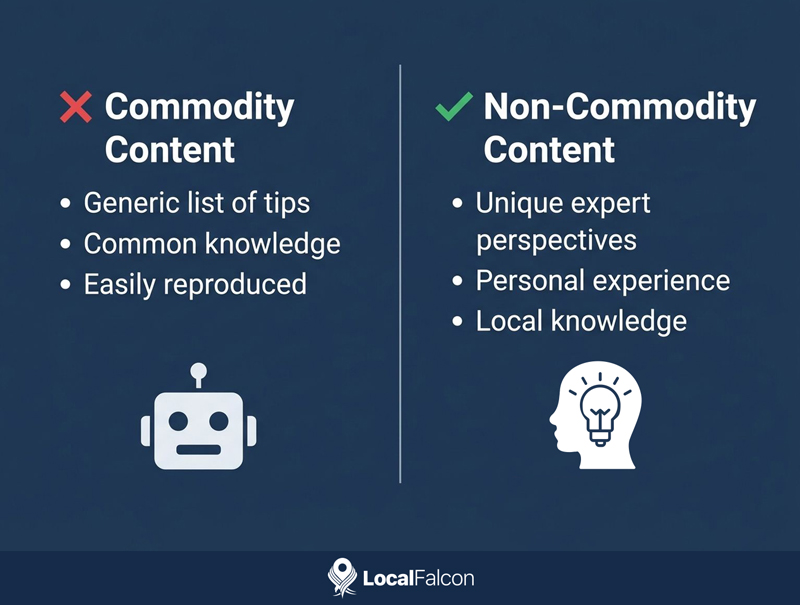
Applied to local businesses, this means a locally relevant guide that provides a unique take based on personal experience and local knowledge is better than a summary of existing content that simply restates information already available elsewhere.
For businesses using AI to enhance local SEO and content marketing strategies, the key is focusing on writing content that reflects your actual work, your specific market, your real customer relationships, and your staff's first-hand knowledge. That's content AI cannot produce all on its own.
Google emphasizes the importance of providing valuable, unique, non-commodity content as a factor in appearing within generative AI features in Search. If your content reads like something any AI could have written about any business in any city, it's not positioned to earn that kind of visibility.
What Good Human Editing Looks Like
When your team reviews and edits AI-drafted content, the goal isn't just to give it a quick proofreading, but rather to enrich it. Good human editors ask things like:
- Does this reflect how we actually work, or is it generic advice any competitor could say?
- Can we add a real example, a specific result, or a customer scenario that only we could speak to?
- Does this answer the question a real person in our area would have, or is it written for an abstract audience?
- Is the tone consistent with how our brand actually communicates?
This layer of editing is where the hyperlocal SEO value lives. It's also what builds trust with readers who are deciding whether to call you or a competitor.
Using AI To Enhance SEO and Content Marketing Strategies for Local Businesses: Workflow Example
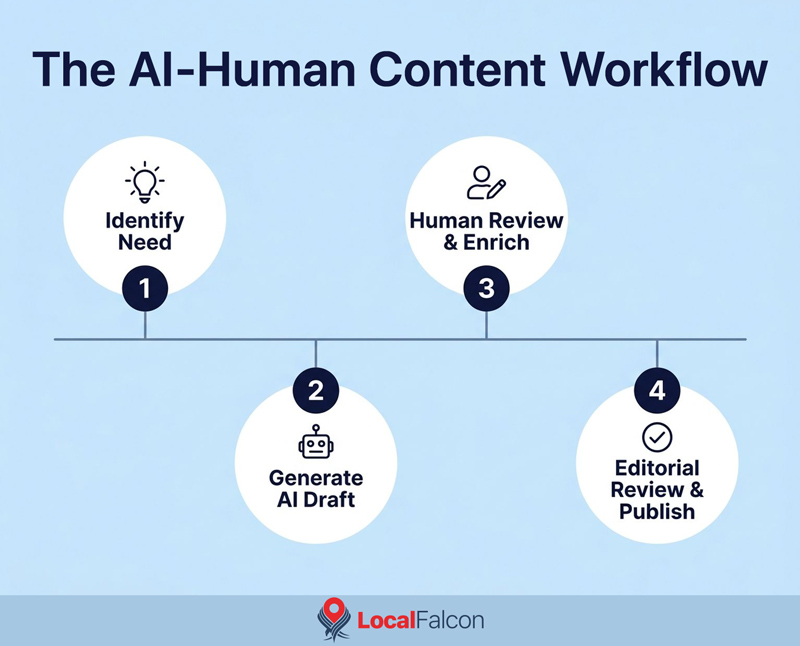
A content workflow that balances AI efficiency with human quality might look like this:
- A team member identifies a content need, whether a new location page, a seasonal blog post, or a service FAQ.
- They use AI to generate a draft or structured template, feeding it details about the relevant service, location, and target audience.
- A content writer or subject matter expert reviews the draft, adding first-hand knowledge, specific examples, and local context.
- The piece goes through a standard editorial review before publishing.
This process allows a small marketing team to produce significantly more content than they could when writing from scratch, without sacrificing the substance that search engines and real customers value.
The Bottom Line
AI is a productivity tool, and a genuinely useful one for local businesses that want to build out their content presence without hiring a large writing team. But it works best as a complement to human expertise, rather than a replacement for it.
Local businesses that treat AI this way can produce more content while maintaining quality, and ultimately build the kind of topical authority that earns visibility in both traditional and AI-powered search. The ones that skip the human touch will have a lot of content that doesn't do much for anyone.