
If you've been paying attention to the recent, rapid evolution of how people find businesses online, you've probably noticed the question coming up more and more: does ranking well in Google still matter if AI platforms are increasingly where people go for recommendations?
The honest answer is that Google rankings still matter (a lot), and strong traditional SEO can certainly help improve AI visibility, but the relationship between traditional search visibility and AI search visibility is more complicated than most businesses realize.
There is definitely some overlap between the two, but how much overlap depends on a surprising number of variables: which AI platform you're looking at, which traditional search engine you're comparing it to, what industry you're in, and even the type of query being asked. Understanding these distinctions is what separates a genuine AI visibility strategy from one that simply assumes Google success will carry over automatically.
The Overlap Between AI Visibility and Traditional Search Results (And Why It Varies So Much)
Research has consistently found meaningful — but far from complete — overlap between AI search citations and traditional organic search results.
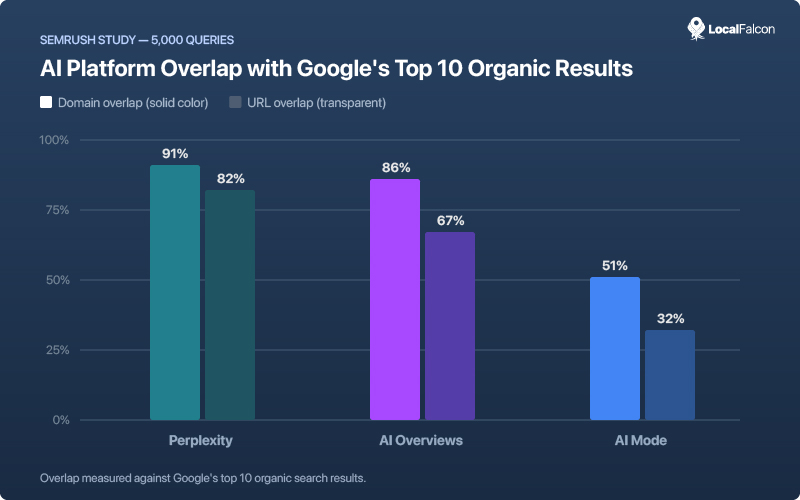
For example, a Semrush study analyzing 5,000 queries found that Google's AI Mode showed roughly 51% domain overlap and 32% URL overlap with Google's top 10 organic search results. Google AI Overviews showed even stronger alignment — around 86% domain overlap and 67% URL overlap with traditional organic results. Perplexity sat at the top end of the spectrum, with over 91% domain overlap and 82% URL overlap with Google's top 10 results. ChatGPT told a different story. ChatGPT had the weakest overlap with Google's top 10 rankings of any platform studied.
These numbers make one thing clear: traditional SEO visibility and AI search visibility are related, but they are not the same thing — and the platform you're looking at makes a significant difference.
Platform Integration Is a Major Factor in Visibility Overlap Between AI and Traditional Search
One of the most important things to understand about AI visibility's overlap with traditional search is that it isn't random — it's partly driven by how each AI platform is connected to its underlying search infrastructure.
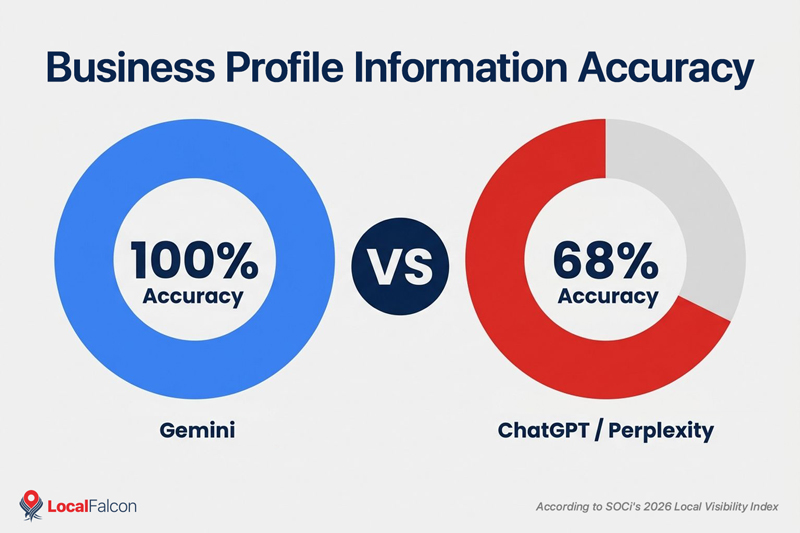
Gemini, Google's AI assistant, draws directly from Google's index and is grounded in Google Maps data when it comes to local businesses especially. This affects not only the overlap between traditional visibility and AI search visibility, but also the accuracy of the business information presented. SOCi's 2026 Local Visibility Index found Gemini to be 100% accurate in the business profile information it presented, compared to only 68% accuracy on ChatGPT and Perplexity.
When Gemini recommends a business, it's essentially pulling from the same data ecosystem that powers Google Search and Google Maps — including information from Google Business Profiles. The result is a much higher degree of overlap between what ranks well on Google and what Gemini surfaces.
ChatGPT has a different approach. It draws on Bing as a data source instead of Google, and does not have a direct integration with Google Business Profile. Instead, it pulls local business data from Bing Places for Business and other reputable online sources. This means a business with a highly optimized Google Business Profile — but a neglected Bing Places listing and thin web presence — can rank at the top of Google Maps and still be effectively invisible on ChatGPT.
A key takeaway from all this is that there is generally more overlap between Gemini and Google, or between ChatGPT and Bing, than between Google and ChatGPT — because of how those platforms integrate directly with their respective search ecosystems and native business listing tools like Google Business Profile and Bing Places for Business. Those connections are a key driver of overlap, and understanding this can help explain some of the variation businesses experience when they compare their Google visibility to their AI visibility across different platforms.
Industry Also Affects How Similar AI Visibility and Traditional Search Visibility Are
Just as industry influences how many Google reviews you need to compete on Google Search and Maps, it also heavily influences how much overlap exists between AI search visibility and traditional search visibility — and how difficult it is to achieve AI visibility in the first place.
The restaurant industry provides a striking illustration of how different these two landscapes can be. According to Local Falcon's research analyzing nearly 190,000 ChatGPT search results alongside local Google search results for restaurant-related queries, 83% of restaurants are completely invisible on ChatGPT, while only 14% are invisible on Google.
That is not a marginal gap. It reveals that strong Google rankings offer no guarantee of AI presence, particularly in competitive, high-volume local categories where AI platforms appear to apply stricter inclusion thresholds. In fact, AI visibility has been estimated to be anywhere from three to thirty times harder to achieve than traditional local search visibility, depending on the platform and the industry.
In highly competitive categories like restaurants, AI platforms appear to apply more conservative inclusion criteria. However, according to our findings, brands that do break through often dominate completely — unlike Google, where ranking improvements are often incremental, ChatGPT appears to operate more as a binary system: a business is either recommended consistently, or it isn't at all. The middle ground that exists in traditional search largely disappears.
What Drives AI Search Visibility
While the signals that drive traditional search rankings contribute to AI visibility in varying degrees, AI platforms weigh signals differently, and in some cases, prioritize entirely different ones altogether.
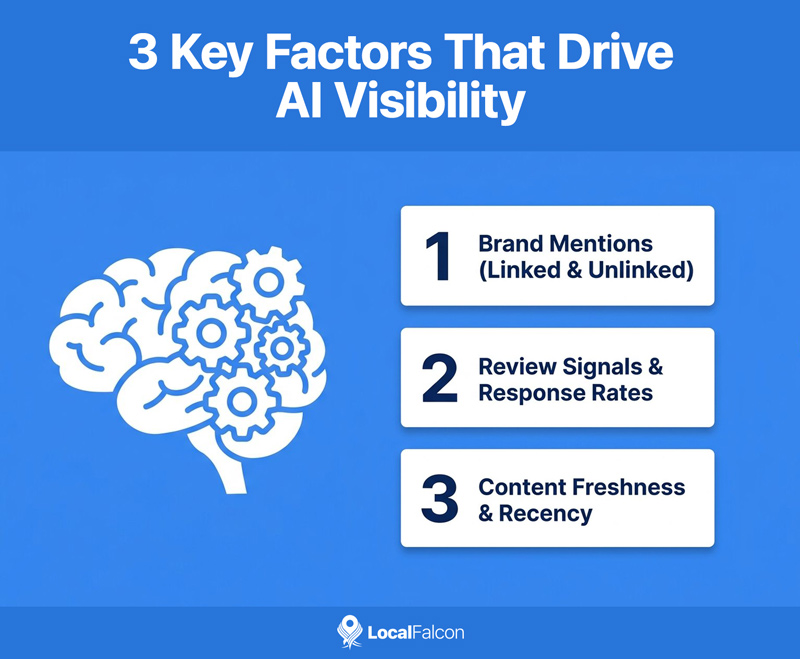
For instance, Ahrefs's research studying 75,000 brands found a stronger correlation between AI Overview visibility and online brand mentions, both linked and unlinked, than with backlinks alone. In other words, simply earning a brand mention can help boost AI visibility, regardless of whether or not that mention links back to your site.
Review signals also behave differently in AI search than in traditional search, and the gap goes beyond star ratings. In certain verticals, brands with average ratings and review response rates below 5% tend to be effectively invisible in AI recommendations — even when their traditional search performance is adequate.
The implication is that certain local SEO best practices that are not direct ranking factors, like responding to reviews (a practice many businesses treat as optional or purely reputational), now appear to function as a trust signal that AI platforms actively factor in when deciding what businesses to mention. Brands that engage consistently with their reviews don't just look better to potential customers; they appear more credible to AI that's deciding whether to recommend them at all.
Content type and freshness play an outsized role in AI visibility as well. AI platforms tend to favor user-generated content and have been found to cite content that is on average 25.7% fresher than content ranked in traditional organic results, with ChatGPT showing a particular recency bias — the same findings showed that 76.4% of its most-cited pages had been updated within the last 30 days.
Other Key Differences Between AI Search and Traditional Search
Beyond the question of traditional and AI visibility overlap, there are other fundamental structural differences between how AI search and traditional search function — differences that have real consequences for businesses trying to be found and chosen by potential customers.
Traditional search presents ranked results. When a user searches for a certain type of business near them on Google Search or Maps, they see a list of businesses that has been ordered according to proximity, relevance, and prominence; the top 3 local ranking factors. Other than presenting results in a certain order, the search engine is neutral — it ranks, it doesn't editorialize.
AI search is different in a way that matters enormously. When a user asks ChatGPT or Gemini the same question, they don't get a ranked list — they get a synthesized recommendation, often framed in natural language that actively positions certain businesses as good choices. This is one of the most underappreciated distinctions between the two: AI search results carry sentiment.
Whereas traditional search simply lists ranked results, AI frames those results — positively, neutrally, or sometimes negatively. The stronger the positive sentiment is, the more persuasively the AI is recommending a business. In traditional search, strong rankings are typically what drives conversions, whereas in AI it's a mix of high visibility and persuasive sentiment.
A business that appears in a ChatGPT response described as "one of the top-rated options in the area, known for quick turnaround and transparent pricing" is receiving something qualitatively different from a #2 Google ranking. The AI is making a case for the business, rather than just showing it before others.
Conversely, a business that appears in an AI response with lukewarm framing — or alongside a mention of mixed reviews — may technically have visibility while actually being disadvantaged relative to a more favorably framed competitor. This sentiment dimension means that a traditional ranking factor like reviews matters not just for whether a business is included in AI results, but for how it's described once it's there.
Volatility is another key distinction to understand. More often than not, AI-generated recommendation lists don't even overlap within the same platform for the same query run multiple times. Traditional search results, while not static, are far more consistent and predictable. This instability makes AI search harder to measure and harder to optimize for.
Finally, while AI-referred visitors show promising stats in terms of engagement and conversions, the raw volume of AI-referred traffic remains small in absolute terms. Google still sends far more traffic to websites than all LLMs combined. AI search is a growing and increasingly important discovery channel, but it has not yet displaced traditional search as the primary driver of website traffic (emphasis on yet — some predict AI search will outpace traditional search by 2028).
The Bottom Line
There is overlap between AI search and traditional search — but it is highly variable, platform-dependent, industry-specific, and increasingly difficult to take for granted. Businesses that rank at the top of Google are not automatically visible across AI search experiences.
The businesses best positioned to capitalize on the growing importance of AI search are those that treat AI search visibility as a distinct discipline that complements, but does not simply mirror, traditional SEO. That means building a consistent, accurate, and richly detailed presence across the data sources AI platforms trust — review platforms, directories, editorial publications, structured website content — while continuing to maintain strong traditional search fundamentals.
It's also crucial to remember that in AI search, appearing alone is not enough. How you appear, particularly what AI says about your business when it does surface you, shapes whether that visibility actually converts.