
According to some estimates, AI search is set to surpass traditional search by 2028. What exactly that looks like remains to be seen, but one thing is certain: the brands that are visible in AI search today will be those winning the most business in a couple of years from now.
But how can you measure brand visibility in AI search? Recent tests have shown that AI-generated answers are simply too variable to measure your AI search visibility by performing manual queries. Sure, you might see your brand mentioned prominently in an AI Overview, but someone performing the same query down the street might see a totally different answer.
That's where Share of AI Voice (SAIV) comes in, providing a reliable measurement of how often your brand is included in AI-generated results.
What Is Share of AI Voice?
Share of AI Voice, or SAIV, is a metric that measures how frequently a brand is included in AI-generated search responses across a defined set of prompts, locations, and AI platforms. Rather than focusing on a single output or snapshot in time, SAIV looks at patterns across many AI responses to determine how often your brand appears as part of the answer.
This distinction is critical. AI-generated search results are probabilistic by nature. They change based on location, phrasing, user context, and AI model behavior. Attempting to measure AI visibility by running a handful of manual prompts will almost always produce misleading conclusions. A brand might appear dominant in one response and disappear entirely in another. SAIV accounts for this variability by measuring presence at scale.
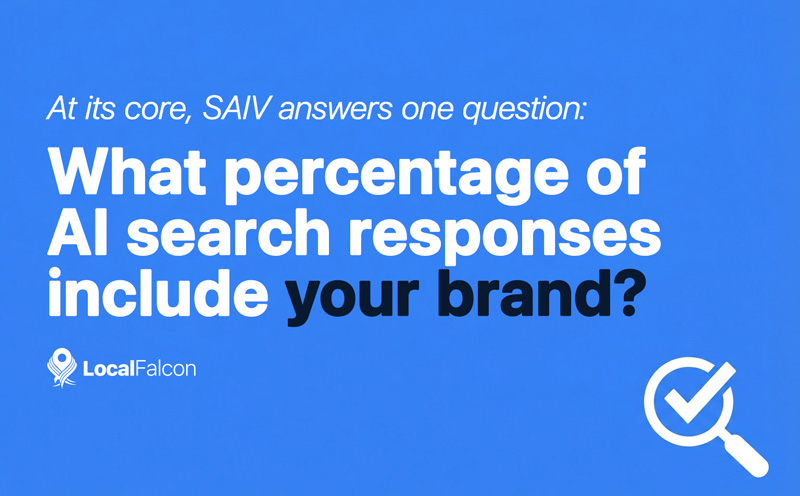
At its core, SAIV answers one question: What percentage of AI search responses include your brand when customers ask questions relevant to your business?
This makes it fundamentally different from traditional ranking metrics. You are not measuring position or order, but rather measuring presence in the conversation.
A strong Share of AI Voice indicates that AI consistently recognizes your brand as relevant, authoritative, and worthy of recommendation when users ask questions related to your business category, products, or services. A weak SAIV suggests that even if you perform well in traditional search, AI may not yet understand or surface your brand reliably.
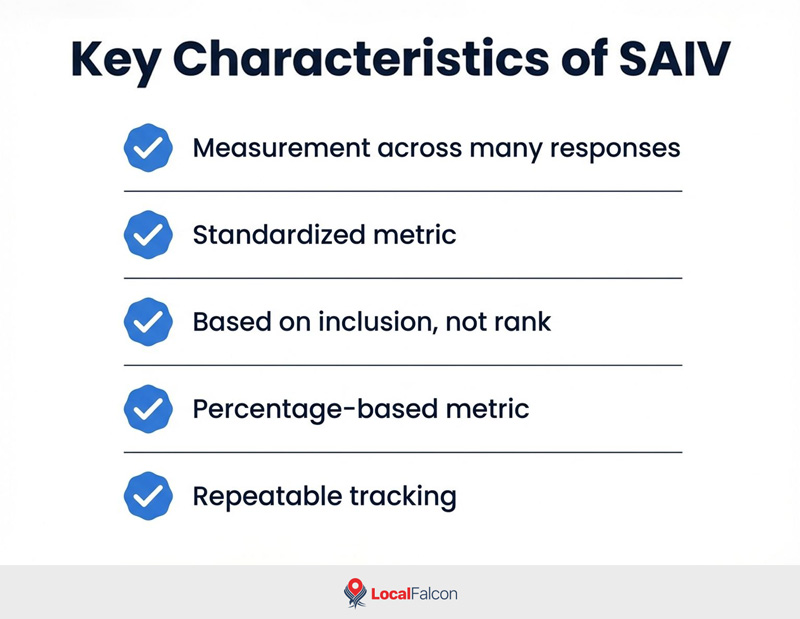
Key characteristics of Share of AI Voice include:
- Measurement across many AI-generated responses rather than a single output
- Standardized metric across prompts, locations, and AI platforms
- Brand presence based on inclusion, not ranking position
- A percentage-based metric that reflects overall exposure
- Repeatable, comparable tracking over time
Because SAIV reflects how often AI systems mention your brand, it provides the most reliable way to understand how exposed potential customers are to your business in AI-driven search experiences. In practical terms, it tells you whether your brand is being seen, referenced, and recommended as part of AI answers that influence buying decisions.
Why Measuring Share of AI Voice Matters
AI search is compressing the customer journey. Users increasingly receive direct answers, shortlists, or recommendations without clicking through to websites or Google Maps listings. When AI presents only a handful of options, brands that are not included simply do not exist at that moment in the customer journey.
This is why measuring SAIV matters more than tracking isolated wins. A single brand mention feels good, but it does not indicate consistent AI search visibility. SAIV shows whether your brand consistently appears when it matters, across the range of questions real customers ask and the areas they search in.
Measuring Share of AI Voice helps you:
- Understand your true competitive presence in AI-generated answers
- Identify gaps where competitors are being surfaced instead of you
- Track whether optimization efforts actually improve AI visibility
- Separate short-term volatility from long-term trends
- Align content, reviews, and location data with how AI systems interpret relevance
For multi-location brands, SAIV also highlights uneven visibility across markets. You may discover that your brand appears frequently in some regions but rarely in others, even when Google Maps rankings look similar. That insight is impossible to uncover through manual testing.
Using Share of AI Voice to Improve Brand Visibility
SAIV isn't just a reporting metric. It's a diagnostic tool. When you track Share of AI Voice over time, changes in performance point directly to how well AI understands your brand. Improvements often correlate with clearer entity signals, stronger location data, better review coverage, and more consistent topical alignment across content.
Practical ways to use SAIV include:
- Monitoring category-level prompts to see where your brand is underrepresented
- Comparing your SAIV against key competitors to identify relative weaknesses
- Segmenting results by location to find markets that need attention
- Tracking SAIV before and after content, review, or citation updates
- Prioritizing optimization efforts where AI visibility is lowest
The goal is not to chase every single AI mention possible. AI search is simply too variable for that. Instead, the goal is to ensure that when AI answers questions in your space, your brand is consistently part of that answer set.
SAIV vs Traditional Local Visibility Metrics
Share of AI Voice complements traditional local search metrics rather than replacing them. Think of it as a new local SEO KPI that every brand needs to track.
Google Maps rankings and Local Falcon's Share of Local Voice (SoLV) metric measure visibility within the Local Pack, the top Google Business Profiles users see when they perform local queries. These metrics tell you how often your locations appear in map-based results for a defined grid of searches. This remains essential for understanding local discoverability and foot traffic potential.
While similar in that it provides insights into trade area visibility saturation, SAIV measures something different. It captures visibility inside AI-generated responses where there is no map pack and no ranking order. These answers synthesize information from multiple sources and present only a few brands seen as highly relevant and authoritative, leaving others out of the conversation entirely.
Looking at both SAIV and traditional local ranking metrics together provides a more complete picture of your brand's overall visibility:
- Strong Maps visibility with weak SAIV suggests AI platforms are not yet surfacing your brand reliably
- Strong SAIV with weak Maps visibility may indicate strong brand understanding but local listing gaps
- Consistent performance across both signals broad visibility across traditional and AI-driven discovery
For enterprise and multi-location brands, this combined view helps prevent blind spots. You can rank well in Maps and still lose a share of attention from potential customers in AI search if your brand is not clearly understood and trusted by AI.
How To Measure Your Share of AI Voice With Local Falcon
Local Falcon provides an automated way to measure Share of AI Voice at scale, removing the variability and guesswork of manual testing.
At a high level, the process works as follows:
- Define the prompts you want to measure: These should reflect how real customers ask questions about your products, services, or locations.
- Select locations and markets: SAIV can be measured across specific cities, regions, or custom geographic areas to reflect local variation.
- Run AI visibility scans: Whether you run a one-time scan or set up an ongoing campaign, Local Falcon generates a large volume of AI responses across the selected prompts and locations.
- Track brand inclusion: Each response is analyzed to determine whether your brand is mentioned as well as what order it's mentioned in.
- Analyze Share of AI Voice: Your SAIV is expressed as the percentage of total AI responses that include your brand.
- Compare and monitor over time: Results can be tracked and compared against competitors over time to identify trends and opportunities.
For local businesses and agencies, Local Falcon turns AI search visibility into a measurable, actionable metric. Instead of relying on anecdotal evidence, you get a clear view of how often your brand is actually part of the AI conversation.
As AI-driven discovery continues to expand, Share of AI Voice provides the foundation for understanding whether your brand is visible where customers increasingly make decisions.
Final Thoughts
AI search is not a future channel. It's already shaping how customers discover, evaluate, and choose local businesses. As those experiences continue to expand, local visibility will increasingly be defined by whether your brand is included in AI-generated answers at all.
Share of AI Voice gives teams a way to measure that reality. It moves beyond isolated examples and anecdotal testing and replaces them with a repeatable view of how often your brand is actually part of the AI conversation.
When combined with traditional local visibility metrics, like Local Falcon's SoLV for tracking Google Maps visibility, SAIV provides a clearer picture of where your brand is present, where it's missing, and where optimization efforts will have the greatest impact on overall visibility.
Brands that start treating AI visibility as something measurable today — and acting on the data — will be far better positioned as AI-driven discovery becomes the default tomorrow.