
If you've been building out structured data for your website to improve local and AI search visibility, you've probably run into two schema types that sound similar but serve different purposes: speakable schema and organization schema.
Both live inside your JSON-LD code, both aim to help machines understand your content, and both can be found on plenty of schema markup checklists. However, they aim to solve different problems.
Understanding the differences between speakable schema vs organization schema will help you prioritize and implement them correctly to improve your local SEO and AI search performance.
What Is Organization Schema?
Organization schema markup is the structured data that tells Google, Bing, and other search engines and machines reading your site who you are as a business. It covers administrative details like your name, address, phone number, logo, website URL, social profiles, founding date, employee count, and identifiers like your VAT ID or DUNS number.
Google recommends placing organization schema markup on your homepage or on a dedicated "About Us" page, rather than on every page of your site.
There are no required properties that a site's organization schema absolutely must include. Instead, Google's guidance on adding organization schema to your site recommends including as many fields as are relevant to your business, since more complete data produces higher-quality results.
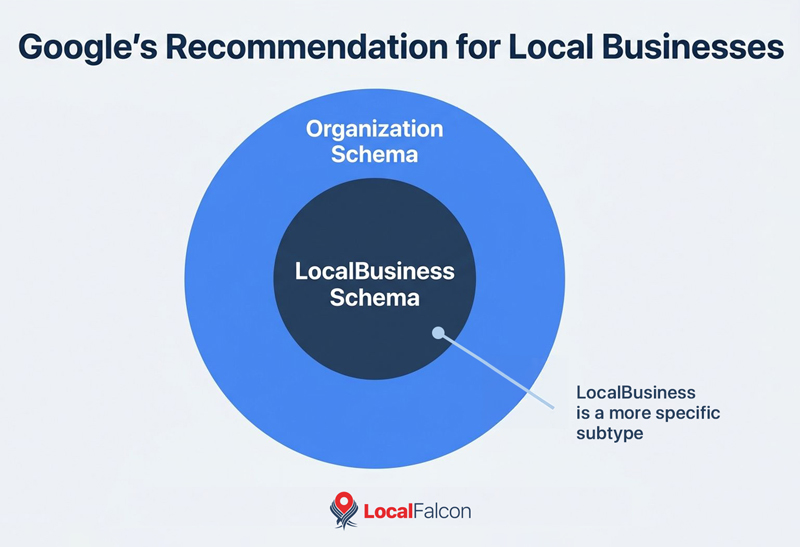
The properties that tend to matter most for local businesses are ones that help establish your business's real-world presence, such as NAP info, URL, links to social profiles, and logo. In fact, Google suggests local businesses specifically use LocalBusiness schema, which is a more specific subtype of organization schema for local SEO.
What Is Speakable Schema?
Speakable schema markup serves a much more specific purpose. Rather than describing your business, it tells machines, including voice assistants and AI tools, which parts of a page are most suitable for text-to-speech playback.
Google built speakable schema specifically for Google Assistant and Google Home devices so they could read topical news content out loud and attribute the source. It's still labeled as beta years after launch, and it's currently limited to English-language content read to users with Google Home devices with location set to the United States.
Technically speaking, implementing speakable schema markup is straightforward. You identify a CSS selector or XPath pointing at two or three sentences that make complete sense with no surrounding context, and you nest the selector inside your existing Article schema.
A speakable passage should open with a direct answer, rather than vague references like "as mentioned above," and should be short enough to be read aloud in about 20 to 30 seconds. If a passage depends on the paragraph before or after it to make sense, it's not a good candidate for speakable schema markup.
Speakable Schema vs Organization Schema: Key Differences
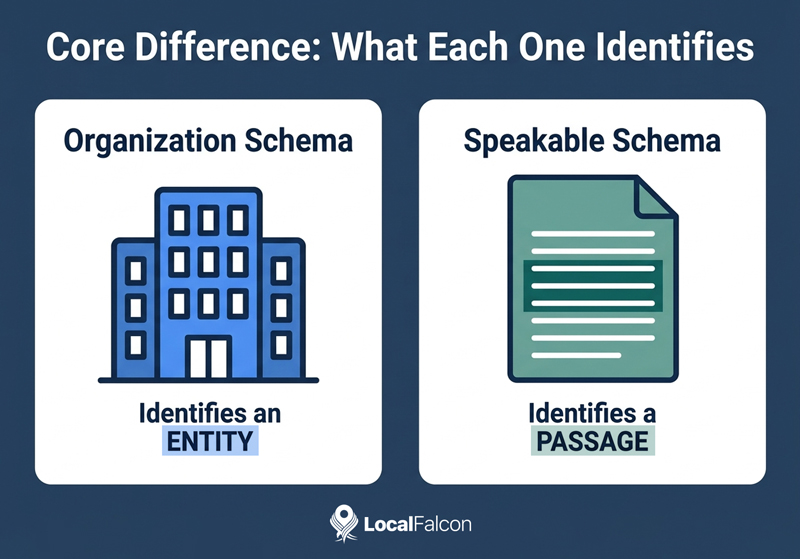
The clearest way to understand the differences between speakable schema vs organization schema is to look at what each one is trying to identify.
Organization schema identifies an entity. It answers questions like "who is this business, and how do people reach it?" It's read by search engines building knowledge panels, by AI models trying to understand which company a page belongs to, and by any system trying to disambiguate your brand from a competitor.
Speakable schema identifies a specific passage. It answers the question of "which specific sentences on this page are most worth reading aloud?" It doesn't describe your business at all.
Another difference between organization schema and speakable schema is scope. Organization schema typically lives on one page, your Home or About page, and describes the whole business there. Speakable schema can appear on many pages, article by article, and only ever describe a couple of sentences at a time.
There's also a maturity gap between speakable and organization schema. Organization schema is fully supported, has no beta label, and directly influences visible search features like knowledge panels. Speakable schema remains in beta with a narrow, single-country, single-language footprint, and no AI platform has confirmed it reads or rewards this markup directly.
Why This Matters for Local and AI Search Visibility
When it comes to local search visibility, including in AI-generated local results, organization schema is the more important of the two types. It's what helps search algorithms and LLMs understand your business entities and reinforce entity associations that influence rankings and visibility.
Speakable schema, on the other hand, does not yet have a significant local search application. It was built for national and regional news publishers being read aloud through smart speakers, rather than for local service providers or brick-and-mortar businesses. However, with the advent of voice-enabled AI assistants, there could eventually be a use case for implementing speakable schema on local business sites.
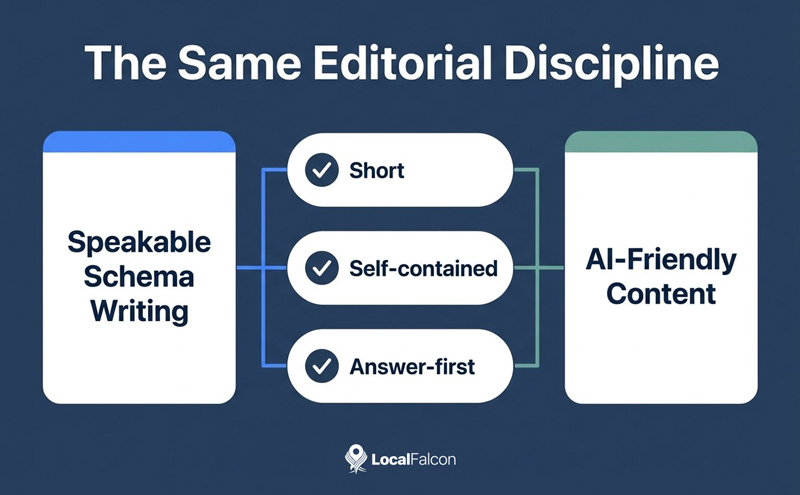
This is because speakable schema encourages the same editorial discipline that AI answer engines are already rewarding: short, self-contained, answer-first passages that make sense without any surrounding context. Writing a genuinely speakable sentence or paragraph and writing one that an AI model is likely to extract and quote look very similar.
Should You Use Both Organization and Speakable Schema?
Organization schema should be an auto-include on any local business site. It's proven to help traditional SEO, and evidence increasingly suggests that it helps with AI search performance, too. There's nothing to lose from implementing it.
Speakable schema is an optional addition that does not currently have any direct impact on local or AI search visibility. That being said, adding it to a piece of content that has a strong quotable passage, a concise definition box, or a clear key takeaway can't hurt.
Speakable Schema vs Organization Schema: FAQs
Is organization schema more important than speakable schema for local SEO?
Yes. Organization schema markup drives entity recognition and knowledge panel accuracy, which matters far more for local search visibility.
Does speakable schema help a business show up in AI-generated answers?
No major AI platform has stated it reads speakable schema markup, though the writing style it encourages tends to overlap with what AI models prefer in terms of extractability.
Can I use speakable schema and organization schema on the same page?
Yes. They serve different purposes and don't conflict. Organization schema typically lives on your Home or About page, while speakable schema can go anywhere it makes sense.
Do I need speakable schema for a local business site?
It shouldn't be a priority, especially compared to organization schema, which even has a LocalBusiness subtype. Speakable schema is still in beta, but it's something to keep an eye on as AI-powered search continues to grow.