Google is still where most customers start when they look for a business, but the way they choose one has changed. Many now read an AI Overview at the top of Google Search results, ask AI Mode for a conversational recommendation, or put the question directly to Gemini.
In each case, the customer may get a list of businesses to choose from without ever visiting a website. These zero-click AI search results mean a brand that isn't mentioned in the answer may never enter the customer's consideration.
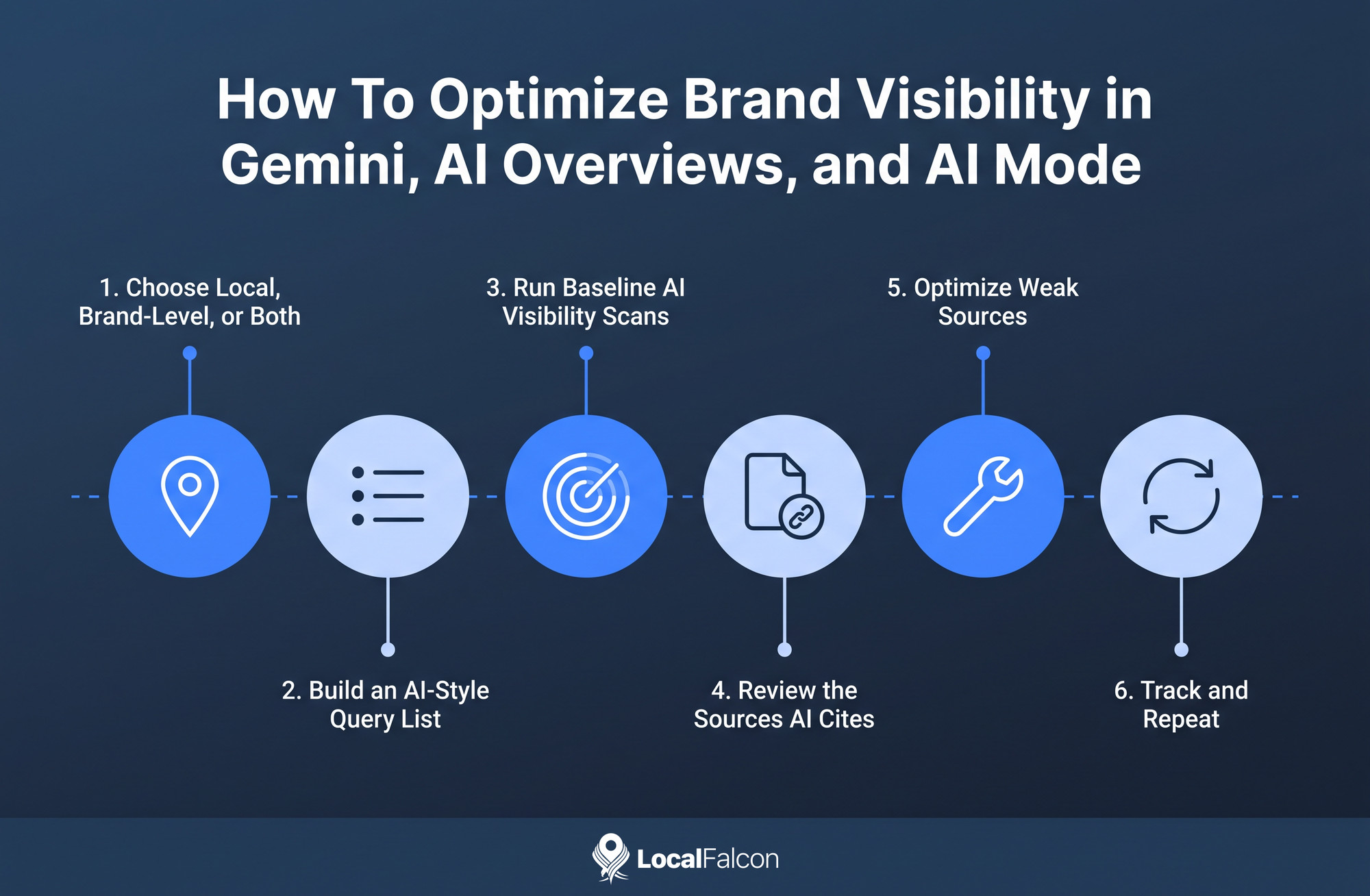
To optimize brand visibility in Google Gemini, AI Overviews, and AI Mode, you need a process that measures where you appear, finds out why (or why not), and fixes the gaps in the information Google's AI draws from when generating answers. The six steps below cover that process from start to finish.
How To Optimize Brand Visibility in Google Gemini, AI Overviews, and AI Mode (Step-by-Step)
1. Determine whether you need local AI visibility, brand-level visibility, or both
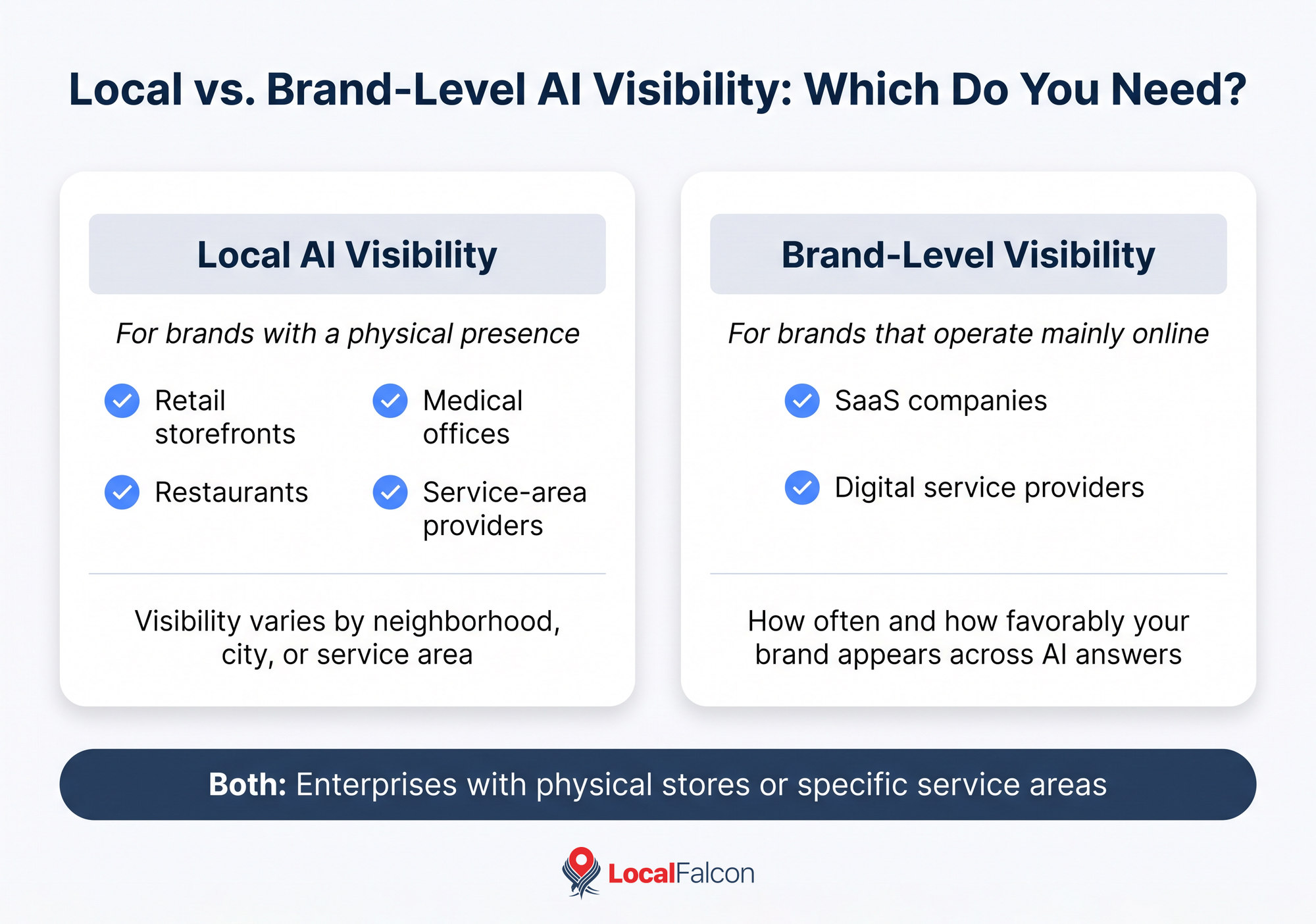
Before you track or optimize anything, decide which type of visibility your business depends on.
Brands with a physical presence, such as retail storefronts, medical offices, restaurants, or service providers with defined service areas, need local AI visibility and should prioritize it. For these businesses, AI recommendations depend heavily on where the searcher is or what geographic terms they include in their prompts, so visibility can vary greatly from one neighborhood, city, or service area to the next.
Brands that operate mainly online, such as SaaS companies and digital service providers, should prioritize brand-level visibility. Their customers aren't tied to a location, so the question to answer is how often and how favorably the brand appears across AI answers in general.
Many businesses need a mix of both. A large global enterprise may focus mostly on brand-level visibility, but if it runs physical stores or serves specific areas, local visibility matters just as much. Understanding the difference between local and brand-level visibility ensures you know what to measure, where to measure it, and how to prioritize the work that follows.
2. Build a list of AI-style search queries representative of how your customers search
AI search queries tend to be longer and more conversational than traditional keywords. Customers describe a problem, add context, or ask for a recommendation outright.
You can't cover every possible prompt, so aim for a list that covers as many angles as possible. Include:
- Each service or product you offer
- The problems your customers are trying to solve
- Comparison and "best option" style questions
- Variations in phrasing, from shorter queries to full sentences
Customer emails, sales calls, reviews, and support tickets are good sources for this language. Local Falcon's local keyword research tool also generates lists of AI-style search terms for local brands.
As you come up with the prompts to track, remember that the goal is a representative set you can monitor consistently and learn from, not an exhaustive one that becomes overwhelming and hard to act on.
3. Run baseline AI visibility scans
With your query list ready, establish where you stand today. An AI visibility tracker lets you measure how often your brand appears across Google's generative AI search features and, where relevant, across the geographic areas that matter to your business.
For local brands, Local Falcon is a good place to start. It produces local AI visibility grids that show how your visibility changes from one point on the map to the next, which makes weak areas easy to spot.
When you review results, look at these metrics:
- Share of AI Voice (SAIV): how often your brand appears in AI answers compared to competitors
- Average ranking: how prominently you appear within answers (this reflects prominence in the response and is not a true ranking position like those in traditional search)
- Sentiment analysis or Buyer Persuasion Score (BPS): how favorably the AI describes your business, if your tool offers it
Local Falcon reports all of these, but not every tool does, so check what a platform measures before you commit to it.
Whatever tool you choose for Google AI rank tracking, a baseline gives you something to measure against. If you start tracking after you've already made changes, it's harder to tell what moved your results.
4. Look at the sources AI cites when recommending your business and competitors
When Google's AI builds an overview or recommendation, it draws on specific sources. Reviewing those sources for your business and your competitors shows you where the AI is getting its information.
Pay attention to patterns. You may find that competitors are cited from listicles and round-up articles you aren't part of, that a certain review platform appears repeatedly, or that the AI relies on a directory with outdated details about your business. Each pattern points to a specific place to focus your work.
5. Optimize sources where visibility is weak
Start with the locations and queries where your visibility is lowest, since those offer the most room to improve.
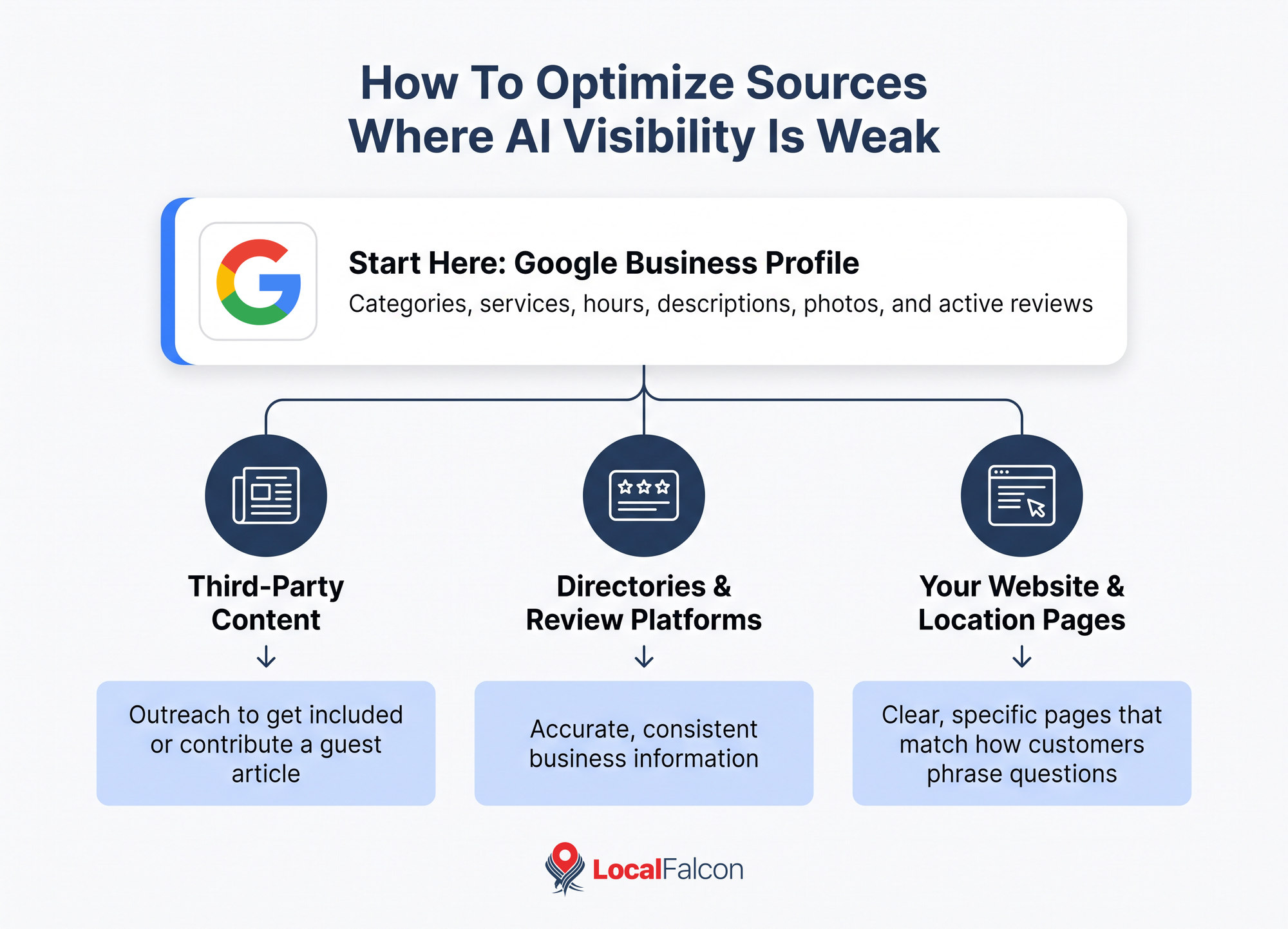
For local businesses, your Google Business Profile is one of the largest inputs into Google's AI results, so optimize it before anything else. Confirm that your categories, services, hours, descriptions, photos, and other details are complete and accurate, and keep your reviews and responses active.
Then work through the other sources the AI cites for your queries. These commonly include:
- Third-party website content, such as listicles, blog posts, round-ups, and news articles
- Directory and review platforms
- Your own website and location pages
Each source calls for a different approach. For third-party content, that may mean outreach to get included or contributing a guest article. For directories, it means accurate and consistent business information. For your own site, it means clear, specific pages with content that matches the way customers phrase their questions.
Working through these sources methodically is an effective way to improve visibility in AI Overviews and across Gemini and AI Mode.
6. Track and repeat
As with traditional rank tracking, AI visibility tracking is never finished. Results change as competitors publish new content, sources get updated, and Google adjusts how its AI features work.
Ongoing brand-level or local AI visibility tracking helps you:
- Spot performance trends early
- Find new optimization opportunities
- Monitor how competitors perform
- Connect specific optimizations to changes in your results
Rerun your scans on a regular schedule, compare them against your previous performance, and repeat steps four and five wherever visibility is still weak.
Conclusion
To optimize brand visibility in Google Gemini, AI Overviews, and AI Mode, start by deciding whether local or brand-level visibility matters most to your business. Build a realistic list of customer queries, measure your baseline, find out which sources the AI relies on, and improve the ones where you're underrepresented. Then keep tracking, because the results will keep moving.
FAQs
Is optimizing for Google's AI search features different from traditional SEO?
They overlap, but they aren't identical. Traditional SEO focuses on ranking pages, while AI visibility optimization revolves around ensuring your brand is mentioned and recommended in AI-generated answers, which are more dynamic than traditional rankings.
How often should I track AI visibility on Google?
Run a baseline first, then scan on a consistent schedule so you can compare results over time. Weekly, bi-weekly, or monthly works for most businesses, depending on how competitive your market is.
Do small local businesses need to worry about brand visibility in AI Overviews, AI Mode, and Gemini?
Yes. Customers use Google's AI features to find local businesses, and local results vary by location, so small businesses can gain or lose AI visibility block by block.
What is the most important source to optimize for local AI visibility on Google?
Your Google Business Profile. Optimize it first, then address the other sources the AI cites.
Can I control what Google's AI says about my business?
Not directly. You can influence it by keeping your GBP, website, and other listings accurate and optimized, by getting a steady flow of detailed positive reviews, and by earning mentions in the third-party sources Google's Gemini AI model draws from.