Earning customers via Google used to be accomplished via a fairly straightforward path for local businesses. You earned a spot in the local pack, kept your Google Business Profile in good shape, and watched your Maps rankings climb, and along with them your clicks, calls, and visits. That still matters, but it no longer tells the whole story. A growing number of people now ask Google a question, read the AI-generated answer, and pick a business without ever clicking through to a website or scrolling a list of results.
That change has created a new measurement problem. If Google's AI is recommending your competitors instead of you, none of your traditional local ranking reports will show it. This guide explains how Google AI rank tracking works, why it matters for local businesses, and how to start measuring your visibility across Google's AI search tools.
What Is Google AI Rank Tracking?
Google AI rank tracking is the practice of measuring how often and how prominently your business appears in Google's generative AI search experiences. As of fall 2026, this covers three main products:
- Google AI Overviews: AI-generated summaries that appear at the top of standard Google search results.
- Google AI Mode: A conversational search experience where users ask longer, more detailed questions and get synthesized answers.
- Gemini: Google's standalone AI assistant, which people increasingly use to ask for local recommendations.
This isn't the same as traditional rank tracking. In the local pack or on Google Maps, businesses appear in a ranked list, and your position (say, 3rd out of 20) is a clear number. AI responses don't work that way. There's no consistently ranked list, and the businesses mentioned can vary a lot from one response to the next, even for the same prompt.
You can still assign a kind of pseudo ranking for AI visibility based on prominence, meaning the order in which your business is mentioned within an AI-generated answer. Being named first generally carries more weight than being named fourth, but that's not the most important performance indicator.
The metric that matters most is Share of AI Voice (SAIV). SAIV measures how often your business gets mentioned across a set of AI responses. If your business appears in 30 out of 100 responses to a relevant prompt, your SAIV is 30%. Because AI answers vary so much, looking at a pattern across many responses gives you a far more reliable picture than any single answer ever could.
Why Do Local Businesses Need Google AI Rank Tracking?
Local Pack Rankings Are No Longer Enough
Ranking in the local pack and showing up on Google Maps used to capture most of the customers searching for a nearby business. Today, a meaningful share of those customers are getting answers directly from AI. They ask something like "who's the best emergency plumber near me" and act on whatever Google's AI says. These are zero-click results: the decision is made inside the AI response, and your website never gets the visit.
If your business isn't mentioned in that response, you're invisible to those customers, no matter how well you rank elsewhere.
AI Visibility Is Local Too
Traditional local rankings change depending on where the searcher is standing and which geo-modified keywords they use. A business might rank first one block from its location and not appear at all two miles away. AI responses follow the same logic. Google's AI factors in the user's location and the wording of the prompt, so the businesses it recommends can differ from one neighborhood to the next.
This means local businesses don't just need brand-level Google AI rank tracking. They need location-specific tracking that shows how often and how prominently they appear across the areas their customers actually come from, whether that's a city, a neighborhood, or multiple service areas.
Location-specific AI visibility data is especially useful for multi-location businesses. It lets you compare visibility from one city, neighborhood, or service area to the next, so you can see which markets locations are performing well in and which need the most attention.
Tracking Citations Shows You What to Fix
Knowing how you perform across Google's generative AI search experiences is only the beginning. Google's AI builds its answers from sources that mention your business, and those sources are called citations. By tracking the citations AI uses for your business and your competitors, you can see exactly which websites, directories, and pages are shaping what Google's AI says.
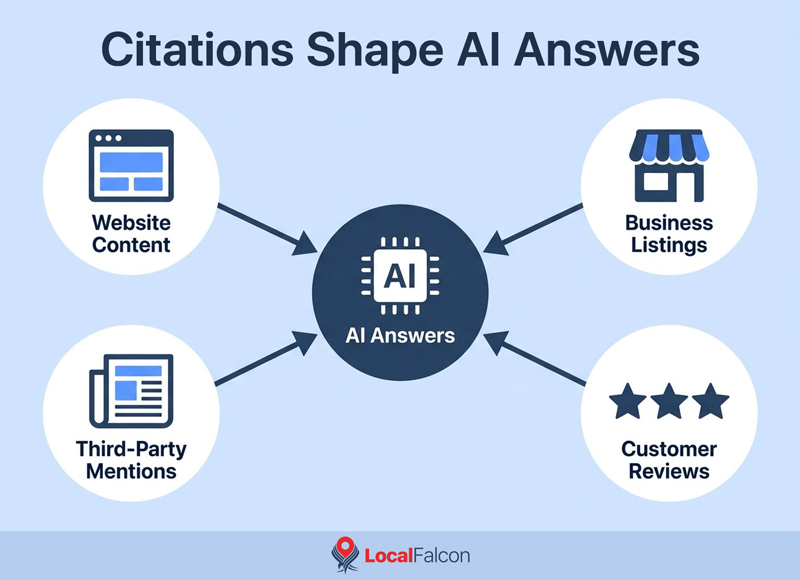
That gives you something to act on. You can update and optimize the sources that influence AI answers about your business, such as your website content, your business listings, your reviews, and your earned third-party mentions. Ongoing Google AI rank tracking then shows whether those changes are working over time, turning winning AI visibility from a guessing game into a measurable, repeatable process.
How Local Businesses Can Get Started With AI Rank Tracking for Google
Getting started requires a local AI visibility tracker built for this purpose. Checking a few prompts by hand won't work, because AI responses vary so much by location and from one response to the next. A single manual check tells you very little.
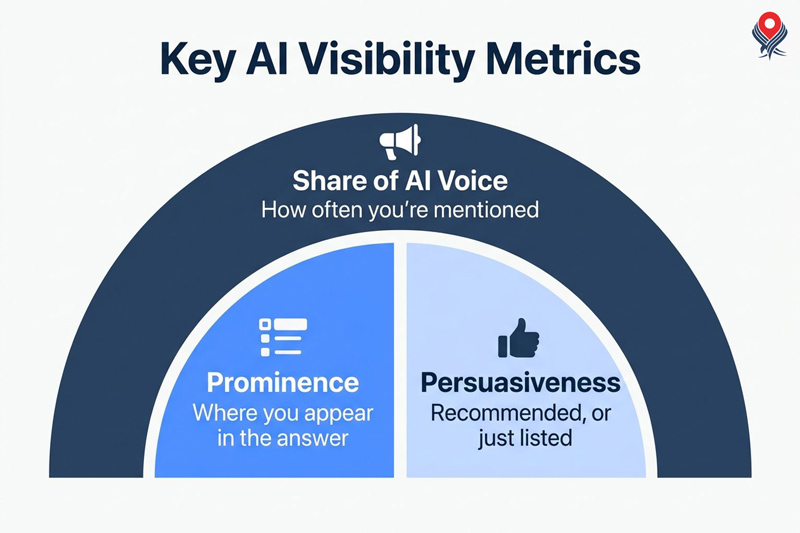
Local Falcon is designed to solve this problem. It runs the same AI prompt, a local search query a customer would actually use, across a defined geographic area. From there, it measures:
- How often the AI mentions your business, reflected in your Share of AI Voice.
- How prominently it's mentioned, based on where your business appears in the sequence of businesses in each response.
- How persuasive the AI's language is, meaning whether the AI describes your business in a compelling, recommendation-worthy way or simply lists it.
Local Falcon supports tracking AI visibility across Google AI Overviews, AI Mode, and Gemini, so you can see how your business performs in each of Google's generative AI search experiences rather than relying on a single data point from a single-platform spot-check.
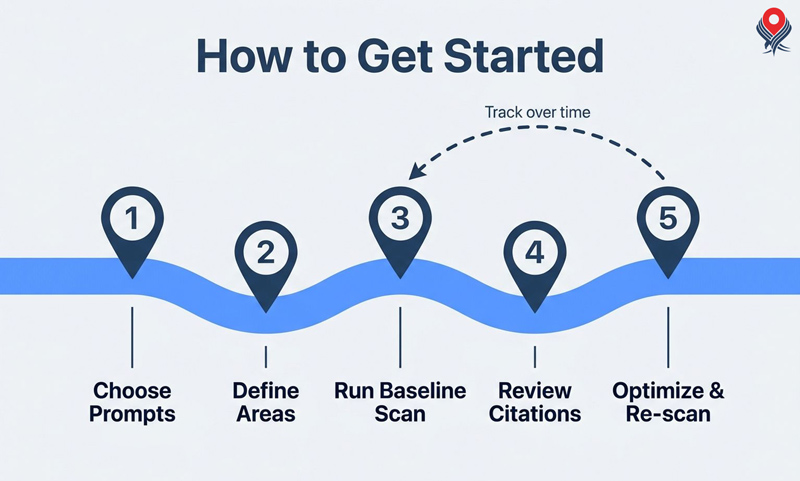
Here's a quick way to get started:
- Choose the prompts that matter: Start with the queries your best customers would ask, including terms related to your core services plus location terms.
- Define the areas you want to measure: Pick the city, neighborhoods, or service area where you want to be found.
- Run a baseline scan: Measure your current SAIV and prominence (average rankings) so you have something to compare against.
- Review citations: Look at the sources AI relies on for you and your competitors, and note which ones you can improve.
- Optimize and re-scan: Make updates, then track results over time to confirm they're moving the numbers.
Wrapping Up
Google's AI is now a major part of how people find and choose local businesses. Traditional rankings still drive a lot of business, but tracking them doesn't show you whether AI is recommending you, how often, or how convincingly.
Google AI rank tracking fills that gap by measuring your visibility across AI Overviews, AI Mode, and Gemini, and by giving you a location-specific view of how you perform where your customers actually are.
The businesses that start tracking now will understand their position sooner, spot opportunities earlier, and be better placed to improve as Google continues to expand its generative AI search experiences. A baseline scan takes little effort, and it's the clearest way to find out what Google's AI is saying about your business today.
FAQs on Google AI Rank Tracking
What is Google AI rank tracking?
It's the practice of measuring how often and how prominently your business appears in Google's AI search experiences, including AI Overviews, AI Mode, and Gemini.
How is Google AI rank tracking different from traditional rank tracking?
Traditional tracking reports a fixed position in a list, like the local pack. AI responses have no consistent list, so tracking focuses on Share of AI Voice and on where your business is mentioned within each answer.
What is Share of AI Voice for AI rank tracking on Google?
Share of AI Voice (SAIV) is the percentage of AI responses that mention your business out of a set of responses to the same prompt. It shows how consistently you get recommended.
Does Google AI rank tracking need to be location-specific?
For local businesses, yes. Google's AI factors in the searcher's location, so results differ by city and neighborhood. Location-specific tracking shows how you perform across the markets you actually serve.
Can I track Google AI visibility for multiple locations?
Yes. A local AI visibility tracker like Local Falcon lets multi-location businesses compare results from one location or service area to the next.