
As AI-driven discovery continues to reshape how people find businesses online, tracking AI search performance through the right KPIs has become essential. Traditional SEO metrics like clicks and impressions now only tell part of the story, as AI search experiences are introducing new layers of visibility that require new ways to measure success.
AI visibility KPIs help businesses understand how often, where, and in what context their brand appears across AI-powered platforms and search features like Google AI Overviews and ChatGPT.
With tools like Local Falcon, businesses and SEO professionals can finally visualize and quantify this performance, gaining actionable insights to strengthen their local AI search presence. That being said, we'd also love to see Google and other AI-driven search platforms introduce their own AI visibility tracking metrics and dashboards. The more data, the better!
What Are AI Visibility KPIs?
AI visibility KPIs, or key performance indicators, are the metrics businesses can use to understand how visible and discoverable they are within AI-driven search environments. As search continues to evolve beyond traditional ranked results into AI-generated summaries, recommendations, and conversational responses, these KPIs are becoming essential for gauging brand presence in the new discovery landscape.
Tracking AI visibility is all about understanding how your brand appears, performs, and is represented in AI-driven contexts. Whether that's in Google's AI Overviews, ChatGPT search results, or other emerging AI discovery platforms, visibility within these experiences increasingly determines how customers find and evaluate businesses online, going beyond traditional metrics like organic search traffic.
For multinational brands and local businesses alike, measuring and optimizing for AI visibility is critical to staying competitive. As AI becomes a primary interface between users and search engines, the companies that learn to interpret and act on these new visibility signals will have a significant advantage in reaching their audiences first.
In short, AI visibility KPIs help marketers bridge the gap between traditional SEO metrics and the next generation of AI-powered search performance, offering insights into how well a business is adapting to this rapidly changing search ecosystem.
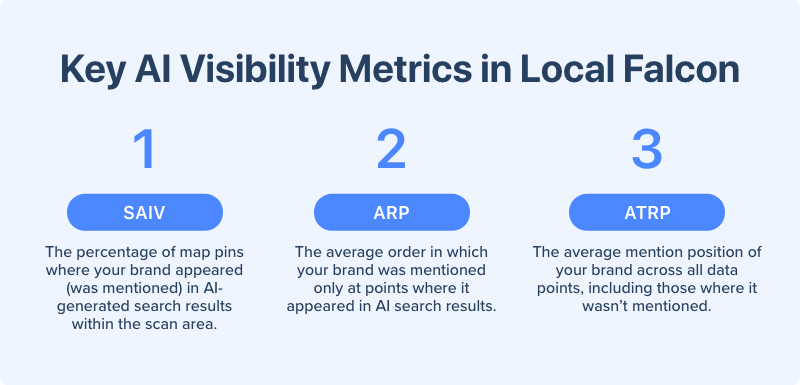
Key AI Visibility Metrics in Local Falcon
When tracking AI visibility in Local Falcon, there are a few important metrics businesses should pay attention to:
Share of AI Voice
A business's Share of AI Voice (SAIV) is the most important AI search visibility KPI you need to understand and track.
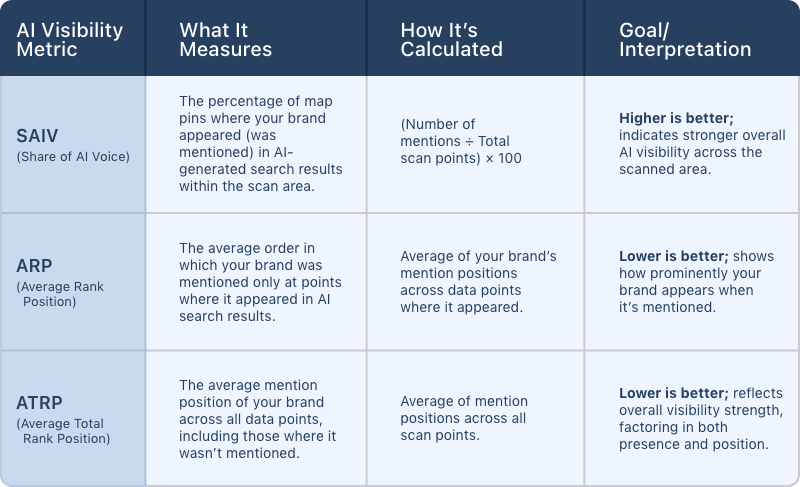
Regardless of whether you're tracking AI visibility for Google AI Overviews, ChatGPT, or any of the other data sources available to track in Local Falcon, your SAIV represents the percentage of map pins where your brand appeared (i.e., was mentioned) in an AI search result for the scanned area. In other words, a higher Share of AI Voice means your brand is more visible in AI search.
For example, let's say you run a scan for your Google AI Overview visibility, and the SAIV score is 35.8. This would mean that your brand is mentioned in AI Overview summaries for 35.80% of the results found in the scan. For a scan with a 9x9 geo-grid, this translates to appearing in AI Overviews for 29 data points, out of 81 total possible points.
As you continue to track and optimize your Google AI Overview visibility, the goal is to increase your Share of AI Voice, so that your brand is mentioned more frequently when users see AI Overviews for Google Search results in your area.
While the goal is always to increase your Share of AI Voice, it's also important to compare your score to that of competitors. An SAIV of 35.8 might sound low, but if all your top competitors have lower SAIV scores, it's a strong indicator that you're dominating AI search results!
ARP & ATRP
ARP and ATRP stand for Average Rank Position and Average Total Rank Position, respectively.
Your brand's AI ARP score is an average of the sequence it was mentioned in across AI-generated results only for data points it was mentioned in at all. So, if your brand was mentioned first across a total of 16 data points, your ARP would be 1.
Your AI ATRP is the average position your brand was mentioned in across all AI-generated results. This means that if your brand was mentioned first at 16 out of 81 data points, your ATRP would be 3.15.
Just like with traditional local search rankings, lower ARP/ATRP scores are always better, as they indicate that users are seeing your business name before others (even though AI search tools don't "rank" businesses in the traditional sense).
When taken alongside your SAIV score, your ARP and ATRP scores give you a Falcon's-eye view of how strong your brand's AI search visibility is.
Comparison of Local Falcon's AI Visibility Tracking KPIs:
Are There Any AI Visibility Metrics in Google Search Console?
At the moment, Google Search Console doesn't offer any way to view AI Overview or AI Mode performance metrics separately. This means that impressions, clicks, and queries that originate from Google's AI-powered search experiences are rolled into your overall Search Console data alongside traditional search result data.
In other words, when someone sees your website cited as a source within an AI Overview or clicks through to your website from an AI Mode result, that visit simply appears as a standard impression or click in your performance report. There's no way to filter or isolate AI Overview/AI Mode traffic, and Google hasn't yet introduced a specific report or data field to distinguish between traditional and AI-driven search visibility.
The same limitation applies to Google Business Profile (GBP) Performance metrics. Any GBP engagement your business gains through AI-powered local results, such as AI Overviews that recommend nearby businesses or pull in GBP data, is also grouped together with standard Google Business Performance insights.
Google hasn't announced plans to provide AI visibility-specific reporting within Search Console, either. For now, businesses and SEO professionals can only make educated estimates about Google-driven AI visibility by monitoring broader performance shifts within Search Console, such as changes in impressions, clicks, and query mix, that may coincide with increased exposure through Google's AI Overviews or AI Mode.
Unless Google introduces AI-specific reporting filters within Search Console, precisely tracking AI visibility for Google AI Overviews and AI Mode requires using a third-party tool like Local Falcon.
Do Any AI Search Tools Offer Built-in KPI Tracking?
Right now, the AI search tools driving significant visibility for brands don't offer any kind of built-in analytics or KPI tracking. But as AI-powered discovery becomes more common, this lack of insight presents a major challenge for businesses trying to understand how people are finding them through these emerging channels.
From an industry standpoint, it would be extremely valuable to see AI search tools introduce built-in dashboards for tracking key performance metrics. Ideally, these would mirror the types of data marketers already rely on for traditional search, such as search queries, impressions, and clicks. For local businesses, integrating Google Business Profile-style insights like phone calls, driving direction requests, and website visits would make these dashboards even more useful.
Even more exciting would be the ability to track performance across directories and third-party listings within AI-generated results. Imagine being able to see when someone clicked on your Yelp, Tripadvisor, or other directory listing after encountering it in an AI search response. That level of visibility would help brands understand not only how AI search tools are surfacing their information, but also which platforms are driving the most engagement.
FAQs About AI Visibility Tracking KPIs
What's the difference between AI visibility and traditional search visibility?
Traditional search visibility focuses on ranked listings in search results, while AI visibility measures how often your business is mentioned or featured within AI-generated content, such as summaries, recommendations, or conversational responses.
Can I track AI visibility in Google Search Console?
Not yet. Google currently combines AI and traditional search data for users, meaning there's no way to view AI-specific impressions, clicks, or queries separately.
Why is Share of AI Voice such an important metric?
Share of AI Voice (SAIV) shows how frequently your brand is mentioned across AI search results in a given area. It's one of the clearest indicators of how visible and competitive your business is within AI-driven search experiences.
Do AI search tools offer their own analytics dashboards?
Currently, they do not. From an industry standpoint, there's strong demand for built-in KPI dashboards that would track metrics similar to Google Search Console and Google Business Profile, such as impressions, clicks, calls, and direction requests.
What tools can help measure AI visibility right now?
Local Falcon is one of the first platforms to introduce dedicated AI visibility tracking for local businesses, including AI-specific KPIs like Share of AI Voice, Average Rank Position, and Average Total Rank Position.
Conclusion
AI search isn't some distant future. It's already shaping how customers discover, evaluate, and choose businesses every day. But without the right data, it's impossible to know whether your brand is being seen or silently passed over in those moments.
That's what makes AI visibility tracking so powerful. Metrics like Share of AI Voice, ARP, and ATRP show precisely how prominently you're being represented in this new AI-driven search landscape. Combined, they give you a clear roadmap for understanding your position in the emerging world of intelligent brand discovery.
As Google, ChatGPT, and other AI platforms continue to redefine what "search" means, the businesses paying attention to these signals now are the ones that will own visibility tomorrow. AI visibility tracking tools like Local Falcon aren't just helping marketers adapt; they're giving them a measurable advantage in an era where visibility in AI results could matter as much as being ranked on page one of traditional search results once did.