
Search engine optimization has been around for decades, yet SEO myths continue to circulate — especially when it comes to local search. Some of these misconceptions are leftovers from earlier eras of SEO, while others are fueled by half-truths, outdated advice, or oversimplified "rules" that don't reflect how local search actually works today.
Believing the wrong things about SEO doesn't just slow growth — it actively leads businesses to prioritize the wrong tactics, misinterpret performance, and miss real opportunities for visibility. This is especially true in local SEO, where rankings are influenced by geography, behavior, platforms, and increasingly, AI-generated results.
Below, we'll break down some of the most persistent local SEO myths, explain why they're misleading, and outline what actually matters if you want to compete in modern local search.
Myths About SEO and Local Search To Stop Believing Today, Plus What To Do Instead
Myth #1: Google Rankings Are the Only Thing That Matters for Local SEO
There's no denying it: Google Search and Google Maps still drive a massive share of customer discovery for local businesses. Rankings matter. Visibility in the local pack matters. But believing that Google rankings are the only thing that matters is one of the most limiting myths about SEO and local search today.
Local SEO has expanded far beyond a single platform.
Modern local visibility includes:
- Google Search and Maps — still huge drivers of digital and foot traffic, generating leads and sales
- Apple Maps — powers increasing numbers of searches across iOS devices and is also available on the web
- Yelp and Tripadvisor — reputable citation and review platforms that still influence consumer trust and discovery in many industries and have a direct impact on both traditional and AI visibility
- Industry-specific directories (healthcare, hospitality, legal, home services, and more) — important citations that contribute to traditional and AI search visibility
- And most importantly, AI-driven search experiences — more and more customers every day are choosing businesses based on AI-generated information and recommendations
AI assistants and generative search results don't just pull information from Google Business Profiles. They synthesize information from a wide range of sources to decide which businesses to mention and how to describe them. If your business only exists in Google's ecosystem, you're potentially invisible in many of the places customers now search.
Local SEO today is about system-wide visibility, not just a single ranking snapshot.
Myth #2: There's a Specific Number of Reviews You Need to Rank on Google Maps
"If I just get 50 reviews, I'll rank."
"If I hit 100 reviews, I'll dominate."
This is one of the most common local SEO myths, and it's dangerously oversimplified.
Our recent large-scale review research shows that there is no universal review threshold that guarantees rankings. Instead, review requirements are highly dependent on business category and location.
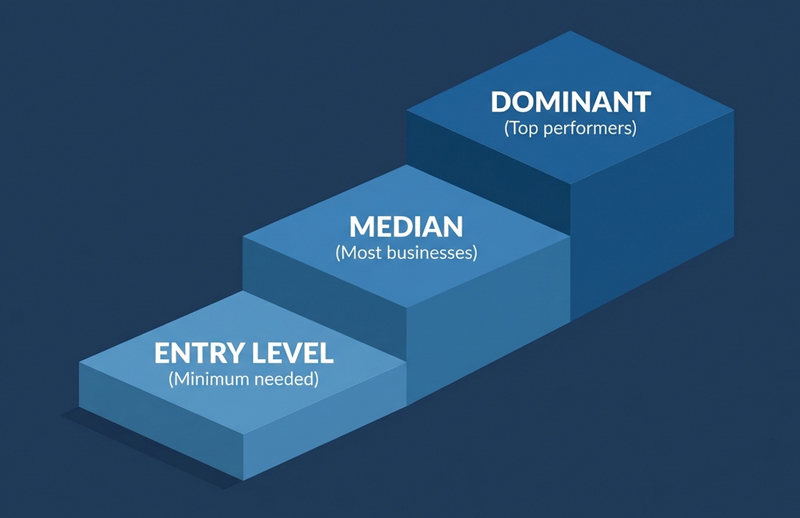
Every business category effectively has three benchmarks:
- An entry-level number: the minimum review count needed to compete at all
- The median: what most businesses appearing in the local pack have
- A dominant number: what top-performing businesses (those in the 90th percentile) have accumulated
A dentist, a hotel, and a fast-food restaurant all operate under very different review expectations. On top of that, geography acts as a multiplier — businesses in dense urban markets generally need more reviews to compete than those in rural or suburban areas.
Other review-related factors matter too:
- Average star rating, which tends to be fairly consistent across most competitive categories
- Review recency, which signals ongoing customer engagement
- Velocity, or how consistently new reviews are coming in
In short, review strategies shouldn't focus on hitting a magic universal number, but rather on matching and exceeding the competitive baseline in your specific market.
Myth #3: You Need a Physical Office to Rank in Local Search
This myth causes unnecessary stress for service-area businesses — and sometimes leads them to break Google's guidelines trying to "look" more legitimate.
The truth: You do not need a public-facing office to rank in local search.
Service-area businesses (SABs) are allowed — and encouraged — to:
- Hide their physical address in Google Business Profile
- Define service areas instead
- Compete normally in local results
Plumbers, electricians, cleaners, landscapers, and countless other service providers rank perfectly well without customers ever visiting a physical office.
That said, there are scenarios where having a physical location can improve performance — especially in hyper-competitive markets where proximity heavily influences rankings. A brick-and-mortar office can act as a strong proximity signal in certain zones.
The key takeaway here is: don't fake an office you don't have — but do recognize that physical locations can sometimes provide a competitive edge when expansion is realistic.
Myth #4: Keywords in Reviews Don't Matter
You'll often hear this framed as: "Google ignores keywords in reviews."
That's not entirely true — and this local SEO myth misses the bigger picture.
While review keywords are not a direct, controllable ranking factor in the traditional sense, they absolutely provide meaningful secondary benefits.
Keywords in reviews can:
- Influence how your GBP appears in local search results (e.g., review justifications/snippets, menu highlights, Place Topics, etc.)
- Help Google and other platforms better understand what customers associate with your business
- Shape AI-generated summaries and descriptions of your brand
As AI-driven local search grows, reviews are becoming one of the richest sources of customer language. When customers naturally mention services, products, neighborhoods, or use cases, that language helps machines understand what your business actually does.
The goal here isn't keyword stuffing or scripted reviews — it's encouraging detailed, authentic feedback that reflects real customer experiences.
Myth #5: Citations Are Dead
Few statements in local SEO are as confidently wrong as this one.
Citations are not only alive and well — they are more important than ever in the AI era.
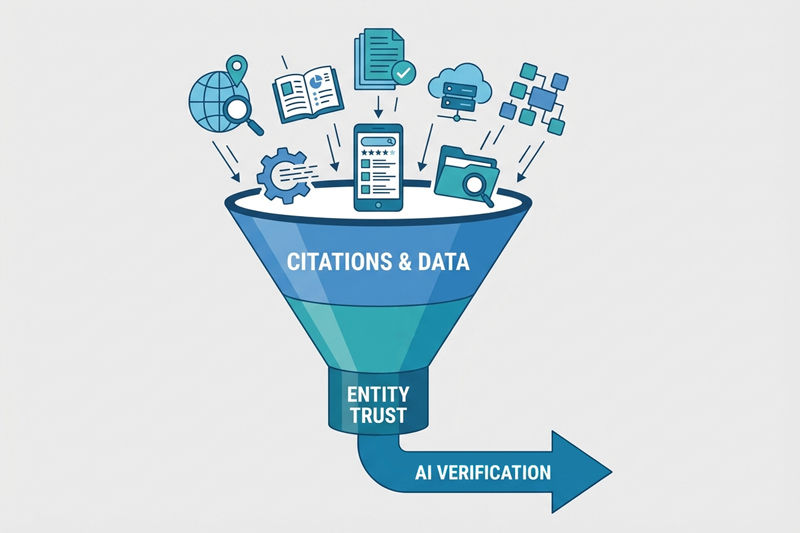
Citations (mentions of your business name, address, phone number, and details across the web) play a critical role in:
- Establishing entity trust
- Helping AI systems verify that your business is real, relevant, and notable
- Influencing which businesses AI chooses to mention in generative responses
However, not all citations are equal.
Quantity alone is no longer the goal. Citation quality matters even more than it used to. Businesses should focus on:
- Platforms that AI models frequently reference
- High-authority directories and industry-relevant sites
- Consistency and accuracy across those sources
In short: citations aren't dead — they've evolved from a volume game into a credibility game.
Myth #6: Adding Geotagged EXIF Data to Images Helps Rankings
This is a local SEO myth that refuses to die.
EXIF data refers to metadata embedded in image files, sometimes including GPS coordinates where a photo was taken. The belief is that uploading images with geotagged EXIF data to Google Business Profile boosts local rankings.
There is simply no credible evidence that this works.
Google strips or ignores most EXIF metadata upon upload, and Google representatives have repeatedly stated that EXIF geotagging is not used as a local ranking factor.
What does matter with images:
- Uploading real, high-quality photos regularly
- Showing your location, team, and services authentically
If you're spending time manually geotagging images, you're wasting effort that could be better used elsewhere.
Myth #7: You Can't Beat Proximity "Walls"
Proximity is one of the strongest — and most frustrating — ranking factors in local SEO.
Many businesses experience "visibility walls," where they simply cannot outrank competitors in certain areas because those competitors are physically closer to the searcher. This is especially common in dense markets with clusters of similar businesses.
While it's true that proximity is difficult to optimize, it's not impossible to work around.
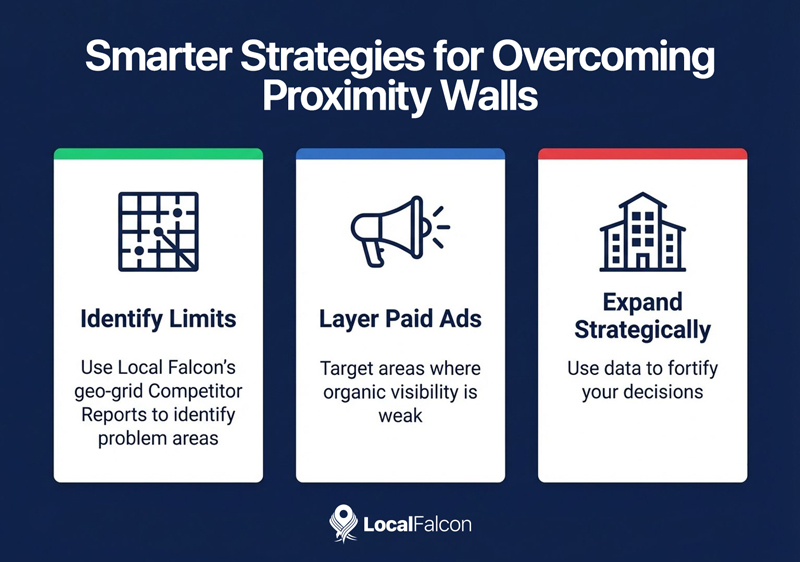
Smarter strategies include:
- Using Local Falcon's geo-grid Competitor Reports to identify exactly where competitor proximity limits performance
- Layering paid ads (i.e., Local Services Ads and/or Google Ads) in areas where organic visibility is capped
- Strategic expansion, such as opening an additional location once data clearly supports the opportunity
The mistake is assuming nothing can be done. Proximity walls aren't dead ends — they're signals that your strategy needs to adapt.
Final Thoughts: Myths Thrive When You Can't See the Full Picture
Most local SEO myths persist because businesses are forced to rely on partial signals — single rankings, average review counts, or assumptions about proximity — without seeing how those factors actually play out across a real market.
Once you can clearly see how visibility changes by location, how competitors dominate specific areas, and where factors like reviews or proximity truly limit performance, many of these myths stop being convincing altogether.
Local SEO becomes less about guessing which rule to follow and more about understanding what's actually happening on the ground — and responding accordingly.
Local Falcon measures your local rankings and visibility across AI platforms and Google Maps, providing the granular visibility intelligence businesses need to stop believing in local SEO myths and start acting on data-backed realities. Give it a try today!