
Content marketing has long been a cornerstone of SEO strategy. For local businesses in particular, publishing authoritative, relevant content builds the topical depth and trust signals that drive local search visibility over time. But since generative AI, sometimes referred to as answer engines, took hold of search, content has taken on a second job.
Getting your content cited by AI, meaning referenced, summarized, and linked back to within AI-generated responses, is now a distinct search visibility objective, and one that requires a deliberate approach to content marketing strategy.
Platforms like ChatGPT, Perplexity, and Google's AI Overviews don't just index your content and spit out ranked lists of blue links for users to click on. They draw from it directly, synthesizing answers and recommendations that users receive without ever clicking through to your site.
This new type of AI-generated search results has produced a major consequence: click-through rates are declining across organic search as AI answers satisfy queries at the top of the results page or directly within a third-party platform, outside of traditional SERPs. Optimizing content for answer engines helps improve AI visibility in these new search interfaces.
Answer Engine Optimization (AEO): The practice of structuring and formatting web content so that AI-powered search platforms, including Google AI Overviews, AI Mode, Gemini, ChatGPT, and others, are more likely to cite it when generating zero-click answers for users.
How Content Marketing and AI Are Connected Now
The relationship between content marketing and AI search has been cemented. Large language models (LLMs) are trained on vast bodies of web content, and retrieval-augmented systems pull live content to generate answers on demand. Either way, your content is the raw material.
For local businesses, whether AI surfaces your business as a recommended plumber in your city or a trusted source on resolving accounting issues depends heavily on how your content is written, structured, and positioned.
In traditional content marketing, writers and SEOs optimized for two main areas: keywords and engagement. Answer-engine-oriented content marketing builds on traditional best practices by placing additional emphasis on structure.
AI systems need to be able to identify, isolate, and confidently cite a specific passage from your content. That changes how you approach everything from article structure to how you phrase definitions and answers.
The good news is that the foundations overlap. Well-written, well-structured content that answers real questions clearly has always performed well in search. AEO sharpens that discipline and makes it more intentional.
AI Content Marketing Strategy Best Practices
1. Lead Every Piece of Content With a Direct Answer
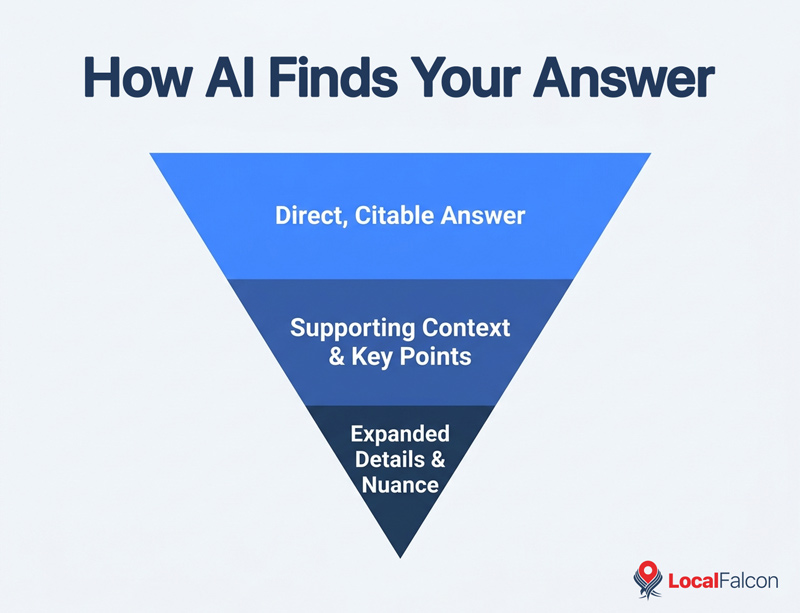
One of the most consistent behaviors across AI search systems is a preference for content that answers the question immediately, before expanding into context and detail. This mirrors the inverted pyramid structure that's been a best practice in journalism for over a century, but AI retrieval systems have made it more relevant to SEO.
When a local HVAC company publishes a blog post titled "How Often Should You Service Your AC in Florida?," the article should open with a clear, concise answer: "In Florida's climate, most HVAC professionals recommend servicing your air conditioning system twice a year." That sentence alone is something an AI Overview can extract and cite. Everything that follows, including seasonal tips, warning signs of issues, and cost ranges, supports the answer and builds the article's depth.
Compare that to an opening paragraph that spends three sentences on what Florida summers are like before getting to the point. AI systems don't reward preamble. They reward clarity.
Apply this pattern at the section level too, not just the article level. Each H2 or H3 subheading should be followed by a direct, self-contained answer to the implied question, typically in one to three sentences, before supporting paragraphs expand on it. This modular structure gives AI systems multiple extractable passages throughout a single article, increasing the chances that at least one of them gets cited.
2. Write to Target Questions, Not Just Keywords
Keyword research has always been the starting point for content marketing strategy. In an AEO context, that research needs to go one layer deeper: from keywords to the actual questions people ask at each stage of their decision process.
For a local law firm, "estate planning attorney Chicago" is a keyword. "What's the difference between a will and a trust?" is a question, and it's the kind of question that ChatGPT users ask directly. If that firm's blog answers that question clearly, accurately, and in plain language, it becomes a candidate for citation when AI systems respond to that query.
Building a question inventory is the first step. Pull from Google's "People Also Ask" boxes for your core topics, review the questions your team fields most often from clients or customers, and use an AI visibility tool like Local Falcon to test queries at scale and see what sources AI cites. That last step is particularly useful for identifying content gaps, places where your competitors are visible in AI responses and you aren't.
Once you have a question inventory, map each question to a piece of content. Some will already have homes in existing articles and just need clearer direct-answer formatting. Others will reveal genuine gaps worth filling. Prioritize questions that are high-intent and specific: "What permits do you need to build a fence in [city]?" is more actionable than "What is a building permit?" and more likely to surface your local landscaping company in relevant AI results.
3. Structure for Extraction: Formatting Choices That Get Content Cited
The way you format content at the HTML level affects whether AI systems can parse and extract it effectively. This is one area where AI in SEO and content marketing has introduced real technical considerations for content teams, not just strategists.
A few structural principles that consistently improve AI extractability:
- Answer-style H2s and H3s work better than clever or vague headings.
- Numbered lists and bullet points improve the parsability of process-oriented or comparison content.
- Comparison tables are high-value for AI citation.
- Definition blocks, or short, clearly labeled explanations of a term or concept, are among the most-cited content formats in AI responses.
- FAQ sections are particularly powerful. A single well-constructed FAQ section at the bottom of an article can account for multiple AI citations from one page.
4. Build Topical Authority Through Content Depth, Not Just Coverage
AI systems, both during training and live retrieval, tend to favor sources that demonstrate consistent, deep expertise on a topic over sources that cover many topics shallowly. This is topical authority, and it's a more important concept for AI in SEO and content marketing than it has ever been for traditional SEO alone.
For a local business, this means developing a content cluster around the topics most relevant to your services and service area, rather than publishing isolated articles on whatever feels timely.
A local dental practice that publishes a comprehensive pillar post on cosmetic dentistry, supported by individual articles on teeth whitening, veneers, bonding, and smile makeovers, all internally linked and consistently reinforcing the same topical territory, builds a stronger AI visibility signal than a practice that publishes one article on cosmetic dentistry and moves on.
Internal linking matters here in a specific way. When AI retrieval systems crawl your site, coherent internal link structures help them understand the relationships between your content and confirm the depth of your expertise on a given topic. Anchor text should be specific and descriptive rather than generic ("compare dental veneer options" rather than "click here").
Fresh content also carries consistent weight. AI Overviews and similar systems show a preference for recency, particularly on topics where accuracy is time-sensitive. For a local real estate agent, a regularly updated post on current market conditions in their city will outperform an evergreen post that hasn't been touched in two years. Building a content refresh cadence into your AI content marketing strategy, not just a publishing cadence, is increasingly essential.
5. Credibility Signals Within the Content Itself
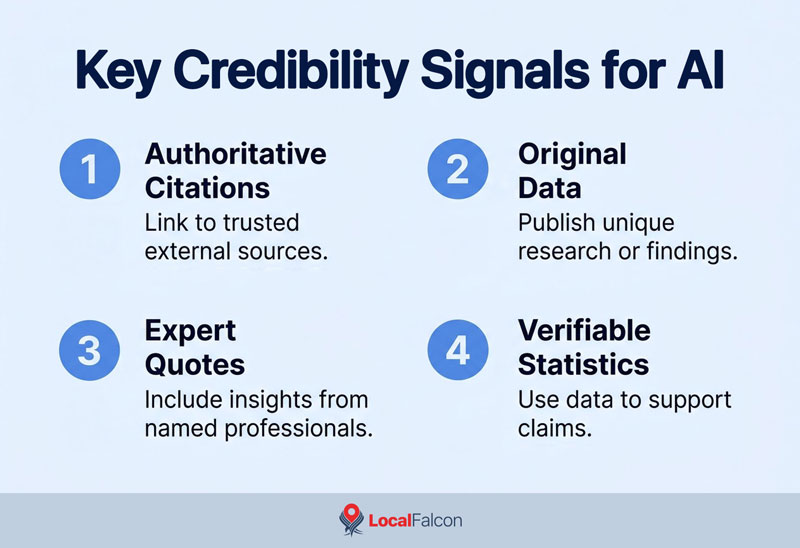
Research on AI citation behavior consistently points to credibility as a selection factor. Content that includes citations to authoritative sources, original data, expert quotes, and verifiable statistics is cited more frequently than content that makes claims without support. This applies directly to how you write and source your blog content.
For a local financial advisory firm, a post that references IRS guidance or cites data from a Federal Reserve survey is more likely to be trusted and cited than a post that makes the same claims without attribution. Linking out to authoritative sources isn't just good practice for readers; it's a credibility signal that AI systems recognize.
Original data is particularly valuable. If a local real estate brokerage surveys buyers in their market and publishes the findings, that data becomes uniquely citable. No other source has it. AI systems, which are optimizing for accurate and differentiated answers, are strongly incentivized to reference original research. Even small-scale original data, like a survey of your own clients or a year-over-year analysis of your service requests, has citation value because it doesn't exist anywhere else.
Author credentials and expertise signals matter too. Content published under the byline of a named professional with verifiable credentials performs better in AI visibility than anonymously authored posts. A local physical therapy clinic whose posts are authored and reviewed by licensed PTs, with credentials noted, is presenting AI systems with the kind of expertise signal that improves citation likelihood.
6. Demonstrate Local Authority in Your Content
For local businesses, AI content marketing strategy has a geographic dimension that national brands don't face in the same way. When someone asks an AI assistant for a recommendation, AI systems draw on content that demonstrates genuine local expertise, not just content that mentions location names.
Writing that reflects specific, accurate local knowledge performs better than content that could have been written from anywhere. An electrician's blog post that references local code requirements, common wiring issues in older homes in the area, or the permitting process specific to the county they serve is more credible to AI systems than a generic post about residential electrical work with the city name inserted in the title.
Hyper-local content (think: neighborhood guides, city-specific service comparisons, local regulation explainers) builds the kind of geographic authority that surfaces your business in AI results when location is a factor. A local moving company that publishes detailed content about the logistics and considerations of moving to and within different neighborhoods in their city is doing the content work that makes AI citation possible for those high-intent local queries.
7. Distribution and Off-Site Presence Amplify Content Visibility
AI systems don't evaluate your content in isolation. They assess authority partly through how your content and brand are referenced across the broader web. A robust AI content marketing strategy therefore extends beyond your own blog to the external environments where your expertise gets validated.
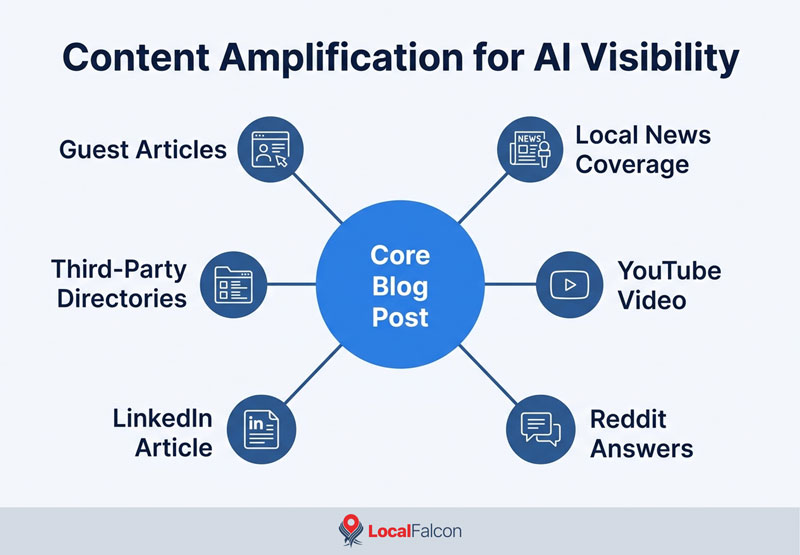
Guest articles in reputable industry publications, local news coverage, and mentions in third-party directories and review platforms all contribute to the authority profile that AI systems consider when deciding which sources to cite. A local restaurant that earns coverage in a regional food magazine, maintains an active and well-reviewed Google Business Profile, and is cited in local guide content has a meaningfully stronger AI visibility foundation than a restaurant with comparable food but minimal web presence outside its own site.
Repurposing blog content into formats that reach new platforms also strengthens this off-site signal. A local chiropractor who turns a blog post on posture correction into a YouTube video, a LinkedIn article, and a Reddit answer in a relevant health community is building multiple citation pathways for the same expertise. Each platform where your insights appear accurately and authoritatively adds another node in the web of references that AI systems use to evaluate credibility.
Putting It Together: An AEO Content Marketing Workflow
Bringing these principles into a practical workflow doesn't require starting your content marketing from scratch. It requires building new habits into the content creation processes you already have.
Before writing, identify the specific question each piece of content will answer and confirm it's a question your audience actually asks. During drafting, lead with the direct answer, use clear structural formatting throughout, support claims with sources or data, and include an FAQ section where relevant.
Before publishing, review whether section headings are question-oriented, whether the opening paragraph is immediately extractable, and whether schema markup has been applied. After publishing, monitor your visibility across leading AI platforms periodically to see whether your content is being cited for the target queries, and refresh when it isn't.
The relationship between content marketing and AI search isn't replacing what worked before. It's raising the bar for what "well-written" means. Content that is clear, authoritative, structurally sound, and genuinely useful to a specific audience has always performed well. In the current environment, it now has another measure of success: whether an AI answer engine trusts it enough to cite.