
Google reviews play an important role in how customers discover, evaluate, and choose local businesses. A steady stream of detailed, positive reviews helps a business build trust with potential customers, improves its visibility in local search, and provides valuable insights into the customer experience.
However, managing Google reviews effectively requires more than simply collecting positive feedback. Businesses need to monitor new reviews, respond to customer feedback, identify recurring issues, and maintain a consistent approach to reputation management.
As AI-powered search becomes more prominent, customer reviews also provide information that can influence how businesses are represented in AI-generated recommendations and summaries.
Whether you're managing a single Google Business Profile or overseeing dozens of locations, developing a comprehensive Google review management strategy can help you improve your online reputation and support your local and AI search visibility.
In this guide, we'll cover the best practices for managing Google reviews, including how to automate review responses, analyze customer sentiment, and optimize your business's reputation for both traditional local search and AI-powered business discovery.
How To Manage Google Reviews
Effective Google review management involves several ongoing activities, from monitoring customer feedback to responding to reviews and identifying opportunities to improve the customer experience.
Here are some of the most important practices businesses should follow.
Monitor New Google Reviews Regularly
The first step in managing Google reviews is making sure you know when customers leave feedback.
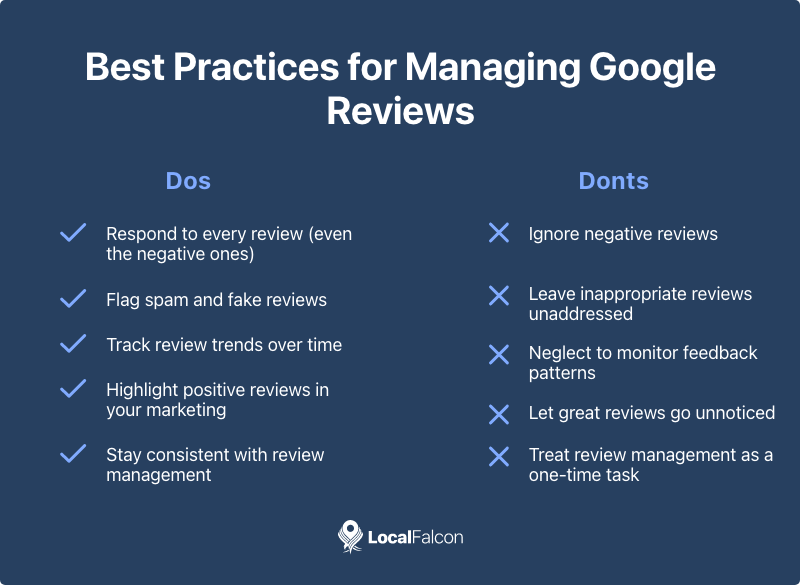
Regularly monitoring your Google Business Profile reviews allows you to identify new feedback, respond promptly, and address customer concerns before they become more significant reputation issues.
For businesses with a single location, manually checking Google reviews daily may be sufficient. However, businesses with multiple locations need a more scalable approach to review monitoring.
A centralized review management platform can help businesses monitor new reviews across multiple Google Business Profiles from a single dashboard. This makes it easier for corporate marketing teams and local managers to stay informed about customer feedback without having to check each location individually.
Consistent monitoring also helps businesses identify trends in customer sentiment, including recurring complaints or positive feedback about specific products, services, or employees.
Respond to Every Google Review
Responding to Google reviews demonstrates that a business values customer feedback and is committed to providing a positive customer experience.
Businesses should aim to respond to both positive and negative reviews. While negative reviews often require more attention, responding to positive feedback is also an opportunity to thank customers and reinforce the aspects of the business they appreciated.
When responding to positive Google reviews:
- Thank the customer for taking the time to leave feedback.
- Reference specific details from the review when appropriate.
- Keep the response friendly and professional.
- Avoid using identical responses for every review.
When responding to negative Google reviews:
- Acknowledge the customer's concerns.
- Apologize when appropriate and take responsibility for legitimate issues.
- Explain how the business intends to address the problem.
- Offer to continue the conversation privately when necessary.
- Avoid arguing with the reviewer or sharing confidential customer information.
Review responses are publicly visible, so they can influence how prospective customers perceive a business's customer service. A thoughtful response to a negative review can demonstrate accountability, while an unprofessional response may further damage the business's reputation.
Flag Fake and Inappropriate Google Reviews
Not every Google review represents a legitimate customer experience. Some reviews may contain spam, fake experiences, conflicts of interest, harassment, or other content that violates Google's review policies.
Businesses should regularly check their reviews for potential policy violations and report inappropriate content to Google when necessary.
However, it's important to understand that businesses cannot have legitimate negative reviews removed simply because they disagree with the customer's feedback. Google only removes reviews that violate its policies.
If a business receives a negative review that appears to be fake or inappropriate, it can report the review through its Google Business Profile or Google's Reviews Management Tool.
Analyze Google Review Sentiment and Customer Feedback
Google reviews often contain details that provide businesses with valuable information about customer experiences. However, simply monitoring review ratings and responding to individual reviews doesn't necessarily reveal the underlying trends in customer feedback.
Sentiment analysis helps businesses identify recurring themes in their reviews, understand what customers appreciate, and uncover opportunities to improve their products, services, and customer experience.
For example, a restaurant may discover that customers frequently praise its food quality but express concerns about wait times. A retail business may find that customers consistently appreciate its product selection but experience issues with customer service.
These types of insights can help businesses identify specific areas for improvement instead of relying solely on overall review scores.
For businesses managing multiple locations, sentiment analysis can also reveal differences in customer experiences between locations. Corporate teams can identify locations that consistently receive positive feedback about certain attributes, as well as locations where recurring customer complaints may require attention.
Local Falcon's AI Reviews Analysis tool can help businesses analyze their Google reviews and their competitors' reviews to identify customer sentiment trends, recurring topics, and opportunities to improve their reputation, whether it's for one location or hundreds.
Encourage Customers to Leave Google Reviews
A consistent flow of genuine customer reviews can help businesses maintain an active, engaging Google Business Profile and provide prospective customers with more information about what to expect.
Businesses should make it easy for satisfied customers to leave Google reviews by sharing a direct review link or QR code.
Some effective ways to encourage customers to leave reviews include:
- Sending follow-up emails after purchases or appointments.
- Including review request links in customer communications.
- Sharing QR codes at appropriate points in the customer journey.
- Asking customers for feedback after a successful service interaction.
However, businesses must be sure to follow Google's review policies. Review requests should be neutral and should not selectively solicit positive reviews. Businesses also cannot offer incentives in exchange for reviews or discourage customers from leaving negative feedback.
The goal should be to make it easy for all customers to share honest feedback about their experiences.

Develop a Consistent Google Review Management Strategy
Businesses should establish clear processes for managing Google reviews rather than relying on individual employees to handle feedback inconsistently.
A review management strategy should define:
- Who is responsible for monitoring reviews.
- How frequently reviews should be checked.
- How quickly responses should be provided.
- Guidelines for responding to different types of reviews.
- Which reviews should be escalated to management.
- How customer feedback should be used to improve operations.
For multi-location businesses, these processes are especially important. Corporate teams need to establish consistent brand guidelines, while local managers should have the flexibility to address location-specific customer concerns.
A centralized review management workflow can help ensure that every location follows the same standards while still allowing responses to reflect the individual customer experience.
How To Automate Google Review Management
Managing Google reviews manually can become increasingly difficult as a business receives more customer feedback or expands to additional locations.
AI-powered tools can help businesses streamline review monitoring, response generation, and sentiment analysis, reducing the amount of time required to manage their online reputation.
Automate Google Review Responses With AI
AI-powered review response tools can help businesses generate relevant, professional responses to customer feedback.
Instead of manually writing every review response, businesses can use AI to draft replies based on the content and sentiment of each review.
For example, an AI tool could generate a response thanking a customer for praising a particular service, while taking a more empathetic approach to a review describing a negative experience.
This can help businesses respond more consistently and efficiently, particularly when managing multiple Google Business Profiles.
However, AI-generated responses should still reflect the business's brand voice and customer service standards. Responses to sensitive complaints or complex issues may require human review before they are published.
Use Agentic AI To Manage Google Reviews
AI review management is evolving beyond generating suggested responses. Agentic AI tools can help businesses automate review management workflows by actually publishing review responses according to defined instructions and rules.
For example, Local Falcon's Falcon Agent can help businesses manage Google reviews through AI-powered workflows that automate review responses and reputation management.
Rather than treating every review the same way, businesses can establish custom rules for different types of feedback.
These rules may include:
- Responding to positive reviews with a thank-you message that reflects the customer's feedback.
- Using a more empathetic approach when responding to negative reviews.
- Escalating reviews that mention serious complaints or sensitive issues.
- Applying specific response guidelines based on review ratings or content.
- Maintaining consistent brand voice and messaging across locations.
This approach can help businesses ensure that reviews receive attention while reducing the amount of manual work involved in managing customer feedback.
For multi-location businesses, agentic AI can be particularly useful because it can help apply consistent review management processes across a large portfolio of locations.
Businesses should still establish appropriate oversight and escalation rules. AI should not be expected to resolve every customer complaint independently, especially when a review involves a complex issue that requires a human response.
The objective is to automate routine review management tasks while ensuring that customers receive thoughtful, appropriate responses.
Google Review Management for Multi-Location Businesses
Managing Google reviews becomes significantly more complex when a business operates across multiple locations.
A multi-location brand may receive hundreds or even thousands of reviews each month, making it difficult for corporate marketing teams to monitor customer sentiment and ensure consistent responses across every location.
A centralized Google review management strategy can help address these challenges.
Centralize Review Monitoring
Corporate teams should have a way to monitor customer feedback across all locations without relying on individual managers to report review activity.
Centralized monitoring helps businesses identify locations that are receiving unusually negative feedback, recognize recurring customer concerns, and identify opportunities to improve the customer experience.
It also makes it easier to compare review performance across locations and understand how customer sentiment varies between markets.
Establish Brand-Wide Response Guidelines
Multi-location businesses should develop response guidelines that define how employees and AI tools should communicate with customers.
These guidelines should establish the appropriate tone, messaging, and escalation procedures for different types of reviews.
For example, a brand may require all responses to negative reviews to acknowledge the customer's concerns and offer a way to contact the business directly.
At the same time, local managers should have the flexibility to address specific customer experiences without relying on generic, corporate-approved responses.
Use Review Analysis To Identify Location-Level Issues
Review analysis can help corporate teams identify operational issues that may otherwise go unnoticed.
For example, if multiple locations receive recurring complaints about long wait times, the issue may indicate a broader operational problem rather than an isolated customer experience.
Conversely, locations that consistently receive positive feedback about customer service may provide useful examples of practices that could be adopted elsewhere.
By analyzing review sentiment across locations, multi-location businesses can use customer feedback to inform operational decisions and improve the customer experience.
How Google Reviews Influence AI Search Visibility
Google reviews are important for more than traditional local search. They can also provide information that AI-powered search platforms use when evaluating and recommending local businesses.
As customers increasingly use Google AI Overviews, Google AI Mode, Gemini, and ChatGPT to research businesses, customer reviews can help these systems understand what a business offers and how customers perceive it.
Reviews Provide Context About Customer Experiences
Review content contains detailed information about customer experiences that may not be available in a business's website content or Google Business Profile description.
For example, reviews may mention:
- The quality of a business's products or services.
- The professionalism and friendliness of its employees.
- Specific amenities or features.
- Pricing and perceived value.
- The quality of customer service.
- Common problems customers experience.
These details can help AI search platforms understand a business beyond its basic category, location, and services.
When a customer asks an AI assistant to recommend a business based on a specific attribute, review content may provide useful context for evaluating potential recommendations.
Customer Sentiment Can Influence AI-Generated Recommendations
AI search platforms may use customer reviews and other reputation-related information when generating local business recommendations and summaries.
For example, a business with consistently positive feedback about its customer service may be described differently from a competitor whose reviews frequently mention poor communication or long wait times.
This makes review sentiment an important consideration for businesses working to improve their AI search visibility.
However, businesses should not assume that a specific star rating, review volume, or response rate guarantees visibility in AI-generated results. AI search platforms use different sources and processes to generate recommendations, and the relationship between review management and AI visibility is not necessarily the same across platforms.
Monitor Your Brand's Visibility in AI Search
Traditional local search rankings and AI-generated recommendations don't always show the same results.
A business that performs well in Google Maps may not necessarily appear in AI-generated recommendations for the same local queries. This makes it important to monitor both traditional local search visibility and AI search visibility.
Local Falcon's AI visibility tracking capabilities can help businesses monitor how their brands appear in Google AI Overviews, Google AI Mode, Gemini, ChatGPT, and other platforms, location by location.
Tracking AI visibility alongside Google Search and Maps rankings and customer review sentiment gives businesses a more complete understanding of their local search performance.
Google Review Management FAQs
How often should businesses check their Google reviews?
Businesses should monitor Google reviews regularly, ideally daily, to identify new feedback and respond promptly. Multi-location businesses may benefit from centralized monitoring and automated review management workflows to ensure that new reviews receive attention across all locations.
Should businesses respond to every Google review?
Yes. Responding to both positive and negative Google reviews demonstrates that a business values customer feedback. Responses should be professional, relevant, and appropriate to the content of each review.
Can businesses automate Google review responses?
Yes. AI-powered review management tools can help businesses generate and automate review responses. Tools such as Local Falcon's Falcon Agent can support AI-powered review management workflows and custom response rules. Businesses should establish appropriate guidelines and escalation procedures to ensure that sensitive reviews receive the attention they require.
Do Google reviews affect local SEO?
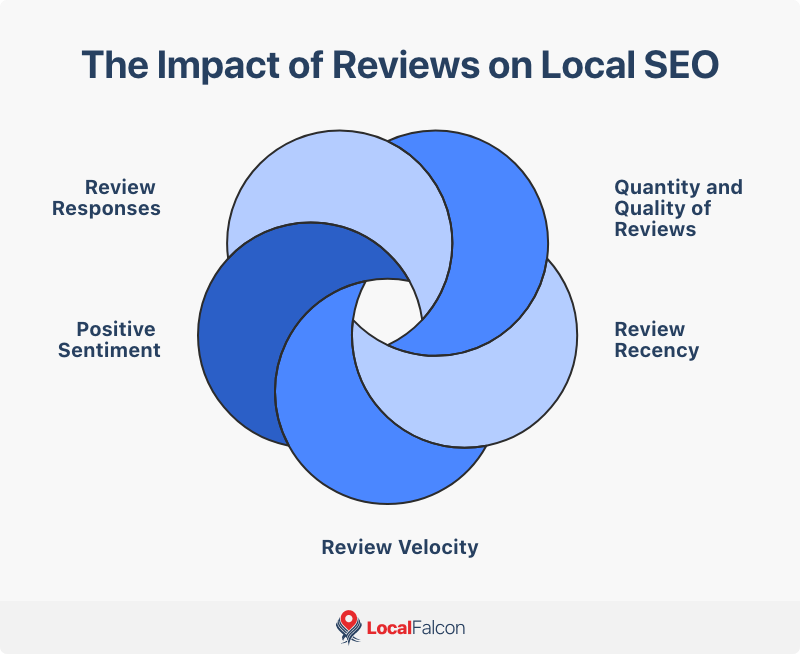
Google reviews have a strong impact on local search visibility. Review-related factors, including review quantity, ratings, recency, and velocity are considered by Google's local ranking algorithm. Reviews also help prospective customers evaluate businesses and decide which ones to contact or visit.
Do Google reviews affect AI search visibility?
Google reviews can provide useful information about a business's reputation, customer experiences, and service quality. AI search platforms may use review content and sentiment when generating business recommendations or summaries. However, strong Google reviews alone do not guarantee AI search visibility, and different AI platforms may rely on different information sources.
How can businesses manage Google reviews across multiple locations?
Multi-location businesses can use centralized review management platforms to monitor reviews, establish consistent response guidelines, analyze customer sentiment, and automate routine review management tasks across locations. This helps corporate teams maintain consistent standards while allowing local managers to address location-specific feedback.