
Franchise brands inhabit a unique yet challenging space in search. They benefit from national brand recognition, but they win or lose customers at the local level.
Whether someone is searching for a restaurant, gym, home services, or healthcare provider, their intent is almost always tied to a specific location. That makes local SEO for franchises not just important, but foundational to growth.
Not only that, but search is evolving. The traditional "ten blue links" on page one of Google are getting pushed further and further down the page, giving way to AI-powered local answers, map-based discovery, and conversational search experiences. For franchises, this raises the stakes even higher.
Winning visibility for franchise service outlets requires a local SEO strategy that balances brand consistency, location-level relevance, and AI-driven search signals.
The Importance of Local SEO for Franchise Outlets
For franchise businesses, local SEO is the primary driver of real-world outcomes: phone calls, direction requests, website visits, and in-store traffic. Even the strongest national brand cannot rely on brand awareness alone when customers are searching with local-intent queries like "near me" or "open now."
Implementing local SEO strategies for franchises ensures that each individual outlet can be discovered in its own market, compete effectively with nearby competitors, and accurately represent its offerings. This includes visibility in Google's Local Pack, Google Maps, Apple Maps, and increasingly, AI-generated local recommendations.
The importance of local SEO for franchise outlets also lies in trust. Searchers want accurate hours, correct addresses, recent reviews, and confirmation that a specific location can meet their needs. When franchise locations lack strong local optimization, they risk losing customers not only to national competitors, but to better-optimized local independents down the street.
Finally, local SEO provides measurable insights. Franchise brands can see how visibility varies by region, how reviews and ratings influence performance, and how optimization efforts translate into ranking improvements across locations. For growing franchise systems, this granular visibility intelligence is essential for scaling responsibly.
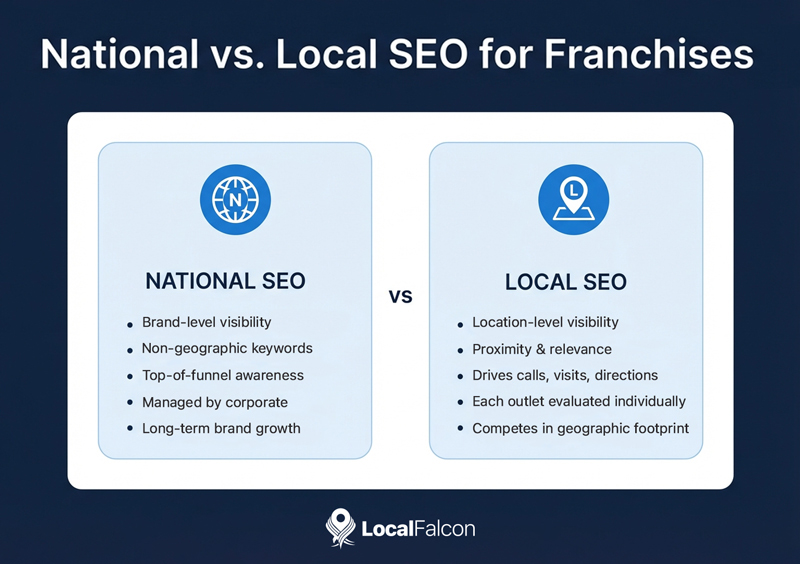
National Vs Local SEO for Franchises
One of the most misunderstood aspects of franchise marketing is the difference between national and local SEO for franchises — and why both are necessary, but not interchangeable.
National SEO focuses on brand-level visibility: ranking for non-geographic keywords, building authority, and capturing top-of-funnel awareness (e.g., informational search intent). This is typically managed by the corporate franchisor and supports long-term brand growth.
Local SEO for franchises, on the other hand, is about proximity, relevance, and prominence at the location level. Google evaluates each franchise outlet individually based on its Google Business Profile, local content, reviews, citations, and user engagement signals.
Problems arise when franchise brands apply national SEO thinking to local markets. A single generic "locations" page or duplicated content across hundreds of city pages often fails to deliver local relevance. Effective local SEO strategies for franchises require empowering each location to compete locally while still aligning with brand standards.
The most successful franchise SEO programs treat national and local SEO as complementary systems: corporate teams build authority and structure, while local optimization ensures each outlet is competitive in its own geographic footprint (i.e., protected territory, operating territory, etc.).
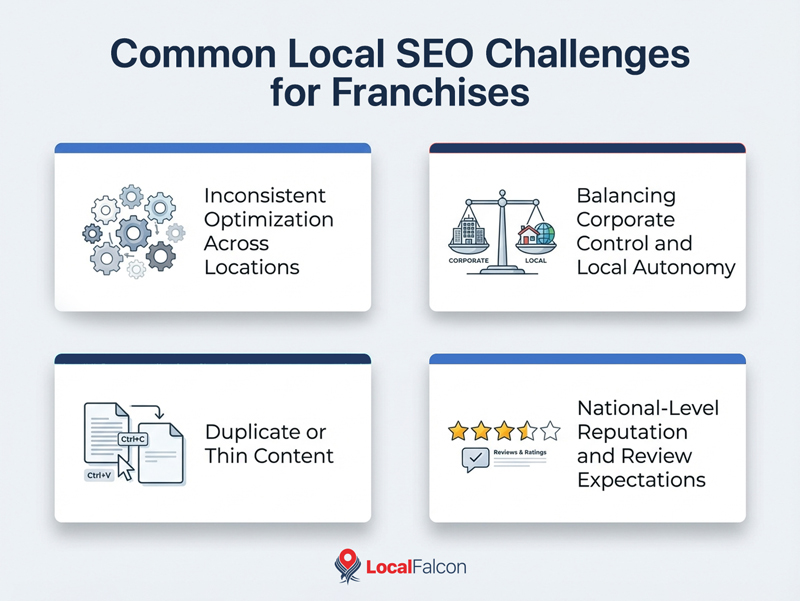
Common Local SEO Challenges for Franchises (And How To Overcome Them)
Franchises face a distinct set of obstacles that don't always apply to independently owned or centrally managed multi-location businesses. Understanding these challenges is the first step toward solving them.
Inconsistent Optimization Across Locations
One major local SEO challenge for franchises is inconsistent execution. Some locations are well-optimized and actively managed, while others are neglected or incorrectly configured. This creates uneven visibility across markets and makes performance difficult to scale.
How to overcome it: Establish clear brand standards, provide repeatable optimization templates, and use monitoring tools to identify underperforming locations quickly.
Balancing Corporate Control and Local Autonomy
Another challenge is ownership and control. Franchisees often manage their own Google Business Profiles, reviews, and local content, which can lead to inaccuracies, outdated information, or violations of brand guidelines. However, overly restrictive corporate control can stifle local relevance and responsiveness. The key is to find the right balance, taking a hybrid approach that builds system-wide authority.
How to overcome it: Centralize franchise local SEO strategy and guidelines at the corporate level, but allow franchisees to customize content, respond to reviews, and highlight local services within approved frameworks.
Duplicate or Thin Location Content
Duplicate content is also a common issue for franchises. Many franchise websites rely on templated location pages with minimal differentiation, which weakens their ability to rank locally. Search engines expect unique, locally relevant signals — not just swapped city names.
How to overcome it: Build unique location pages with locally relevant content, service details, FAQs, and internal linking that clearly signals geographic intent.
National-Level Reputation Management and Review Expectations
Another local SEO challenge for franchises is assuming that the number of reviews and ratings needed to rank — especially in Google's Local 3-Pack — is consistent across all locations. In reality, review benchmarks are hyperlocal. What works for one franchise location may be insufficient or excessive for another, even within the same brand and category.
How to overcome it: Start by identifying your business category review benchmark, then factor in market context such as urban vs. suburban vs. rural locations. Analyze local competitors in each market to understand the review volume and quality required to compete.
Pro tip: Data from Local Falcon's whitepaper research on reviews and Local Pack rankings shows that review requirements vary significantly by category and location, reinforcing the need for location-specific reputation goals rather than a single national target.
AI Strategies for Franchise Location Visibility
AI is changing how local search results are generated, summarized, and delivered to users. For franchises, this means optimizing not just for rankings, but for how locations are understood and represented by AI.
Strengthening Location-Level Entity Signals
AI-driven search experiences rely heavily on entity understanding. Franchise locations must be clearly defined as distinct entities with accurate attributes, services, and relationships to the parent brand. Structured data, consistent NAP information, and well-maintained business profiles all support this understanding.
Leveraging Reviews and Sentiment Signals
Reviews play an increasingly important role in AI strategies for franchise location visibility. AI systems analyze review volume, ratings, sentiment, and themes to determine which locations are most relevant for a given query. Encouraging authentic reviews and responding thoughtfully helps reinforce trust signals that AI models rely on.
Optimizing for AI-Powered Search
Another key strategy is monitoring visibility across AI-powered local results, such as conversational answers and AI-generated map packs or overviews. Traditional rank tracking alone is no longer enough. Franchise brands need insight into how their locations appear across different search contexts and how optimizations and market-level changes influence AI-driven exposure.
Ultimately, AI rewards clarity, consistency, and real-world relevance. Franchises that treat local SEO as a living system — rather than a static checklist — are best positioned to benefit from these shifts.
FAQs on Local SEO Strategies for Franchises
How is doing local SEO for a franchise different from any other multi-location business?
Franchise SEO must balance centralized strategy with decentralized execution. Independent ownership creates variability that requires stronger governance, tools, and education.
What are the biggest local SEO challenges for franchises?
The biggest challenges include inconsistent optimization, duplicate content, inaccurate listings, and limited visibility into location-level performance.
Should franchises have separate URLs for local SEO?
Yes. Separate location URLs allow search engines to associate unique relevance signals with each outlet and improve both rankings and user experience.
What are the top AI strategies for franchise location visibility?
Focus on accurate business data, strong review signals, clear entity relationships, and visibility tracking across AI-driven local results.
How many reviews do franchise locations need to rank?
There is no single number. The number of reviews a franchise location needs to rank — especially in Google's Local 3-Pack — is hyperlocal and varies by business category, market density, and local competition. Each location should benchmark itself according to category, location, and against nearby competitors in its specific market rather than relying on a national-average review target.