
Creating local landing pages can provide local businesses with more opportunities to rank on Google for services they offer, increasing visibility in searches with local intent. However, the quality of the content on these pages matters.
Google rewards high-quality content with better rankings, while low-quality pages do little for SEO, and can even hurt your local search performance if Google sees them as duplicate content.
In other words, you can't just create a local landing page template, then simply duplicate it for all your services and service areas. You have to know how to create content for local landing pages for SEO in order to make each page unique and maximize performance.
What Are Local SEO Landing Pages?
A local SEO landing page is a page on your website built to target customers in a specific city, neighborhood, or service area. It combines location-specific content, including your NAP details, local keywords, customer reviews, and area-specific context, with strong on-page SEO to help your business rank for searches with local intent. Unlike your homepage or generic service pages, each local landing page is optimized for one location and one audience.
A well-optimized local SEO landing page helps businesses:
- Improve rankings for location-based searches
- Capture traffic from users looking for services in their area
- Increase conversions by offering localized and relevant content
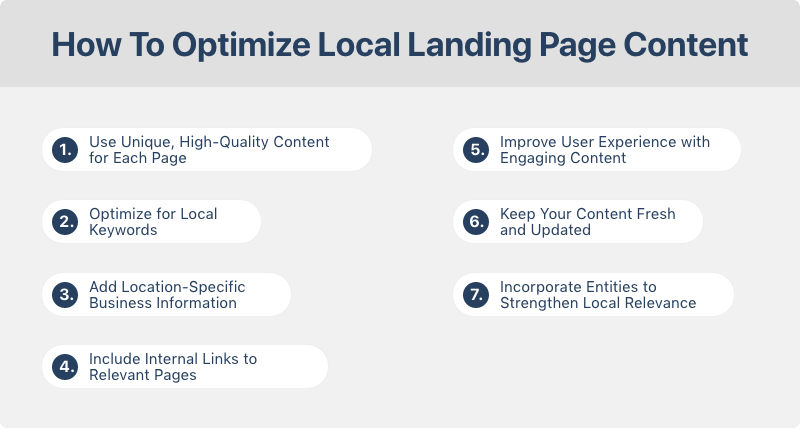
How To Optimize Local Landing Page Content
1. Use Unique, High-Quality Content for Each Page
Avoid copying and pasting the same content across multiple local landing pages with only minor changes to city names or services. Google's algorithm can detect duplicate or thin content, and this can negatively impact your rankings. Instead, customize each page by:
- Writing unique service descriptions tailored to each location
- Highlighting local case studies, testimonials, and success stories
- Incorporating location-specific details, such as landmarks or local community involvement
For example, instead of:
"We offer plumbing services in [City Name]. Contact us today!"
Try:
"Need a reliable plumber in Austin? Our expert team at XYZ Plumbing has been serving Austin homeowners for over 10 years, specializing in emergency repairs, drain cleaning, and water heater installations. Whether you live near Zilker Park or in the heart of downtown, we're just a call away!"
2. Optimize for Local Keywords
Naturally incorporating localized keywords in service page content helps your pages rank higher in organic search results. Each local landing page should include:
- Primary keyword: "[Service] in [City]" (e.g., "Plumber in Seattle")
- Secondary local modifiers: neighborhood names, landmarks, nearby areas
- Long-tail keywords: "best HVAC repair service in Los Angeles" or "affordable pest control near me"
Place these keywords in:
- The page title and meta description
- Headings (H1, H2, H3)
- Normal paragraph text
- URLs (e.g., [your site].com/plumbing-austin)
- Image alt text and file names
3. Add Location-Specific Business Information
Make sure your local landing pages clearly showcase essential business details, including:
- Business name, address, and phone number (NAP consistency is key)
- Service area details, especially if you serve multiple neighborhoods or cities
- Google Map embedded for easier location discovery
- Customer reviews or testimonials from local clients
Consistency across your local SEO landing pages, Google Business Profile, and other business listings strengthens your overall local search presence and makes it easier for potential customers to find and contact you.
4. Include Internal Links to Relevant Pages
Strong internal linking improves both SEO and user experience. Link your localized SEO landing pages to:
- Your main service pages for more information
- Blog posts related to the specific service or location
- Contact or booking pages for easy conversion
For example, if you have multiple local landing pages for HVAC repair in different neighborhoods, link them all to a main parent page for HVAC repair in your city.
5. Improve User Experience with Engaging Content
A well-designed local landing page should be both informative and visually appealing. Boost user engagement by:
- Including high-quality images of your team, storefront, or completed projects in the area
- Adding customer testimonials and video content
- Writing compelling calls to action (e.g., "Call our Portland team today for a free quote!")
The more time people spend on your service pages, the better it is for your local SEO, not to mention it's easier to convert leads into paying customers with helpful content!
6. Keep Your Content Fresh and Updated
Google favors pages that are current and relevant, so make sure to regularly update your local SEO landing pages with:
- New customer reviews
- Recent project photos
- Seasonal promotions or local event tie-ins
- Additional service offerings
This keeps your pages dynamic and signals to Google that your business remains active and relevant.
7. Incorporate Entities to Strengthen Local Relevance
In SEO, entities are distinct concepts like businesses, locations, services, and landmarks that search engines recognize to understand content better.
Unlike keywords, which are specific words or phrases with search volume, entities provide deeper context and improve relevance in local search results. To incorporate entities into your local SEO landing pages:
- Mention specific local landmarks, neighborhoods, or well-known businesses near your location
- Use structured data (LocalBusiness schema) to clearly define your business, services, and service area
- Naturally integrate related entities, such as local events, industry-specific terms, or service categories, into your content
For example, instead of just saying, "We offer pest control in Vancouver," strengthen the entity associations on your local landing page by stating, "Our Vancouver pest control team serves homes near Stanley Park and throughout downtown Vancouver."
By strategically including entities, you help search engines connect your business to its local context, improving visibility in local searches across platforms, from traditional Google searches to AI-driven queries.

8. Optimize for AI Fan-Out Queries
As AI-powered search tools become more embedded in how people find local businesses, local landing pages need to do more than satisfy a single keyword query. Tools like Google's AI Overviews and conversational AI search platforms evaluate local content through a process called query fan-out, where a single user search triggers multiple sub-queries behind the scenes to gather information about relevant businesses before generating a response.
What this means in practice: an AI system responding to "best HVAC company near me" isn't just matching your page to that phrase. It's simultaneously asking sub-questions about your services, your location, your reviews, your hours, and your credibility, and synthesizing the answers into a recommendation. Local landing pages that answer a wide range of those sub-questions within a single, well-structured page are far more likely to be cited in AI-generated results than pages that only address the primary keyword.
To optimize your local landing pages for fan-out queries:
- Cover the full context of your service in each location: Don't just describe what you do. Include who you serve, what specific problems you solve, what makes your business relevant to that area, and what customers can expect. AI systems especially reward breadth and depth within a page.
- Answer implicit questions directly: Think about what a potential customer would want to know before choosing your business. Are you licensed? Do you serve their specific corner of the neighborhood? What does the process look like? Structured FAQ sections and clear, declarative sentences help AI systems extract and use your answers.
- Reinforce entity associations throughout the page: The entities tip above establishes local relevance for traditional search, and those same entity references, including landmarks, neighborhoods, and service categories, also help AI systems correctly associate your page with a geographic location when processing fan-out sub-queries.
- Keep your GBP and landing page consistent: AI Overviews and other AI-generated answers for local queries, especially on within Google's Search ecosystem, draw from both your on-site content and your Google Business Profile. When the two tell the same story, meaning they have the same services, location details, and framing, your business presents as a more authoritative, coherent result.
Local landing pages that are built for depth rather than just keyword placement are naturally better positioned for AI search visibility. The work you put into tips #1 through #7 above isn't just good traditional SEO; it's the same foundation AI systems use to evaluate whether your business deserves to be recommended.
Local SEO Landing Page Examples From Enterprise Brands
The fastest way to understand what makes a local landing page work is to look at how large brands do it at scale. These local landing page SEO examples cover two of the most common business types: multi-location retail and service-area businesses. Each one executes the fundamentals well.
Home Depot (Multi-Location Retail)
Example URL: https://www.homedepot.com/l/Lakeline/TX/Austin/78717/509
Home Depot's location pages are a textbook example of scalable local landing page architecture. Each store gets a unique URL structured around location name, state, city, and ZIP (/l/[Store-Name]/[State]/[City]/[ZIP]/[ID]), which gives Google clear geographic signals at every level.
What makes these pages work:
- Hyperlocal orientation copy. Every page includes a sentence describing where the store sits relative to known local landmarks. In this case: "You can find us north of the intersection of US-183 and TX-45, between the Target and the Kohl's." This is entity-building in practice.
- Location-specific features listed. Each page surfaces which services are available at that store (rental center, flooring showroom, curbside pickup), so the page is genuinely useful rather than templated filler.
- Local reviews displayed on-page. Customer reviews tied to that specific location appear directly on the page, providing fresh, unique content and trust signals without any manual effort.
The result is thousands of location pages that avoid duplicate content penalties because the landmark copy, store features, and review content are unique to each location.
Roto-Rooter (Service-Area Business)
Example URL: https://www.rotorooter.com/seattle/resources/local-plumbing-service-in-seattle/
Roto-Rooter is one of the better examples of SAB local landing pages done right. As a plumbing company with no storefront, they can't rely on a physical address to anchor local relevance, so their pages do it through content instead.
What makes these pages work:
- Location-specific problem framing. Rather than generic service descriptions, the Seattle page addresses plumbing issues specific to Seattle homes, such as older cast iron and galvanized steel pipes common in pre-1980s construction, moisture-related drainage problems from the region's climate. This is exactly the kind of location-specific content Google rewards.
- Clear service area scope. The page explicitly states which neighborhoods and districts are covered, which helps Google understand the geographic boundaries of the page's relevance.
- Urgency and trust signals above the fold. 24/7 availability, licensed technicians, and emergency response framing are all present immediately, addressing the high-intent nature of someone searching "plumber in Seattle."
For SABs, this is the model: write about the location as if you understand it, not just as a city name to swap into a template.
FAQs
Do I need a separate local landing page for every city I serve?
Not for every city, but yes for every location where you have a meaningful presence (i.e., a physical location or service area) or genuine service history. Avoid creating pages for areas you barely serve; thin location pages do more harm than good.
What's the difference between a local landing page and a service page?
A service page describes what you do. A local landing page describes what you do in a specific place, for a specific audience, combining your service description with local keywords, NAP data, and location-specific context.
Can duplicate local landing pages hurt my SEO?
Yes. Copying the same page and simply swapping city names is one of the most common local SEO landing page mistakes. Google treats near-identical pages as thin content, which can suppress rankings across your entire site. Each location page needs genuinely unique content.
How long should a local landing page be?
Long enough to be genuinely useful. Pages that rank well typically cover: a service description, NAP information, an embedded map, customer reviews, location-specific context, and a clear call to action. If it answers every question a local customer would have before calling or visiting, it's the right length.
Should local landing pages link to each other?
Yes. Linking between nearby location pages helps Google understand your geographic coverage, distributes authority across your location cluster, and improves user experience. Use the city name as anchor text.
How does Google Business Profile relate to local landing pages?
They work as a pair. Your GBP website link should point to the specific location page, not your homepage. Consistent NAP across both, and landing page content that mirrors and expands on your GBP, reinforces local relevance signals in both Maps and organic results, as well as AI-generated results.
Final Thoughts
Local landing pages are one of the most important assets in local SEO, but only when they're built with genuine local intent. A page that exists purely to target a city name, with thin content copied from your other location pages, will underperform or actively hurt your rankings. A page that actually answers what a nearby customer wants to know, in the context of that specific location, earns rankings because it deserves them.
The local landing page examples above from Home Depot and Roto-Rooter share a common principle: they treat each location as its own content problem to solve, not a template slot to fill. That's the standard worth building toward.
Once your local landing pages are live and optimized, the next step is knowing whether they're actually driving visibility where it counts. Local Falcon's geo-grid rank tracking lets you monitor exactly how each location performs on Google Maps, Apple Maps, and AI search so you can see what's working and where gaps remain.