
AI-generated answers now decide which businesses get seen, and often chosen, before a searcher ever clicks through to a business listing or website, and that makes generative engine optimization (GEO) metrics and KPIs essential for anyone trying to understand their brand's presence in tools like ChatGPT, Gemini, and Google's AI Overviews and AI Mode.
Unlike traditional SEO, where high rankings and click-through rates were the goal, GEO requires tracking a different set of metrics and KPIs tied to how often, how favorably, and how prominently AI mentions a business.
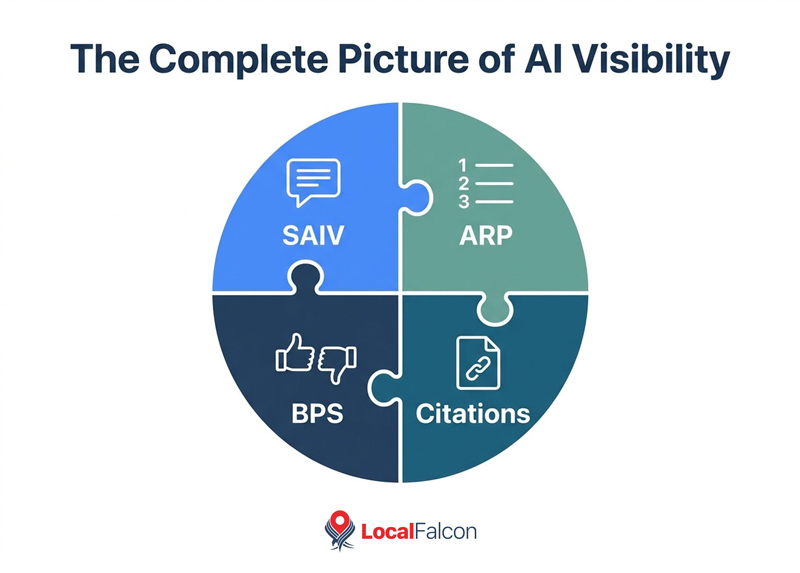
Understanding generative engine optimization success metrics means moving past simple visibility checks and building a repeatable measurement framework. The four metrics below give a structured way to evaluate AI visibility, benchmark it against competitors, and identify where content and citation strategies need work.
4 Generative Engine Optimization KPIs and Metrics You Need To Know
1. Share of AI Voice (SAIV)
Share of AI Voice (SAIV) measures how often a business is mentioned across AI-generated answers, also called inclusion rate or mention rate. It's expressed as a percentage: if a business is mentioned in 5 out of 25 AI-generated responses for a given query set, its SAIV is 20.
SAIV is most useful when measured by platform and by query rather than as a single blended number. AI results vary significantly between answer engines, and even small changes in query phrasing can produce vastly different results. Breaking SAIV down this way shows exactly where a business has strong AI visibility and where it's being left out.
2. Average Rank Position (ARP)
AI doesn't rank businesses in a list the way a traditional search engine does, but it does mention some businesses before others within a generated response. Average Rank Position (ARP) captures this by tracking where a business falls, on average, among the other businesses included in AI-generated answers when it is mentioned.
An ARP of 3.6, for example, indicates a business is regularly included as a relevant option but isn't the first name AI reaches for every time. Tracking ARP over time shows whether content and citation efforts are actually moving a business toward more prominent placement, not just more frequent mentions.
3. Buyer Persuasion Score (BPS)
Being mentioned by AI doesn't guarantee a strong recommendation, which is why Buyer Persuasion Score (BPS) matters. BPS scores the sentiment of what AI actually says about a business when it appears in a response. A higher positive BPS means AI is describing the business in more persuasive, favorable terms, while a negative score signals the AI may be surfacing the business alongside qualifiers, comparisons, or criticism that undercut its appeal.
BPS adds a layer of generative engine optimization measurement that SAIV and ARP can't provide on their own. A business could have solid visibility and a reasonable rank position while still being described in less-than-stellar terms, and BPS is what catches that.
4. Citations
Citations are the specific sources AI references or links to when generating a response, such as a directory listing, a page on a business's own website, or a third-party article or blog post that mentions the brand. A business being mentioned by name is useful, but a business being cited with a direct source is more valuable, since it points to exactly what content is earning AI's trust.
Tracking AI citations for a business and its competitors reveals what's actually driving AI visibility within a given category or market. It also highlights specific, actionable opportunities: if competitors are consistently cited from directory profiles, review platforms, or particular types of content, that's a clear indication of where to focus content and citation-building efforts.
What Are the Best GEO Metrics and Measurement Tools?
The right GEO measurement tool depends on the type of business and what's being tracked. A global SaaS brand and a local law firm have very different needs when it comes to measuring their generative engine optimization performance.
For local businesses specifically, whether they operate from a single storefront, serve a defined area, or run a hybrid model with both, a general, brand-level AI visibility tool isn't enough. Any business with a Google Business Profile and a local SEO strategy needs a tool built to measure AI visibility at the local level, and this is where a platform like Local Falcon comes in.
Local Falcon tracks SAIV, ARP, BPS, and citations within a specific geographic area through geo-grid AI visibility tracking, showing how a business's AI presence shifts from one location to the next rather than reporting a single global, national, or regional average.
This matters because AI-generated answers to local queries can vary block by block or neighborhood by neighborhood, especially in competitive markets or for businesses with multiple locations. A business might perform well in AI responses near one location and be virtually invisible a few miles away, and that kind of variation gets lost in tools that only report aggregate visibility.
Geo-grid tracking also makes it possible to isolate exactly where AI visibility is weak and connect that back to citation strength or local ranking factors that overlap with AI search performance, like proximity, reviews, and Google Business Profile optimization. For businesses managing multiple locations or competing in dense local markets, this level of granularity turns GEO measurement from a general awareness exercise into a targeted optimization plan.
Generative Engine Optimization Metrics, KPIs, and Tools: FAQs
What's the difference between GEO metrics and traditional SEO metrics?
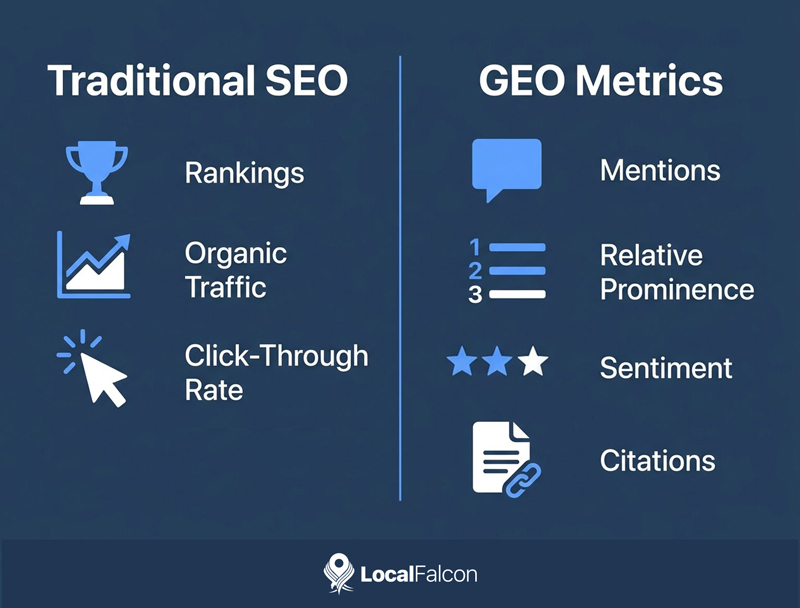
Traditional SEO metrics track rankings, organic traffic, and click-through rates from search engine results pages. GEO metrics track how a business appears within AI-generated answers themselves, including mention frequency, relative prominence, sentiment, and citation sources.
How often should GEO metrics be tracked?
Tracking frequency depends on query volume and how competitive a market is, but consistent, regular tracking is necessary because AI-generated responses change frequently as models update and content sources shift.
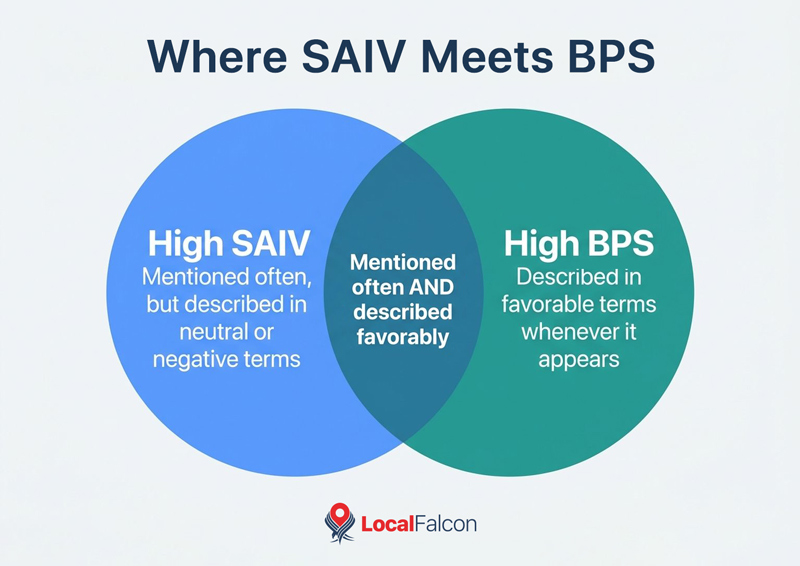
Can a business have a high Share of AI Voice but a low Buyer Persuasion Score?
Yes. A business can be mentioned frequently while still receiving a neutral or negative sentiment score, which is why SAIV and BPS need to be tracked together rather than in isolation.
Do citations matter more than mentions?
Both matter, but citations carry additional weight because they point to a specific source AI trusted enough to reference, which often reveals content or listings that are actively influencing AI visibility.
Is geo-grid tracking necessary for businesses with only one location?
Yes, since AI-generated responses to local queries can vary even within a few miles of a single location, and geo-grid tracking shows how visibility shifts across the surrounding service area rather than relying on one averaged result.
Wrapping Up
GEO metrics exist because AI-generated answers require a different kind of measurement than traditional search results. Share of AI Voice, Average Rank Position, Buyer Persuasion Score, and citations each capture a distinct part of how a business shows up in AI responses, and together they provide a far more complete picture than tracking mentions alone. For local businesses, pairing these metrics with geo-grid tracking adds the geographic specificity needed to turn that picture into a workable optimization strategy.