
AI platforms don't generate responses from thin air (unless they hallucinate, but that's a whole other conversation). They pull from specific sources, and for local businesses, knowing which sources those are is the first step toward actually influencing your AI visibility.
In this guide to tracking AI citations for local businesses, you'll learn:
- What AI citations are
- What AI citation tracking is
- Why tracking AI citations matters for local businesses
- How to track AI citations for your business overall, plus how to track AI citations for your business content specifically
What Is an AI Citation?
When an AI platform like ChatGPT, Google's AI Overviews or AI Mode, Gemini, or Perplexity generates a response to a query, it often pulls information from specific sources and either links to them directly or references them as the basis for its answer. Those sources are AI citations.
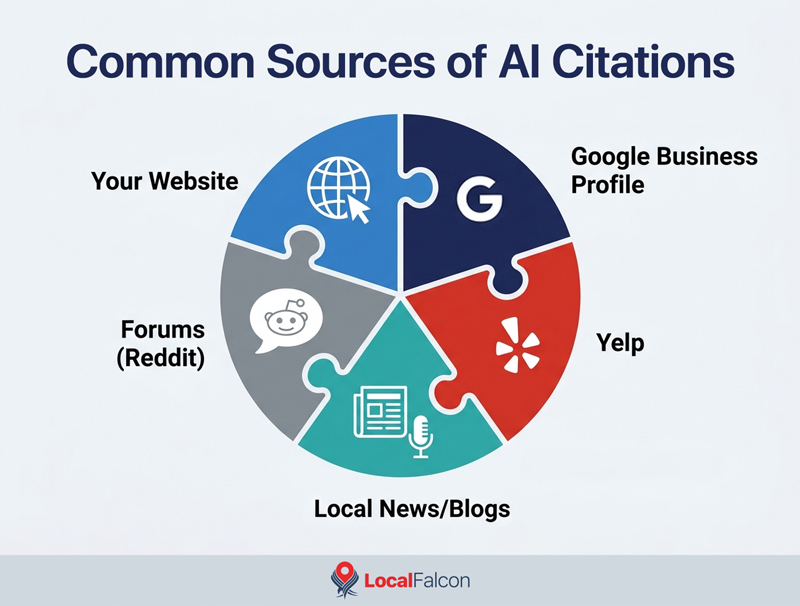
For local businesses, these citations frequently come from your own website, but they also come from directory listings like Google Business Profile and Yelp, third-party websites, local blog or news coverage, and forums like Reddit. Understanding which sources are being cited, and why, is the foundation of improving your visibility in AI-generated results.
What Is AI Citation Tracking?
AI citation tracking is the practice of monitoring which specific sources AI platforms reference when generating responses to particular queries. Businesses use it to understand what's driving AI visibility in their space, whether that's their own content, a competitor's content, or third-party platforms they might not have focused on before.
Why Does AI Citation Tracking Matter for Local Businesses?
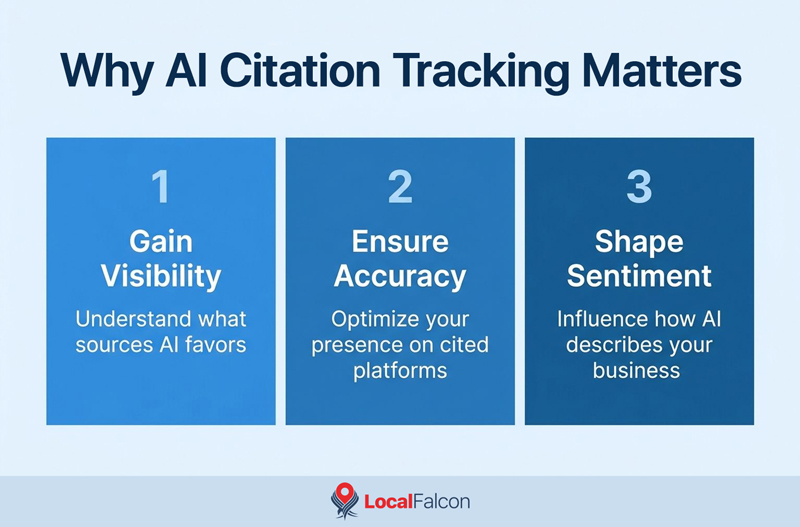
If you want to show up in AI-generated responses for queries relevant to your business, you need to know what sources those platforms are already favoring. That varies by platform, industry, and geographic area, and there's no way to guess your way to an accurate picture.
AI citation tracking gives you that picture. Once you know which sources AI consistently cites for your target queries, you can build out your brand presence on those platforms, make sure your content there is accurate, complete, and optimized, and generally put yourself in a stronger position to be cited by AI going forward.
There's also a separate but related use case: AI brand sentiment. AI doesn't just cite sources, it synthesizes them into a description of your business. If that description is lukewarm, vague, or missing key details, AI citation tracking helps you identify which platforms are shaping that less-than-stellar narrative. From there, you can work on improving the quality of the content on those platforms, which over time can influence the language AI uses when talking about your business.
How To Track AI Citations for Your Business: Step by Step
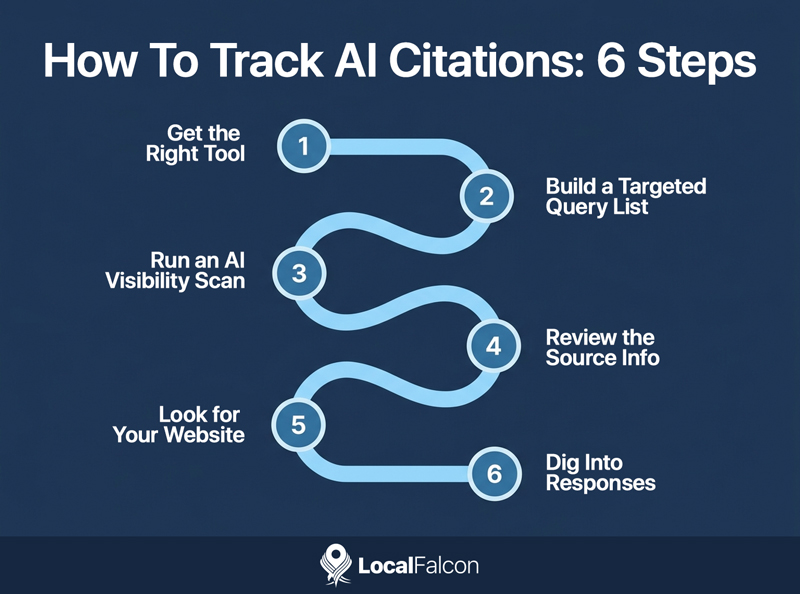
Step 1: Get the Right Tool
Before you can track AI citations for your business, you need an AI citation tracking tool. For local businesses specifically, we recommend Local Falcon. It applies the same geo-grid technology used for traditional local rank tracking to AI visibility, meaning it can show you exactly which sources are being cited at a granular, hyperlocal level across your entire target market or service area.
This level of granularity is important because AI search results can change depending on where someone is searching from, just like traditional results. The citations that appear in a response generated for someone searching from one neighborhood may differ from those generated a few miles away. Local Falcon surfaces citation data across the whole grid, for both your business and your competitors, so you can see what's driving visibility even in areas where you're not currently showing up.
Step 2: Build a Targeted Query List
Before you run an AI visibility scan, you need a list of queries that reflect how potential customers would realistically search for your type of business. AI search is conversational and extremely variable, so don't worry about building an exhaustive list of every possible phrasing (that would be impossible). Instead, focus on ensuring you have queries that cover all your different service types, your locations or service areas, common customer questions, and so on.
Local Falcon's Local Keyword Research Tool can generate AI-style query lists based on your specific business locations, which makes this step significantly faster.
Step 3: Run an AI Visibility Scan
Once you have your query list, run an AI visibility scan in Local Falcon. The platform will generate responses across the geo-grid for each query and compile the citation data.
Step 4: Review the Source Information
When your AI visibility Scan Report is ready, open it and go to the Source Information section. This gives you a full list of every URL cited by AI for each query across your target area. You can also click on individual data points within the geo-grid heatmap to see exactly which sources were cited in the response generated for that query at that specific location.
Step 5: Look for Your Own Business Site
Within the citation data, check specifically for any links back to pages on your own website. This is how you track AI citations for your business content directly. If your website is being cited, that's useful confirmation that your content is being picked up. If it's not, that tells you something too, particularly when you can see which other sources are getting cited in its place.
Step 6: Dig Into Individual Responses
For a more granular view, click to open the individual AI responses at specific geo-grid data points where your business was mentioned. Look for links to your site, but also for citations from directory listings, third-party review sites, or any other sources directly mentioning your business. This is where you start to understand the full picture of your AI visibility footprint and where the gaps are.
FAQs on How To Track AI Citations for Your Business
Is there a difference between how to track AI citations for your business and how to track AI citations for your business content, specifically?
Yes. Broad AI citation tracking looks at all sources cited in relation to your business in AI-generated results. That includes directory listings, review platforms, third-party articles, and anything else AI pulls from. Tracking citations for your business content specifically refers to monitoring when AI cites pages on your own website.
How can I track citations to my site in AI results?
Use an AI citation tracking tool. Run visibility scans for your target queries, then check the source data for URLs from your own domain. Local Falcon makes this straightforward by listing every cited URL in the scan report, so you can quickly see whether your site is being referenced and for which queries.
How often should I run AI citation tracking scans?
There's no universal answer, but given how frequently AI platforms update their models and data sources, running scans on a regular cadence, monthly at minimum, gives you a more accurate picture than a single snapshot. It also helps you track whether changes you've made to your content or listings are having an effect on your citation presence over time.
Can I track AI citations for competitors?
Yes, this is one of the more valuable applications of Local Falcon specifically. Because the AI visibility scans cover citations across the entire geo-grid and not just for your business, you can see which sources are driving visibility for competitors in your area. That competitive intelligence can help you prioritize which platforms to focus on to catch up.