
Local search is undergoing its most dramatic shift in the decade+ since Google Business Profile originally launched.
Between the rapid proliferation of AI-generated responses and search results, more sophisticated Google Business Profile ranking signals, and Google's growing reliance on real-world behavioral data and sentiment, the fundamentals of how businesses earn visibility are rapidly evolving.
In 2026, local SEO won't just revolve around checking optimizations off a list and ranking in the local pack anymore. It will require improving accuracy, trustworthiness, and relevance across every surface where AI and users evaluate local businesses. At Local Falcon, we see this mandate to optimize more surfaces as an amazing opportunity for agencies and SEO's everywhere to increase the value of what they are providing to their employer, client, and customer.
This guide will break down some of the top local ranking factors and local SEO trends that will continue reshaping local search in 2026, plus the actionable strategies brands and agencies should adopt now to stay ahead.
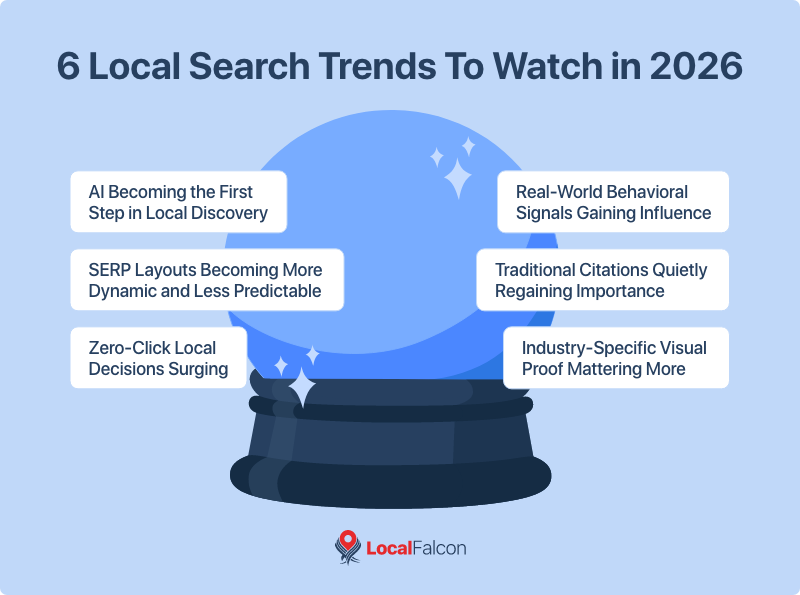
6 Local Search Trends To Watch in 2026
1. AI Becoming the First Step in Local Discovery
Unlike when we rounded up some of the experts' predictions for the future of local search around this time a year ago, AI-generated local answers are no longer experimental. They're quickly becoming the front door to search.
Increasingly, users ask AI for recommendations without ever navigating to a traditional search results page. Or, they perform a Google search and only read the AI Overview, choosing a business mentioned without ever engaging with the local pack or blue-link organic results.
These AI systems rely on a wide variety of signals, such as:
- Clear, well-structured business information that's easy for the AI to interpret
- Consistent details and mentions across the web, reducing ambiguity about who you are and what you offer
- Recent, detailed customer feedback that reinforces trust and relevance
Instead of simply ranking pages, AI is sorting local business entities and surfacing only those it can confidently trust.
This creates a new layer above traditional local SEO: AI search optimization, or optimizing your digital presence to ensure your business is "in the conversation" for relevant local-intent queries.
2. SERP Layouts Becoming More Dynamic and Less Predictable
Google is rapidly testing new SERP formats, and 2026 is likely to bring even more fluid, AI-driven layouts. Instead of one stable page structure, results may shift dynamically based on query intent, user context, and real-time experiments. Two people searching the same term could see entirely different combinations of AI Overviews, local packs, organic links, carousels, and other dynamic SERP features.
This increased variability means visibility will depend as much on which modules appear as on traditional ranking positions.
3. Zero-Click Local Decisions Surging
As AI takes on a larger role in helping users choose local businesses, fewer people are clicking through to websites before making a decision. As we touched on above, they instead rely on AI-generated summaries and answers to evaluate options instantly.
In other words, local discovery is increasingly happening without a traditional "visit the website, evaluate, convert" journey.
Third-party AI tools, and even Google's own AI-integrated search interfaces, are giving users enough information up front to feel confident making decisions without additional research. For many consumers, the choice happens inside:
- A conversational AI recommendation
- Google's AI-enhanced local answers
- Local pack/Maps results that show photos, hours, reviews, and service details at a glance
Because so many critical details are now surfaced directly in these environments, the website plays a smaller role in early-stage evaluation, and CTRs are plateauing or even dropping due to features like Google's AI Overviews.
This gives rise to two important considerations:
- More local decisions happen before a click: Users may call, message, book, or navigate to a business after interacting only with AI results or in-profile information.
- Lead attribution becomes more difficult: With fewer website visits, traditional analytics capture a shrinking percentage of the local customer journey.
The zero-click trend means that businesses and SEO professionals must focus more on share of visibility, including AI visibility, as a performance metric than ever before, knowing that being visible wherever customers are searching can directly translate to more business, whether or not there's ever a traditional "click."
4. Real-World Behavioral Signals Gaining Influence
Google is leaning on real-world cues to validate whether businesses are trustworthy, well-liked, and actively operating. These signals include:
- Review recency (not just volume/score)
- Review detail and sentiment patterns
- Accuracy of business hours
- Popular times
- User-generated photos
- Photo interactions
- Call activity
- Direction requests
- Patterns of real-world local engagement
This creates a more dynamic local algorithm where businesses that "look alive" gain an advantage over those that are simply "there."
5. Industry-Specific Visual Proof Mattering More
According to findings from Sterling Sky, the impact of uploading fresh Google Business Profile photos is particularly strong in several verticals (those that tend to be more visual-focused):
- Restaurants: think food freshness/quality, ambiance, menu clarity
- Retail: think product availability, layout, accessibility
- Home services: think before-and-after evidence, workmanship quality
- Health, beauty, and wellness: think salon cleanliness, vibes, results
Google interprets photo recency, quality, and relevance to assess authenticity and usefulness. In other words, fresh photos aren't just aesthetic; they're ranking and trust signals.
6. Traditional Citations Quietly Regaining Importance
As AI systems verify business data across multiple sources, inconsistencies create uncertainty, and uncertainty reduces surfacing likelihood.
Clean, consistent citations across major and industry-specific platforms help AI models cross-validate:
- Name
- Address
- Phone numbers
- Categories
- Services
- Hours
Citations don't necessarily drive traditional rankings the way they once did, but they increasingly contribute to entity confidence, which strongly affects AI-generated answers.
In fact, according to Whitespark's 2026 Local Search Ranking Factors survey, three of the top five AI search visibility ranking factors are citation-related, including the presence of a business on expert curated "best of"-type lists, a business's prominence on top industry-relevant domains, and the quality/authority of unstructured citations, like newspaper articles, blog posts, government sites, and industry associations.
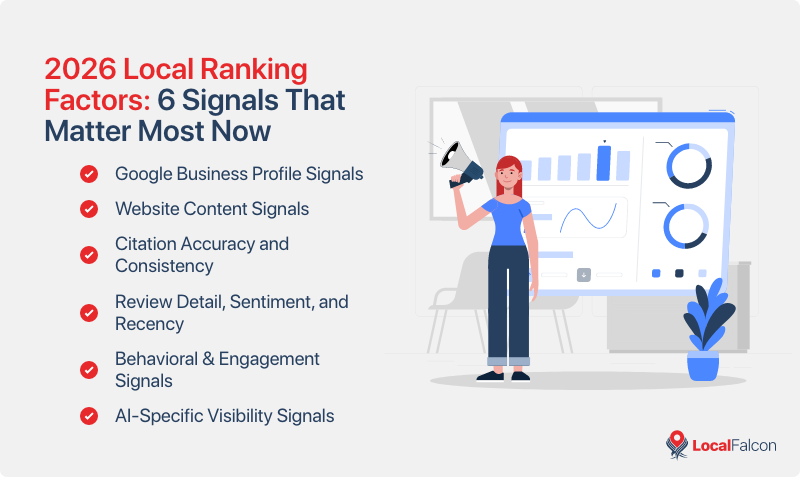
2026 Local Ranking Factors: 6 Signals That Matter Most Now
1. Google Business Profile Signals
The strongest visibility gains still come from the place where Google collects the most structured business data: Google Business Profile. GBP signals heavily influence how confidently Google (and certain AI systems) can understand, categorize, and recommend your business.
High-impact GBP ranking factors include:
- Primary category selection (still foundational)
- Secondary categories aligned with actual services
- Review recency (a top local ranking factor; often stronger than volume)
- Detailed review content describing specific services or outcomes
- Owners responding to reviews with helpful, specific replies
- Fresh, high-quality, and diverse photos uploaded regularly
- Accurate business hours
- High engagement levels (calls, direction requests, bookings)
- Product/service listings kept up to date
Google rewards businesses with well-rounded, complete, accurate, and active profiles.
2. Website Content Signals
AI search tools and traditional search engines alike reward websites that deliver:
- Clear, direct answers to common service and intent questions
- Concise explanations of offerings
- Local context relevance (neighborhoods, landmarks, service zones)
- High-quality photos and supporting media
- Regular updates or content recency signals
- Enhanced clarity via schema markup
- Demonstrated expertise
Poorly structured or generic, keyword-stuffed SEO content no longer delivers the same results. The most powerful content today is written with query specificity and local nuance, aligning directly with different types of search intent at different stages of the buyer's journey.
3. Citation Accuracy and Consistency
Even minor discrepancies in business information across the web can create hesitation in AI models and search engine algorithms deciding whether a business is trustworthy or active.
Key priorities should be to:
- Keep business info consistent across the top local citation sources
- Especially avoid conflicting business hours
- Ensure categories and services match GBP selections
- Reduce outdated or duplicate listings
More brand consistency across the web = higher confidence = more visibility.
4. Review Detail, Sentiment, and Recency
In 2026, the nature of the reviews you get matters more than the raw count.
Important review ranking factors include:
- Recent reviews (better to get a steady stream than a big burst followed by none)
- Reviews that describe the specific service provided
- Mention of staff names, locations, or outcomes
- Photo reviews
- Responses from the business that add value
- Patterns of positive sentiment over time
- Diversity of reviews across platforms (need to get reviews beyond Google; on Yelp, Tripadvisor, Facebook, etc.)
5. Behavioral & Engagement Signals
Google increasingly uses real-world engagement data to understand whether a business is truly relevant to searchers. Several user-interaction signals appear to correlate with stronger and more stable local rankings:
- Profile actions signal relevance. When users regularly tap "Call," "Directions," or "Website," Google interprets the listing as satisfying local intent.
- High photo engagement boosts visibility. Consistent views and interactions on photos indicate that the listing is appealing and trustworthy.
- Steady review velocity signals freshness. A consistent flow of new reviews shows ongoing customer activity, an advantage over competitors with stagnant profiles.
- Branded searches demonstrate authority. When people directly search for a business name, it reveals brand strength that can improve prominence signals.
- Popular Times signals real foot traffic. Google uses aggregated location data to gauge how busy a place is. Businesses with stronger real-time activity often see improved prominence in local results.
Because Google's goal is to surface businesses that users actually find helpful, fluctuations in engagement, such as more calls, fewer photo views, or spikes in reviews, can directly influence ranking shifts. These signals help Google understand which businesses users prefer in the real world, not just which ones are optimized the most online.
6. AI-Specific Visibility Signals
AI-driven local answers are using a fast-evolving set of signals to decide which businesses they can trust enough to surface:
- Consistent facts across your website, GBP, directories, and citations
- Clear, scannable service descriptions that AI can easily interpret
- Structured content (headers, FAQs, schema) that clarifies what you offer
- Accurate, current business info everywhere it appears
- Verified local presence supported by real-world experiences
- Review content that demonstrates expertise and real customer outcomes
- Strong contextual relevance to the user's location, intent, and needs
Businesses now need to optimize not just for rankings, but for AI interpretability and confidence.
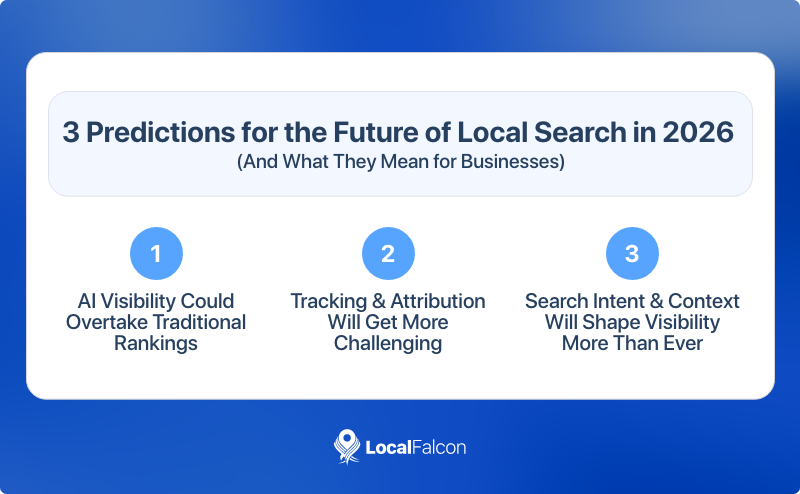
3 Predictions for the Future of Local Search in 2026 (And What They Mean for Businesses)
1. AI Visibility Could Overtake Traditional Rankings
As AI assistants and integrated AI search features expand, the concept of "ranking on Google" may evolve into "being surfaced more often and more confidently by AI." For businesses, this means that it's time to start thinking beyond ranking in the traditional local pack or at the top of organic results, and start thinking of local SEO success more holistically.
While Google Business Profile rankings still drive the majority of local search traffic, we've seen in just a year how AI search has gone from a novel tool to being deeply integrated within search experiences, and there's no doubt that it will continue to account for an increasing amount of local search visibility over the year to come.
2. Tracking & Attribution Will Get More Challenging
Traditional metrics like CTR, organic sessions, and page-level conversion rates will capture a shrinking portion of the customer journey. As AI surfaces answers directly and users engage more with zero-click results, less of that behavior will show up in familiar analytics dashboards.
In 2026, businesses will need to view visibility through a wider lens, combining platform interactions, first-party insight, and modeled conversions to understand true performance.
What's emerging now is a shift from pure traffic analytics to visibility intelligence: measuring how often your business is seen, selected, and validated across multiple surfaces, not just how many visitors reach your site.
Agencies and organizations that adapt to this broader understanding of attribution will have a clearer picture of where local visibility is actually coming from.
3. Search Intent & Context Will Shape Visibility More Than Ever
AI-assisted search introduces a level of personalization that goes far beyond what traditional local rankings have ever delivered.
While proximity, keyword variations, and other factors have always created some differences in local results, AI systems now factor in much richer context, including the user's precise intent, past behavior, conversational cues, and even follow-up questions within an ongoing chat.
Two people standing in the same neighborhood can now receive completely different AI-generated business recommendations, not because of ranking fluctuations, but because the AI interprets their needs differently. A similar request might surface entirely different options, even if the user never explicitly states specific preferences, but rather hints at them through conversational prompts.
This creates a more fluid and fragmented visibility landscape. Instead of optimizing for one predictable set of search results, businesses must understand what triggers inclusion in AI-generated answers and how to ensure they appear across as many intent scenarios as possible.
The challenge ahead isn't just ranking well; it's becoming the most contextually relevant, verifiable, and trustworthy choice in a growing number of micro-moments where AI decides which businesses to surface.
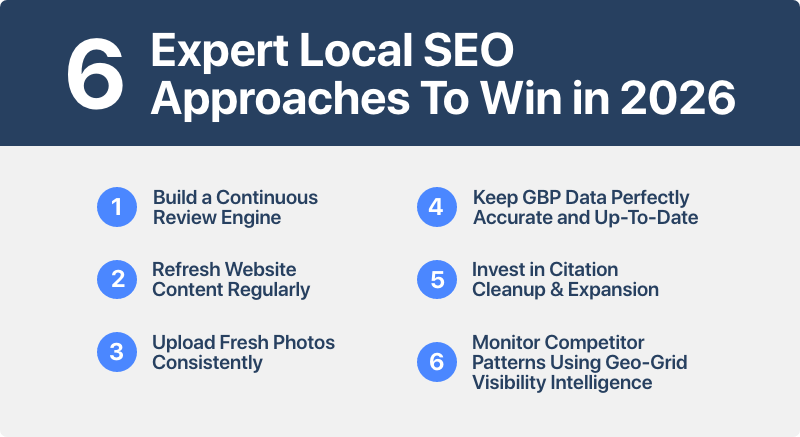
6 Expert Local SEO Approaches To Win in 2026
1. Build a Continuous Review Engine
While review volume and score matter, recency, velocity, and sentiment are equally important.
Focus on:
- Asking customers to mention the service provided
- Encouraging photo uploads
- Requesting feedback consistently throughout the year
- Getting reviews on other platforms in addition to Google
- Responding with meaningful, helpful replies
- Monitoring review sentiment trends (and turning them into action)
Fresh reviews = fresh ranking power and stronger overall local visibility.
2. Refresh Website Content Regularly
You don't need full rewrites, just updates that signal:
- Accuracy
- Recency
- Service nuances
- Expanded local relevance
- Authoritative answers to hyperlocal questions
Update service pages, add new FAQs, publish helpful localized guides, and maintain schema accuracy.
3. Upload Fresh Photos Consistently
Aim for new GBP images at least monthly, especially in visual-first industries.
Include things like:
- Staff
- Vehicles
- Equipment
- Completed work
- Menu items
- Interior layout
- Seasonal changes
Frequent, high-quality uploads show activity and improve engagement, ultimately increasing trust and visibility.
4. Keep GBP Data Perfectly Accurate and Up-To-Date
Continuously review and optimize:
- Business hours
- Categories
- Services
- Products
- Descriptions
- Booking links
- Menu URLs
- Attributes
Small inaccuracies or missed opportunities to optimize can cost visibility where it matters most, from traditional local pack results to AI-generated overviews.
5. Invest in Citation Cleanup & Expansion
Ensure:
- No duplicates
- No outdated info
- Consistent formatting
- Updated categories
- Expanded presence in niche/local directories
Citations support both algorithmic trust and AI certainty.
6. Monitor Competitor Patterns Using Geo-Grid Visibility Intelligence
As always, local visibility in 2026 won't be determined solely by what you do. It will be shaped just as much by what nearby competitors are doing. Businesses need to track not only their own position on the map, but how competitor activity correlates with sudden shifts in their visibility.
Geo-grid visibility intelligence, like Local Falcon's, makes these patterns measurable and actionable. When you see a ranking dip or surge, it's rarely random; it often aligns with a competitor making strategic updates or increased engagement. Understanding these movements helps you diagnose why visibility changed and how to respond before the impact compounds.
Watch for things like:
- Category changes
- Review velocity spikes
- Photo uploads
- Posting activity
- Seasonal ranking shifts
- Competitor territory encroachment
- New third-party mentions
Local SEO in 2026 will reward proactive monitoring over reactive SEO.
2026 Local SEO Reminders
The good news is that many of the local SEO tactics that worked over the last year will continue to function in 2026.
- Optimize for AI-generated answers, not just local rankings
- Keep reviews fresh, detailed, and photo-supported
- Update website content regularly
- Maintain perfect GBP accuracy
- Upload new photos every month
- Build consistent citations across the web
- Track performance for you and competitors with local geo-grid visibility scans
- Monitor sentiment, engagement, and visibility metrics, not just clicks
- Align content to directly answer queries and match different types of intent
- Maintain well-structured, consistent data across every surface AI uses
Conclusion
Local search in 2026 is fragmenting into a multilayered ecosystem where AI-generated answers, real-world behavioral cues, and continuously refreshed business data all shape visibility.
The businesses that win in local SEO this year won't simply be the ones with the most optimized listing profiles; they'll be the ones that are easiest for both search engines and AI systems to understand, verify, and trust.
Many of the shifts anticipated last year, including AI taking a more active role in local recommendations, zero-click results mattering more, and the increased importance of brand consistency, are now fully materializing.
What's ahead will require an even broader mindset: one that values share of visibility across traditional and AI search experiences as much as traffic. Local SEO in 2026 will be all about reinforcing who you are and why you should be surfaced.
Brands and agencies that embrace this shift early will build an advantage that's difficult for competitors to replicate: durable trust, stronger entity authority, and a presence that shows up wherever users search; whether or not they ever "click" before becoming a customer.