Local search has changed dramatically over the last few years. While Google Maps and the Local 3-Pack are still critical drivers of foot traffic and phone calls, they are no longer the only way customers discover local businesses. Increasingly, people are turning to AI-powered search experiences — like Google AI Overviews, ChatGPT, Gemini, and other generative AI tools — to research and choose local service providers.
This shift creates a new challenge for local businesses: traditional local rankings alone no longer tell the full story. To truly understand your visibility, you need to measure both how well you rank on Google Maps and how often AI platforms mention or recommend your business.
Local Falcon does exactly that, combining precise Google Maps ranking data with AI visibility metrics to give businesses and agencies a complete view of how they show up across the modern local search ecosystem.
Local Rankings vs AI Visibility: Key Differences To Understand
How Traditional Local Rankings Work
The primary goal of local SEO has long been ranking in Google's Local 3-Pack. When someone searches for a brick-and-mortar store or a service provider, Google typically displays a map with three featured businesses at the top of the search results.
These positions are heavily influenced by:
- Proximity to the searcher
- Relevance to the query
- Prominence (reviews, citations, authority, etc.)
If your business appears in those top three results, you gain immediate visibility, clicks, calls, and direction requests. As a result, most dedicated local SEO tools and strategies have focused almost entirely on tracking map rankings.
Why Rankings No Longer Tell the Full Story
While the Local 3-Pack remains highly important, user behavior is evolving. More people are now discovering local businesses through AI-driven experiences rather than traditional search engine results pages.
Examples include:
- Google AI Overviews summarizing "best options" in a city or neighborhood
- ChatGPT recommending businesses when asked about local services
- Gemini or Grok answering conversational queries with business suggestions
In these cases, users may never even see a map or a list of ranked results. Instead, they see a synthesized response where a handful of businesses are mentioned by name. If your business is not included, it may as well be invisible — regardless of how well you rank on Google Maps.
SoLV vs SAIV: Measuring Two Different Realities
With Local Falcon, Google Maps visibility is quantified using a Share of Local Voice (SoLV) score. SoLV represents how often your business appears in the Local 3-Pack across a defined geographic area for a specific keyword.
AI visibility, on the other hand, is measured primarily using Share of AI Voice (SAIV). SAIV tracks how often AI platforms mention or recommend your business when responding to location-based prompts.
The key distinction between SoLV and SAIV is this:
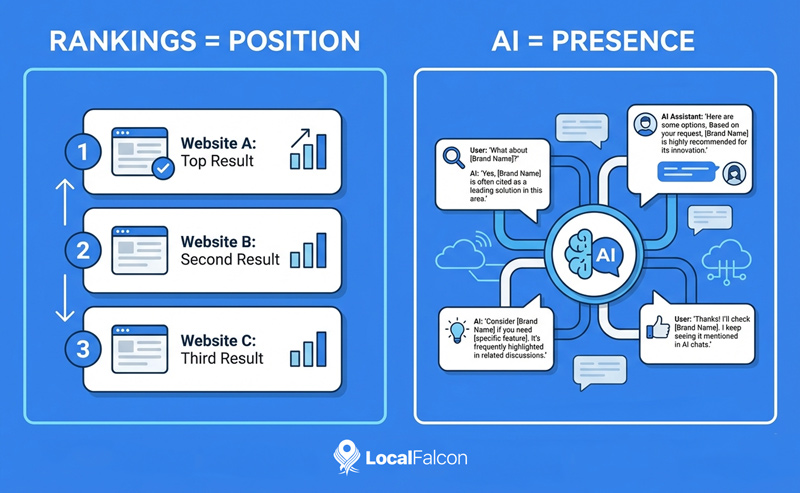
- SoLV is about position (how often your business appears in the local pack across all data points on a map)
- SAIV is about inclusion (whether you're mentioned at all in AI-generated responses to local queries)
You can potentially have a high SoLV, meaning you consistently appear in the Local Pack in your target area, but still be absent from AI responses, which is why tracking both your SoLV and SAIV is now essential.
How Local Falcon Measures Your Google Maps Rankings
Local Falcon measures Google Maps rankings using a geo-grid system that reflects how proximity actually works in real-world local search.
Instead of checking rankings from a single location, Local Falcon simulates searches from many precise coordinates across a defined area. This creates a far more accurate picture of where your business is visible — and where it's not.
Geo-Grid Data Points
Each scan places a grid of "pins" over a map. Every pin represents a unique search request sent to Google Maps from a specific latitude and longitude.
This allows Local Falcon to show how rankings change block by block and neighborhood by neighborhood, rather than assuming a single static ranking.
Ranking Positions
For each pin in the grid, Local Falcon identifies where your business ranks for the target keyword:
- Positions 1-3 (highly visible — in the Local Pack)
- Positions 4-20 (somewhat visible)
- Positions 20+ (essentially invisible)
This data reflects how a real user standing at that exact location and performing the same query would see the Google Maps results.
Core Google Maps Ranking Metrics
Local Falcon reports this data using several key metrics:
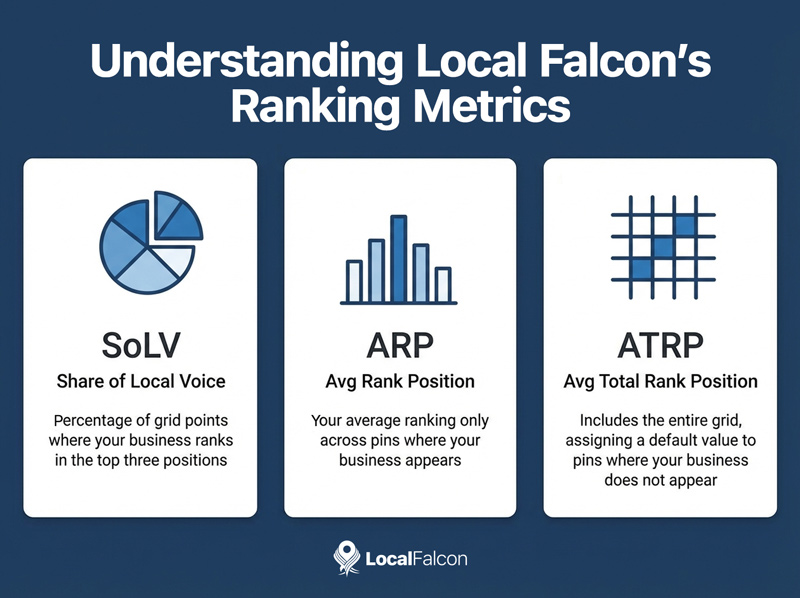
- Share of Local Voice (SoLV): SoLV is the percentage of grid points where your business ranks in the top three positions. This is the clearest indicator of your dominance within the Local 3-Pack across an area.
- Average Rank Position (ARP): ARP calculates your average ranking only across pins where your business appears. It helps you understand how strong your visibility is when you are actually present.
- Average Total Rank Position (ATRP): ATRP includes the entire grid, assigning a default value to pins where your business does not appear. This gives a more realistic view of overall visibility gaps.
Local Falcon Scan Reports also include additional Metric Insights based on competitive analysis that tell you your potential for SoLV improvement (OSoLV), how far away from your location you are ranking (SoLV Distance), and who your active competitors actually are (you don't need to worry about low-ranking businesses!).
Why This Matters
Proximity is the single most important ranking factor in local search. Local Falcon's geo-grid approach allows you to clearly see:
- Where your visibility begins and ends
- Where competitors outrank you
- How far your influence extends from your physical location
This level of precision is impossible with most traditional local rank-checking methods.
How Local Falcon Measures Your AI Visibility
AI visibility requires a different measurement approach. There is no fixed ranking list and no universal format for AI responses. That's why Local Falcon uses Share of AI Voice to quantify your presence across generative platforms.
Platform Coverage
Local Falcon scans across major AI -driven search platforms, including:
- ChatGPT
- Google AI Overviews
- Gemini
- Grok
- Google AI Mode
This ensures visibility is tracked where users are most actively asking AI for local recommendations and seeing AI-generated overviews before traditional results.
Brand Mentions Instead of Rankings
Instead of checking local rankings across the geo-grid map, Local Falcon analyzes AI responses to prompts at each data point.
The system evaluates whether your business is:
- Mentioned by name
- Recommended directly
- Included in a list or summary
If your business appears, it counts toward your AI visibility.
SAIV as a Percentage
SAIV is essentially a percentage that represents how often your business appears across all scanned AI responses.
For example, if your business is mentioned in 4 out of 10 AI responses, your SAIV is 40, equivalent to 40%.
This provides a clear, comparable metric for AI search performance — similar in spirit to SoLV, but designed for generative AI results.
Pseudo-Rank Metrics (ARP/ATRP)
Because AI responses are often paragraphs or lists, Local Falcon assigns a pseudo-rank based on the order in which businesses are mentioned.
This allows Local Falcon to calculate ARP and ATRP-style metrics for AI visibility, helping you understand not just if you appear, but how prominently.
How Local Rankings and AI Visibility Work Together
Tracking Google Maps rankings or AI visibility in isolation only tells half the story. Together, they reveal how often users discover your business across the full spectrum of the modern customer journey.
Immediate Intent vs Research Intent
Google Maps and AI search often serve different user needs:
- Google Maps captures high-intent, "near me"-type searches
- AI platforms support research, comparison, and decision-making
In this sense, SoLV measures your local dominance at the moment of intent, while SAIV measures your "recommendability" when AI synthesizes information to guide a decision.
Technical Synergy Between Google Maps and AI
There is also a direct technical connection between Google Maps listings (Google Business Profiles) and Google's AI search features.
Google AI Overviews, AI Mode, and Gemini rely heavily on Google Business Profile data. If your business is not visible in the Map Pack, your likelihood of being selected as an "AI pick" drops significantly.
Conversely, if you rank well on Maps but have low AI visibility, it often signals missing trust signals from other areas of local SEO, such as weak structured data, inconsistent citations, or limited authority.
Future-Proofing Your Local SEO Strategy
Google Business Profiles remain the single biggest driver of local business traffic. However, AI is rapidly carving out a larger share of discovery.
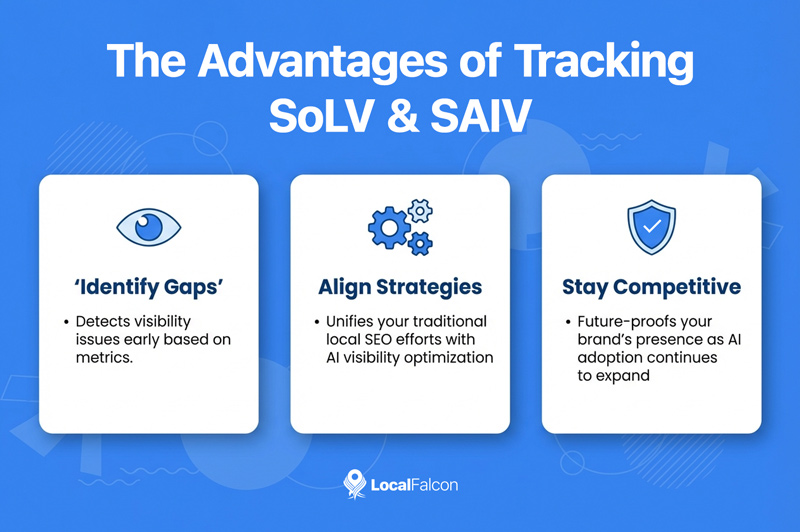
By tracking both SoLV and SAIV, Local Falcon helps businesses:
- Identify visibility gaps early
- Align traditional local SEO and AI visibility optimization strategies
- Stay competitive as AI adoption grows
This dual-measurement approach ensures you are optimized not just for today's search behavior, but for where local discovery is heading next.
Conclusion
Local search is no longer defined by a map and three business pins. Customers now discover businesses through a mix of Google Maps, AI summaries, and conversational recommendations across multiple platforms.
Local Falcon bridges this gap by measuring both where you rank and where you're mentioned. With Share of Local Voice and Share of AI Voice, businesses gain a complete, accurate view of their real-world visibility.
When you understand how these two signals work together, you can refine your strategy, strengthen your authority, and ensure your business is found — whether the customer is searching on Google Maps or asking AI for advice.