
The heyday of platforms like Expedia, Booking.com, and Tripadvisor as the default starting point for travel research is over. People still book through those platforms, but they're no longer where the discovery happens. Increasingly, travelers open ChatGPT, Gemini, or Google's AI Mode and ask a conversational question instead of scrolling through a list of travel accommodation listings. They describe what they want in plain language and expect a short, confident answer with two or three names in it.
For hotels and resorts, this change in search behavior has a profound effect on which brands get found. A property that has spent years building a strong Google Business Profile and a solid position in the local pack can still be completely absent from the answer an AI assistant gives when someone asks where to stay. Generative engine optimization (GEO) is the discipline built around closing that gap, and hospitality brands need tools designed specifically for it.
Why Generative Engine Optimization for Hotels & Resorts Matters
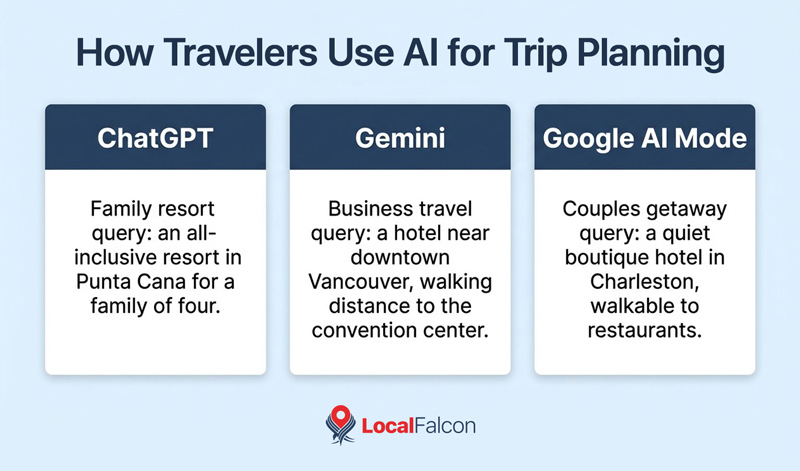
Let's consider how a traveler might actually use AI to plan a trip today:
- Someone asks ChatGPT which all-inclusive resort to book in Punta Cana for a family of four.
- A business traveler asks Gemini for a hotel near downtown Vancouver within walking distance of the convention center.
- A couple asks Google's AI Mode for a quiet boutique hotel in Charleston under $400 a night, walkable to restaurants.
In each case, the AI doesn't return a list of three Google Business Profiles or ten blue links to choose from. It names a small handful of options, sometimes just one or two, and that answer shapes where the booking goes. If a hotel or resort doesn't appear in that answer, it loses the guest before the guest ever sees a website or Maps listing. And many hotels are still missing from AI-generated local search results.
Local Falcon's own research into restaurant visibility, a comparable local-service category, found that the majority of restaurants showing up reliably on Google Maps are invisible when the same searches are used to generate AI Overviews.
In other words, strong local pack rankings and years of Google Business Profile reviews don't automatically carry over into AI recommendations, and many hospitality brands face the same disconnect: a property can dominate its local Google 3-pack and still be left out of AI-generated overviews and recommendations for its market.
It's also important to understand that GEO is not only about getting named by AI. It's also about how a brand is described when it's mentioned. An AI assistant that mentions a hotel but pairs it with lukewarm sentiment, outdated amenity information, or a vague description isn't doing the property many favors. Positive AI brand sentiment, meaning the AI actively recommends a property with confidence and accurate detail, is what actually drives a click or a booking decision. Managing that requires visibility into how AI platforms are talking about a brand and its competitors, not just whether the brand shows up at all.
All of this is going on right now, but the stakes are about to get even higher. Google has named hotel booking as the next vertical for its Universal Commerce Protocol, the infrastructure that lets AI agents complete purchases directly inside a conversation rather than routing a user to a website. Additionally, OpenAI has already opened ChatGPT to travel booking partners for flights and hotels.
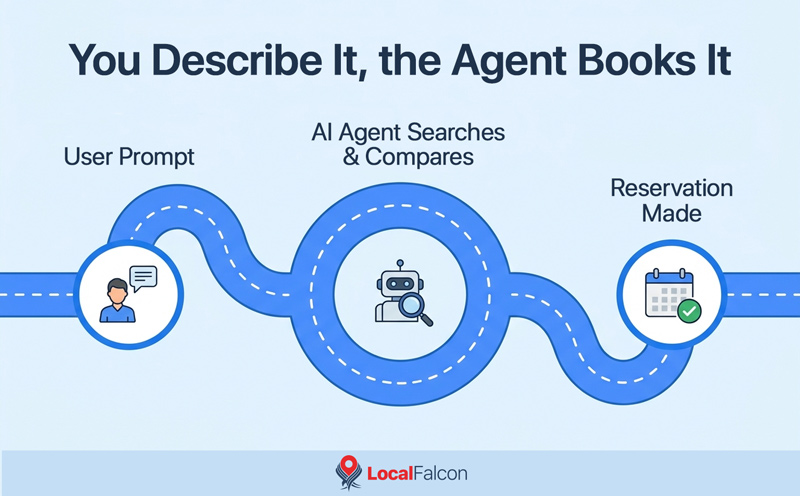
The direction is clear: travelers will increasingly hand off entire booking tasks to an AI agent, describing their criteria once and letting the agent search, compare, and book on their behalf. A guest might tell an agent to watch for a beachfront resort in a given city under a certain nightly rate with a flexible cancellation policy, and the agent checks continuously until a match appears, then completes the reservation without further input. A hotel that isn't optimized enough for that agent to find doesn't get considered for the booking. It doesn't just lose out on a click. It loses the reservation entirely, and the agent books a competitor instead.
Here Are the Best Generative Engine Optimization Tools for Hotel Industry Brands
AI search platforms behave very differently to traditional search engines. Rather than trying to match results to a user's keywords, they break prompts down and fan them out into multiple related queries based on intent and conversational context.
Manually tracking and improving visibility across the virtually infinite number of queries a brand could appear for in generative AI platforms isn't realistic for any hotel, let alone those brands managing more than one property. That's where GEO tools for hotel industry generative engine optimization come in.
But general-purpose GEO tools aren't enough. Hotels need generative engine optimization tools that go a step further than high-level brand monitoring: platforms built for local and multi-location businesses that can show AI visibility, sentiment, and competitive standing at the geographic level, city by city and property by property, not just as a single national-level score.
1. Local Falcon
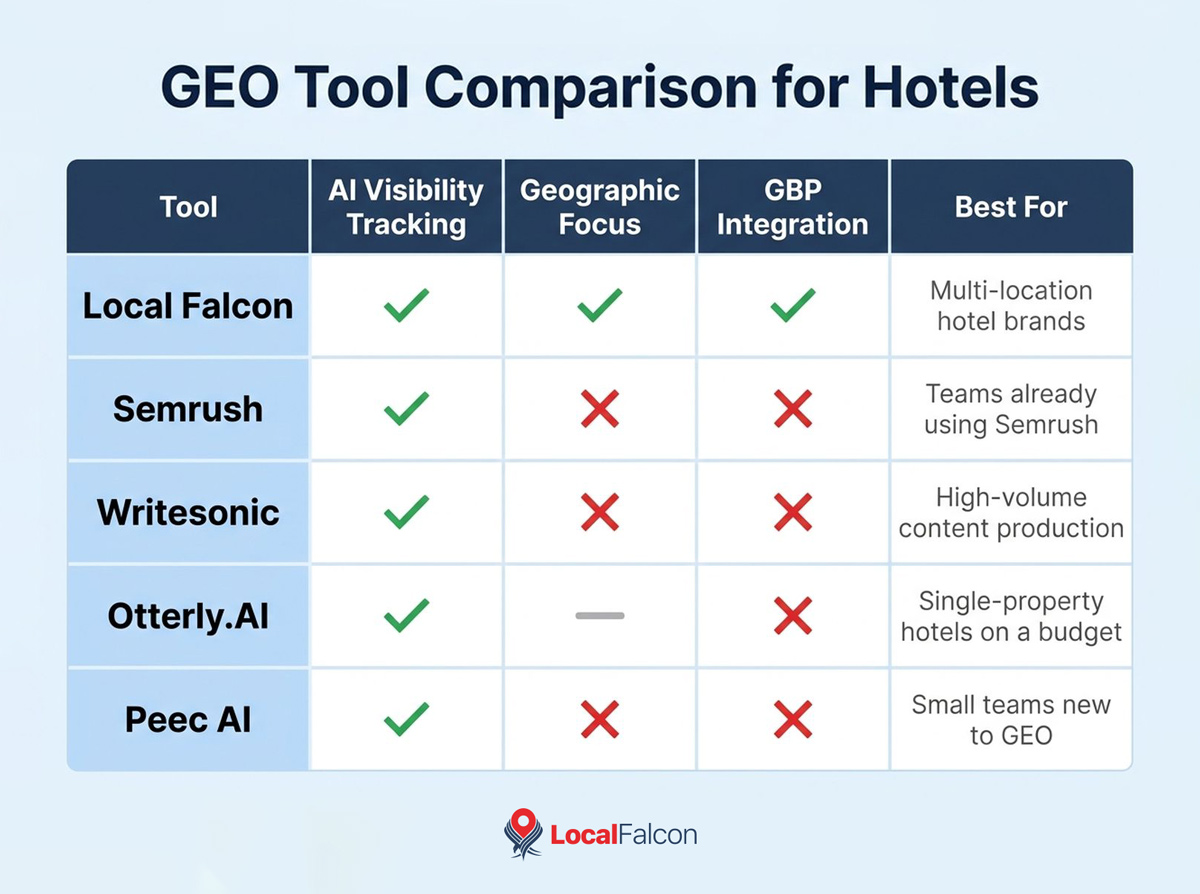
Local Falcon is the clear standout generative engine optimization platform for hospitality brands because it was built around geographic granularity from the start, which is exactly what GEO tools built for national or global brand tracking tend to miss. A hotel chain doesn't need to know its aggregate AI visibility score. It needs to know how it's showing up in AI searches for the markets it has locations in.
Local Falcon's AI visibility tools let hospitality brands run geo-grid rank tracking style searches across leading AI platforms the same way they've long done for traditional local rankings, showing exactly where a property is mentioned, where it is invisible, and which competitors are winning the strongest recommendation instead. The AI sentiment analysis surfaces how positively or negatively an AI platform is describing a property, so a hotel brand can see not only whether it's included in AI-generated answers but also whether the AI is actually selling it.
Beyond its geographic granularity, what sets Local Falcon apart from other GEO tools for hotels is that it doesn't treat AI visibility as a separate initiative from local SEO. It's built on the same platform many hotels already use for local rank tracking and Google Business Profile optimization, so AI visibility data sits alongside map pack rankings, Google review data, and GBP listing management in one place. That matters because some generative AI models, like Gemini, draw on the same GBP signals that drive local pack rankings.
For multi-location hospitality brands specifically, Falcon Agent is another incredibly valuable Local Falcon feature. It automates the GBP maintenance that Google's AI relies on for accurate, current information: responding to reviews, publishing posts, and pushing updates across every property in a portfolio without a corporate marketing team manually logging into dozens of individual profiles.
Using Falcon Agent, a resort chain with properties in dozens of markets can keep every listing current and every review answered without the operational drag that normally makes multi-location GBP management an uphill battle. Since AI platforms favor brands with complete, accurate, and recently updated business data, that consistency directly supports AI visibility, not just traditional local rankings.
2. Semrush AI Visibility Toolkit
Semrush added an AI Visibility Toolkit on top of its existing SEO suite, and it's a reasonable option for a hotel brand that already lives inside Semrush for keyword research and backlink tracking. It tracks brand mentions and sentiment across multiple generative AI platforms, and its prompt research tool works similarly to keyword research, surfacing the questions travelers are actually asking. What it doesn't offer is geographic-level tracking built for local and multi-location businesses or any connection to local listing management. It's a monitoring layer bolted onto a general SEO platform, not a purpose-built local GEO tool.
3. Writesonic
Writesonic started as an AI content generation platform and has since added a GEO monitoring layer that tracks brand mentions across several AI engines. It's a reasonable fit for a hotel marketing team that wants to pair AI visibility tracking with high-volume content production. But the visibility tracking itself is generalized and not built for the geographic nuance a hospitality brand needs, and it has no local SEO or GBP management component at all.
4. Otterly.AI
Otterly.AI is a lightweight AI visibility monitor that tracks brand mentions and citations across several AI platforms at a lower price point than most enterprise tools. It works as a simple dashboard for a single-property hotel that just wants a basic read on whether it's showing up in AI answers. It has no local search integration and nothing built specifically for hospitality or multi-location brands.
5. Peec AI
Peec AI focuses on straightforward, easy-to-read visibility tracking, including a prompt suggestion feature that helps brands figure out what travelers are actually asking AI platforms. It's approachable for smaller teams getting started with GEO, but like the other tools on this list outside of Local Falcon, it's a standalone monitoring layer. It doesn't tie into local rank tracking or GBP management and has no geographic grid functionality for comparing AI visibility market by market.
Conclusion
AI is the new hotspot for hotel discovery, and it's on track to become a transactional one as agentic booking rolls out across Google and other platforms. Hotels and resorts that treat GEO as an afterthought risk losing bookings to competitors they used to beat easily in the local pack.
The tools above all offer some level of AI visibility tracking for hotel industry GEO, but Local Falcon is the only one built specifically for the geographic granularity, localized competitive insight, and AI-powered GBP management that hospitality brands actually need to compete for those bookings.
FAQs on the Best GEO Tools for Hotel Industry Generative Engine Optimization
Why do hotels need generative engine optimization (GEO)?
Travelers are already planning and will soon be booking trips through conversational AI instead of starting with search engines or listing sites. A hotel that isn't optimized for AI visibility risks being left out of the shortlist entirely, regardless of how well it ranks in traditional local search. This is quickly becoming the new normal for how guests discover where to stay.
What do the best GEO tools for hotel industry businesses offer?
The strongest GEO tools for hotels track AI visibility and sentiment at the geographic level, show how a hotel compares to nearby competitors in AI-generated answers, and connect that data to the local SEO and Google Business Profile signals that influence it. Local Falcon is currently the only platform that combines traditional local SEO and GEO in one system built for hospitality brands.
Can a hotel rank well in Google Maps and still be invisible in AI search?
Yes, and it happens often. Local Falcon's research into a comparable local-service category, restaurants, found that a strong presence in Google Maps results doesn't reliably predict whether the same business shows up in AI-generated recommendations. The two search systems weigh signals differently, so hotels need to track them separately.
Will AI agents eventually book hotel rooms directly?
Google has already named hotel booking as the next vertical for its Universal Commerce Protocol, which lets AI agents complete purchases inside a conversation, and OpenAI has opened ChatGPT to hotel and flight booking partners. Full autonomous booking is still rolling out, but the infrastructure is actively being built.
How often should a hotel brand check its AI visibility?
AI answers are far less stable than traditional search rankings and can shift from one query to the next. Hotel brands, especially those with multiple properties, should track AI visibility on an ongoing basis rather than treating it as a one-time audit, the same way they'd monitor local pack rankings.