
The agency-client relationship has always been built on a combination of expertise and trust. Agencies interpret complexity, translate it into strategy, and execute on behalf of clients who lack the time, tools, or specialized knowledge to do it themselves.
AI hasn't changed that fundamental dynamic, but it has raised the bar for what "expertise" actually means, and what clients expect agencies to deliver.
Let's take a closer look at how AI has reshaped the client-agency relationship, and where the new dynamic gives rise to opportunities to strengthen that relationship, especially in the world of local and AI search visibility.
AI Services Are Now a Client Expectation, Not a Differentiator
Not very long ago, agencies could position AI adoption and expertise as a forward-looking competitive advantage, but that window has closed. Businesses now expect their agency partners to implement AI-powered marketing.
This expectation extends well beyond simple automation. Clients want their agencies actively managing AI visibility, optimizing for AI-driven search features and platforms, and executing campaigns through AI-powered workflows. Agencies that haven't yet built these capabilities into their service offerings are increasingly at a disadvantage, regardless of how strong their traditional SEO chops or media performance may be.
For local SEO agencies in particular, this creates a major opportunity. Local businesses are now highly dependent on how they appear in AI-driven search experiences, from Google's AI Overviews and AI Mode to conversational results in ChatGPT, Gemini, and Perplexity. Agencies that can track, optimize, and report on AI visibility at the local level offer something clients genuinely need to stay competitive.
The Scope of Agency Work Has Expanded
AI has not simplified what agencies do. In many ways, it has made the work more complex. The shift toward AI-powered marketing was shaped by the platforms clients use every day. Google, Meta, and other major advertising and analytics platforms have embedded AI deeply into their products, and as a result, businesses assume their agencies are operating at the same level of sophistication.
What this actually means is that agency teams are now expected to manage more channels, generate more granular insights, and iterate faster than manual workflows ever allowed. Clients no longer accept long feedback cycles or delayed insights. They expect rapid iteration, frequent reporting, and continuous optimization.
This broader scope benefits agencies that invest in the right tools. AI allows smaller agency teams to deliver capabilities that previously required much larger operations, particularly for local clients with multiple locations.
Agencies can use AI-powered marketing tools to deploy campaigns and automate workflows across hundreds or thousands of locations simultaneously, monitor performance in near real time, and quickly identify where adjustments are needed. That scale was not accessible to most agencies before AI, and it is now a genuine selling point for local and multi-location clients.
Google Business Profile optimization is one of the most pertinent areas where this plays out. GBP remains a foundational element of local search visibility, including for AI search, and the volume of ongoing work it requires, from responding to reviews and publishing posts to optimizing categories and maintaining accurate business data across locations, has historically made consistent execution difficult at scale.
AI agents like Falcon Agent change that by automating these workflows, enabling agencies to maintain a high standard of GBP management across every client location without proportionally scaling their team. For agencies serving multi-location clients, this is one of the most concrete ways AI translates into a stronger service offering and a more resilient client-agency relationship.
AI Has Added New Layers To Agency-Client Reporting and Measurement
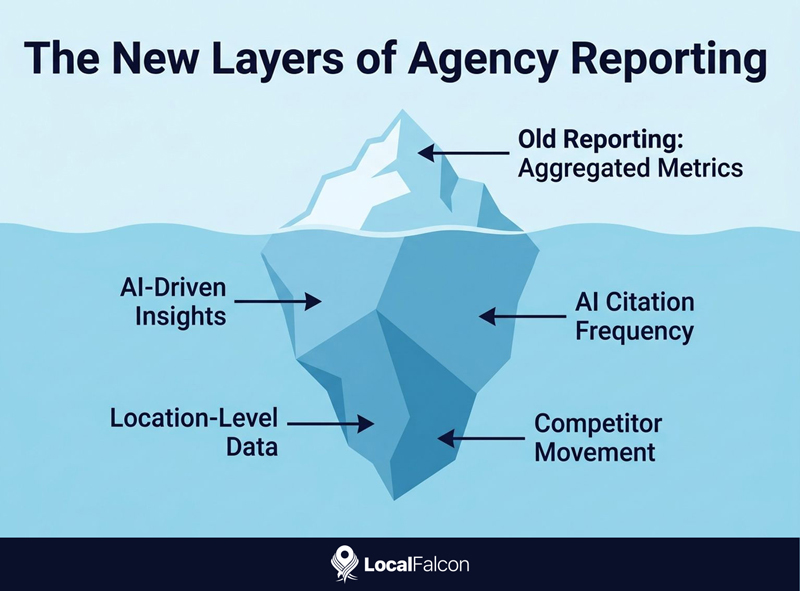
Another one of the most significant changes AI has introduced in terms of client-agency relationship dynamics is around reporting. Businesses want AI-driven insights that help them understand what's working, where it's working, and why. Clients increasingly expect these insights at the location level, market level, and platform level. Aggregated, overly broad metrics alone are no longer sufficient, particularly for businesses with physical locations.
This has changed how agency value is communicated. Reporting shouldn't just be a summary of activity, but rather an ongoing demonstration of strategic impact in real time. Agencies that can connect campaign performance to local search visibility, AI citation frequency, and competitor movement position themselves as true strategic partners rather than just vendors.
For local SEO, this means tracking how a client appears not just in traditional map pack results, but across AI-generated summaries and recommendations. Tools like Local Falcon provide granular, location-level AI visibility data that allows agencies to explain outcomes, justify investments, and proactively surface opportunities before clients think to ask.
Human Judgment Remains the Core Differentiator
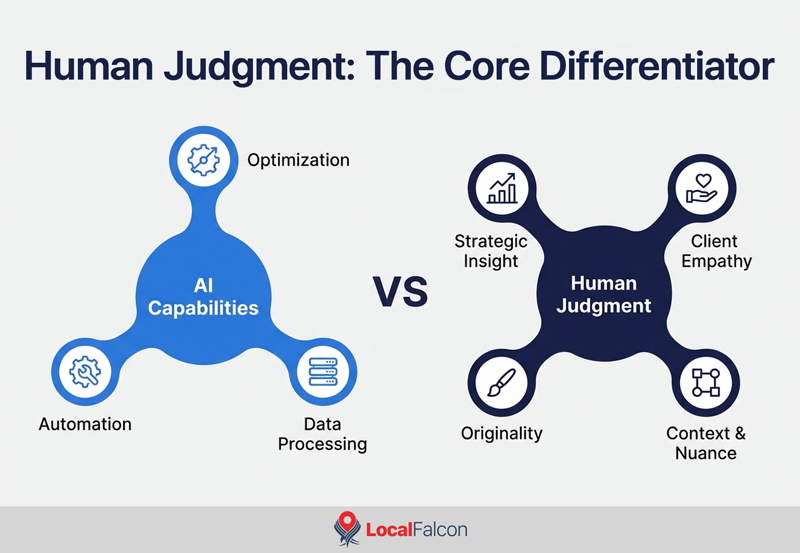
Despite the capabilities AI brings, what agencies have that AI cannot duplicate is their relational side: the ability to connect with others and understand, strategically, what business owners are actually after. AI can optimize, but it is not interested in who clients are as people and it doesn't sympathize with their specific pain points.
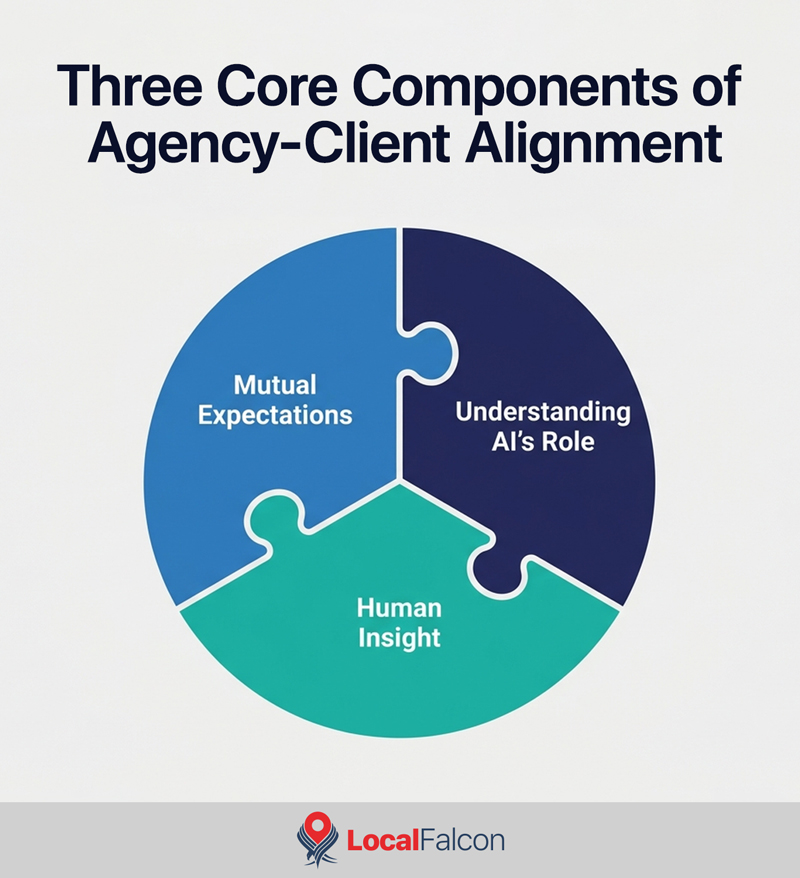
AI-generated output often lacks the nuance and originality that comes from human expertise, especially when it comes to content creation. Great agencies are now being asked not just to create content but to refine and humanize AI-generated content to get results. The key is alignment: setting mutual expectations, understanding what AI can and cannot do, and ensuring human insight remains at the core of all communication.
This is especially true in local marketing, where context matters deeply. A business serving a specific neighborhood has unique competitive dynamics, seasonal patterns, and audience nuances that require human interpretation. AI surfaces the data; experienced agency teams turn it into strategy.
The Agency-Client Relationship Is Stronger When AI Is Used Intentionally
The agencies that are navigating their new client-agency relationships the best are not simply adding AI tools to existing workflows "just because." They are rethinking how those workflows are structured, where human judgment is most valuable, and how to present AI-driven insights in ways that build client confidence.
In short, what differentiates agencies today is not whether they use AI, but how effectively they use it to execute campaigns, surface insights, and drive results. Agencies that embrace AI as a partner themselves will be better equipped to meet rising client expectations, build stronger agency-client partnerships, and remain relevant in an increasingly automated digital marketing ecosystem.
For local SEO agencies, that means building fluency in AI visibility optimization alongside traditional rank tracking, and being able to demonstrate how both contribute to client growth. The agencies that do this well will both retain clients and become harder to replace.