
When a user asks AI for information, they expect an output that is accurate and verifiable. However, that's not always the case. Across industries, generative AI is known to provide users with factually inaccurate information. For local businesses working to earn visibility and customers through AI-powered search experiences, these "AI hallucinations" present major risks.
Understanding what AI hallucinations are, what can cause them, the risks for businesses, and how to prevent or reduce AI hallucination is crucial for brands and marketers in order to maximize AI-driven conversions.
What Is AI Hallucination?
An AI hallucination happens when a large language model (LLM) presents false or fabricated information as if it were fact. The term describes an LLM perceiving patterns or generating content that doesn't actually exist or isn't grounded in reality, producing outputs that are nonsensical or flatly wrong.
The name borrows from human psychology, where a hallucination means perceiving something that isn't there. Applied to AI, it's a useful shorthand: these models sometimes work the same way humans see shapes in clouds or a face on the moon, misreading patterns and inventing structure that doesn't exist. The output can look and sound completely authoritative, which is exactly what makes it dangerous. There's no visual cue, no asterisk, no "I'm not sure about this part." The AI states it the same way it states things that are true.
AI Hallucination Examples
Some well-known AI hallucination examples include Google's Gemini (then known as Bard) incorrectly claiming that the James Webb Space Telescope had photographed the first images of a planet outside our solar system, ChatGPT fabricating six court cases, complete with made-up quotes, for a New York-based lawyer's legal brief, and Grok misreporting that the NBA's Klay Thompson was throwing literal bricks through windows (rather than missing shots).
What Causes AI Hallucinations?
There's often not a single, clean explanation for why an AI model hallucinates. A few overlapping factors tend to be responsible.
Bad or incomplete training data
If the data an AI model learned from contains errors, outdated information, or gaps, those flaws can surface in its answers. The model doesn't know the difference between a reliable source and an unreliable one unless it's been specifically trained to weigh that distinction.
No built-in way to verify reality
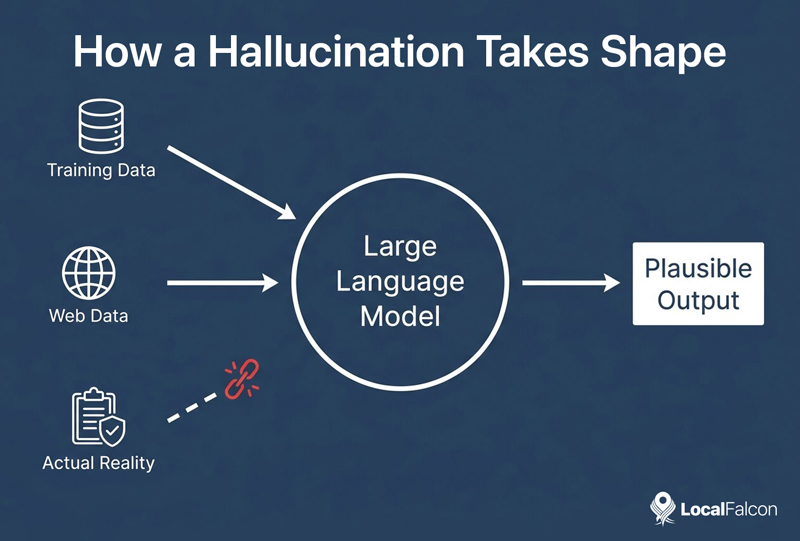
This is the root of the problem. An LLM can only draw from the patterns in the data it was trained on and that it retrieves fresh from the web in real time. It has no independent way to check whether a statement is actually true right now.
Because the model has no direct way to know if a statement is currently true, it can only match patterns from training and cannot cross-check its output against actual reality. Feed it flawed inputs and it will just as confidently produce flawed outputs.
Filling in the gaps
When an AI model doesn't have solid information about something, it doesn't usually respond with "I don't know." It tends to generate the most statistically plausible answer instead, essentially guessing in a way that sounds authoritative.
This has been compared to a people-pleasing instinct: the model is optimized to give a satisfying, fluent answer, and a confident guess often reads as more satisfying than an admission of uncertainty.
The prompt itself
Even how a user's question or request is phrased can push an AI model toward hallucination. Ambiguous, open-ended, or highly specific questions about lesser-known subjects tend to make a model "guess" more, filling gaps with whatever sounds fluent rather than what's accurate. A user who keeps pushing for an answer, or rephrases a question repeatedly, can sometimes coax a model into fabricating something just to be agreeable.
Put simply, a hallucinating AI model isn't lying in the human sense. It doesn't know it's wrong. It's producing the most plausible-sounding continuation of a prompt, and plausible isn't the same thing as accurate.
Risks of AI Hallucinations for Local Businesses
Most major AI platforms include some version of a disclaimer warning users that the tool can make mistakes and that responses should be double-checked. In practice, a lot of users skip that step, especially for lower-stakes questions like "what time does this restaurant close" or "which hardware store is closest to me."
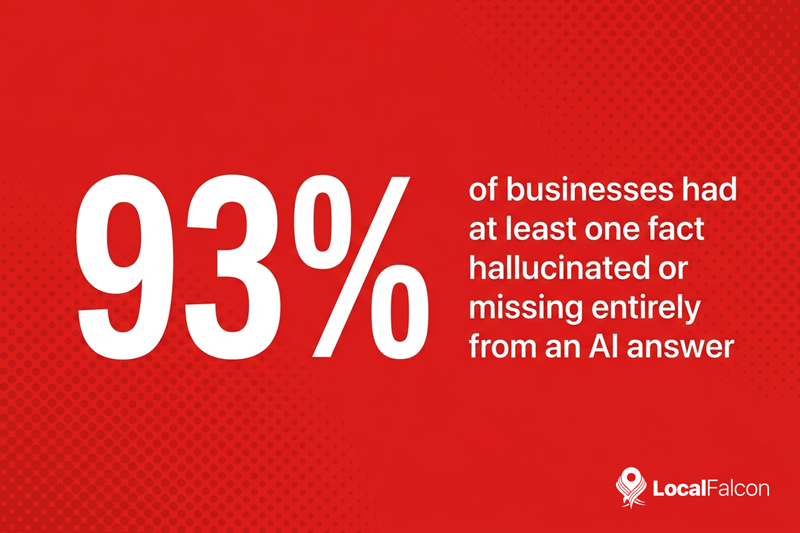
That's a real problem for local businesses, because the numbers on how often AI gets local details wrong are not small. Research querying ChatGPT, Perplexity, and Gemini more than 13,000 times about London-based companies found that 93% of businesses had at least one basic fact hallucinated or missing entirely from an AI-generated answer.
Smaller businesses were hit noticeably harder than large ones, with half of SMEs receiving at least one fabricated fact compared to about a third of large brands, and AI misattributing or confusing SME brand names roughly five times more often than those of larger brands.
The likely explanation for this disparity is that it's connected to larger companies typically having a wider digital footprint, since even a business with an accurate, optimized business website will struggle to surface as reliably in AI answers as one with substantial third-party validation across the web.
When AI gets a local business's information wrong, and a customer trusts that answer, the business is likely to lose the sale to whichever competitor happened to be represented more accurately.
Someone asking an AI assistant where to grab dinner tonight, which locksmith is open right now, or which HVAC company services their zip code isn't going to cross-reference the answer against five other sources. They're going to act on what the AI tells them, and if a business's info is wrong or the AI-generated answer points them somewhere else, that business gets passed over by potential customers.
Examples of AI Hallucinating Local Business Details
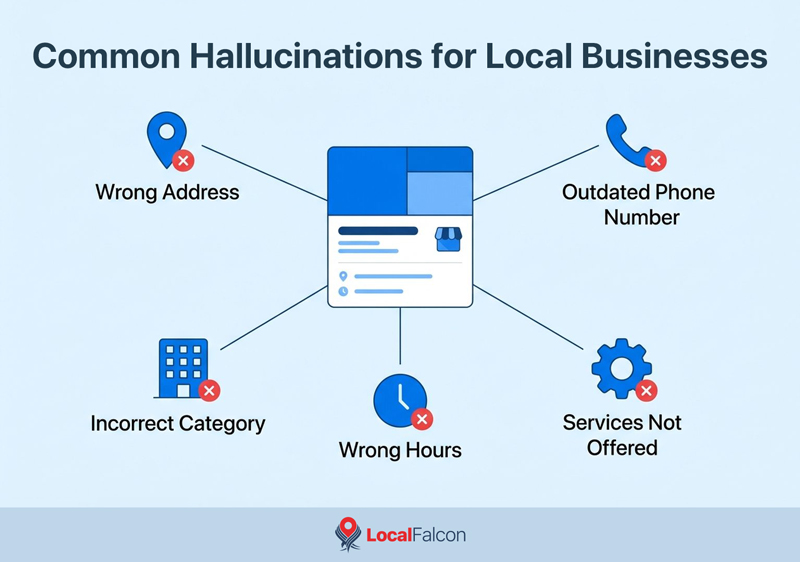
For local businesses specifically, hallucinations tend to cluster around a predictable set of details: the wrong address, an outdated phone number, an incorrect business category, hours that haven't been accurate in years, or services the business doesn't actually offer.
Some cases are more dramatic. There have been instances of AI recommending a business hours away by car in response to a clearly local query, something like "where can I watch tomorrow's World Cup match in [city]." In this example of AI hallucination, the AI wasn't being malicious. It likely simply didn't have strong, geographically specific data to draw from, so it filled the gap with something plausible-sounding that happened to be entirely wrong.
Generative AI models have frequently been found to be inaccurate when it comes to a business's contact details, including name, address, and phone number (NAP); the exact kind of practical information a potential customer needs to actually visit or call a business. Because of where AI models like Gemini get local business info, all it takes is one wrong source for AI to hallucinate and present a business inaccurately.
That's why AI hallucinations are such a problem for local businesses. AI can get precisely the details that determine whether a customer shows up wrong, ultimately sending them elsewhere (read: through a competitor's doors).
How To Prevent AI Hallucinations for Local Searches
The good news is that AI hallucinations about your business aren't unfixable. This process overlaps with monitoring your AI visibility and brand sentiment, but it's a distinct exercise.
Visibility is whether AI mentions your business at all, while sentiment has to do with whether the AI frames your business positively or negatively. Preventing AI from hallucinating business details, on the other hand, revolves around ensuring AI is getting the facts straight in the first place.
Start With an Audit
Before you can fix anything, you need to know what AI is currently saying about your business. Ask the same questions a real customer would ask, across the platforms your customers are likely to use, and compare the answers against what's actually true.
A tool like Local Falcon can help here, letting you check real AI responses across a specific geographic area, whether that's a single neighborhood, a whole city, or every zip code in your service area.
Find and Fix the Source
Whenever you spot an AI hallucination or a factual inaccuracy, look at what source the AI is citing (if it cites one at all). Sometimes the fix is as simple as updating an old directory listing or correcting an outdated Google Business Profile that the AI happens to be pulling from.
Local Falcon's AI visibility reports include a list of all sources found in the scan, for every geo-grid data point and competitor included. This makes it much easier to identify and fix the root causes behind any local AI hallucinations you come across.
Widen Your Digital Footprint
If there's no obvious source behind the wrong answer, that's often a sign the AI simply doesn't have enough reliable information about your business to work with, so it's filling the gap with a guess.
This is where larger brands have an innate advantage. They tend to have far more third-party mentions, press coverage, and citations across the web, giving AI more material to cross-reference. Smaller businesses can close that gap by deliberately building out their presence:
- Getting listed and keeping information up to date and accurate across relevant local directories
- Earning mentions in local press, industry publications, blogs, or community sites
- Making sure your Google Business Profile, website, and other core assets are complete and consistent
- Encouraging and responding to customer reviews, since that content also feeds AI training and real-time data retrieval
A useful tactic here is to look at where AI is mentioning or recommending your competitors accurately, then checking whether your business has a comparable presence on the sources it cites for those answers. If a competitor is listed on a niche local business directory or mentioned by a regional publication or local blog and you're not, that's a concrete gap you can work to close.
Final Thoughts
While AI hallucinations are frustrating, especially for local businesses working to drive business through AI search, remember that not every AI hallucination requires a huge effort to fix.
Sometimes it's just a matter of making a quick correction somewhere, like updating an outdated address on one listing.
Other times, especially when AI seems to have no clear source for a hallucination, it may take longer to build up enough credible mentions elsewhere until the AI has better material to draw from the next time someone asks something related to your business.
The key is that AI hallucinations are not the end of the world for a local brand. Just as you can work to fix negative brand sentiment in AI, you can take steps to increase accuracy.
Regardless of whether you want to increase AI search visibility, improve AI brand sentiment, or prevent AI hallucinations, the first step is measurement.
FAQs on AI Hallucinations
What is an AI hallucination?
An AI hallucination is when a generative AI tool presents false, fabricated, or inaccurate information as if it were verified fact, often stating it with the same confidence it uses for accurate information.
Why do AI hallucinations happen?
They typically stem from gaps or errors in training data, a lack of any built-in fact-checking mechanism, and AI models' tendency to generate a plausible-sounding guess rather than admit uncertainty.
How common are AI hallucinations for local businesses?
Very common. Research testing major AI platforms against real local business data found that the vast majority of businesses had at least one factual error in how AI described them.
Can small businesses do anything about AI hallucinations?
Yes. Auditing what AI currently says about your business, correcting inaccurate sources, and building a stronger footprint of accurate third-party mentions all reduce the chances of AI generating wrong information about you.
Is an AI hallucination the same as negative AI sentiment?
No. Sentiment refers to whether AI frames a business positively or negatively, or how persuasively it recommends for or against choosing the business. An AI hallucination relates to factual accuracy, or whether the AI's information about a business is even correct in the first place.