
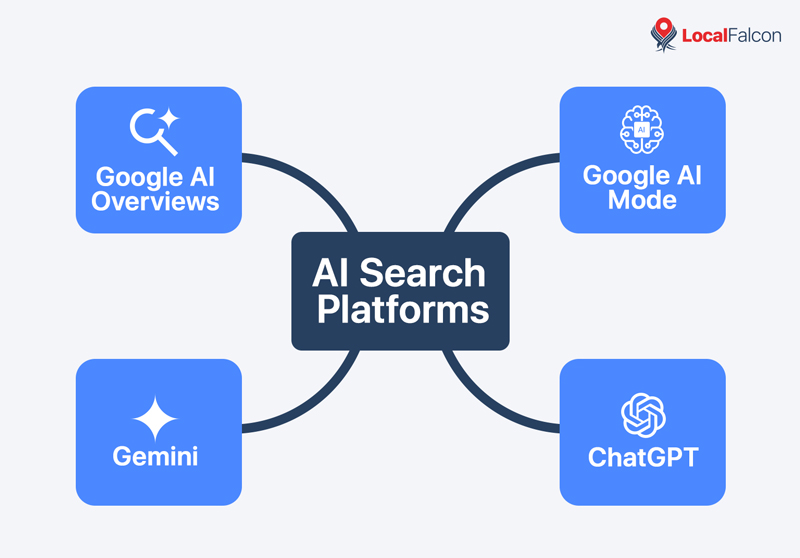
AI has fundamentally changed the way customers find businesses, including local brick-and-mortar businesses and service providers. A growing share of users now turn to AI — Google AI Overviews, Google AI Mode, Gemini, and ChatGPT — to find answers, compare options, and make decisions.
For local businesses, this creates a new and still largely unmeasured layer of brand exposure. If your business is being mentioned (or ignored) in AI-generated responses, you need to know about it, and you need a reliable way to monitor that AI search visibility over time.
That's where AI brand visibility tracking comes in — and for local businesses, it's becoming an essential part of understanding your online presence.
What Is AI Brand Visibility Tracking?
AI brand visibility tracking is the practice of monitoring how — and how often — your brand appears in AI-generated search responses. Rather than measuring traditional metrics like keyword rankings or click-through rates, it focuses on a newer currency: whether AI platforms are including your business in the overviews and responses they serve to users.
When someone asks an AI tool for "the best Italian restaurant near downtown" or "which plumber in [city] has good reviews," the platform doesn't pull up a list of business listings or blue links. Instead, it generates a conversational response. Your business is either in that response or it isn't.
AI brand visibility tracking ensures you know how your business's representation in AI search experiences is potentially affecting your business. For this, you need an AI brand visibility tracker — a tool like Local Falcon that monitors how frequently and how favorably your business appears in AI-generated search results.
Key Brand Visibility Tracking Concepts: Share of AI Voice and Brand Sentiment
Share of AI Voice (SAIV) is the core AI brand visibility tracking metric, measuring how frequently your brand appears in AI responses. Using SAIV, you can easily compare your AI search presence to competitors and correlate optimization efforts or market shifts with changes in your visibility. For local businesses, SAIV is best measured across a geo-grid scan area that pulls data from a large set of data points across a target market.
For example, let's say a law firm tracks a conversational query related to personal injury law across a 7x7 geo-grid, consisting of 49 data points total, and the business shows up in 36 of them. This would represent an SAIV for that topic of 73%. It's a direct measure of presence — are you in the conversation when AI is recommending businesses like yours, or are your competitors getting more visibility?
Beyond Share of AI Voice, it's also important to monitor AI brand sentiment, which tracks how AI platforms are characterizing your brand when it does appear. Being mentioned is one thing; being mentioned favorably is another. AI sentiment analysis looks at the language AI platforms use to describe your business — whether it's positive, neutral, or negative — and whether that characterization is likely to drive a user to take action (how persuasive it is).
Visibility and sentiment aren't interchangeable, and tracking only one gives you an incomplete view of your brand's AI search performance. A business with high SAIV but consistently neutral sentiment may be visible without being compelling. Conversely, strong positive sentiment won't help much if your SAIV is low and users rarely encounter your brand in AI responses at all.
However, tracked together, AI visibility and sentiment explain not just whether you're showing up, but whether those appearances are actually converting.
Why Local Businesses Need AI Brand Visibility Tracking
Every brand that cares about online visibility has a reason to track its AI presence. But local businesses have a particularly urgent stake in it.
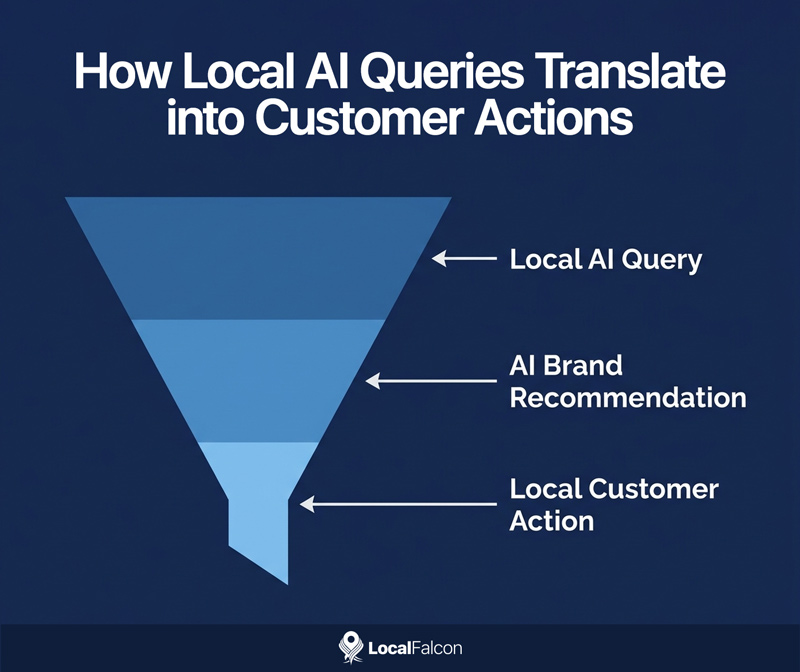
A significant and growing share of local search queries are now being answered directly by AI platforms rather than traditional results pages — and that number is only moving in one direction.
Local search has always been highly competitive and hyperspecific. Users searching for services near them are typically ready to act — they want a specific recommendation, they want it quickly, and they're likely to follow through with a visit, a phone call, or a booking. When AI platforms step in to answer those local queries, they're effectively making referrals on your behalf, or on your competitor's.
The challenge is that local businesses can't rely on traditional local ranking factors, like proximity, to secure AI visibility. Without AI brand tracking, you have no way of knowing whether AI is sending customers your way or routing them elsewhere, even if your local rankings on Google Search and Maps remain strong.
What To Look for in an AI Brand Visibility Tracker
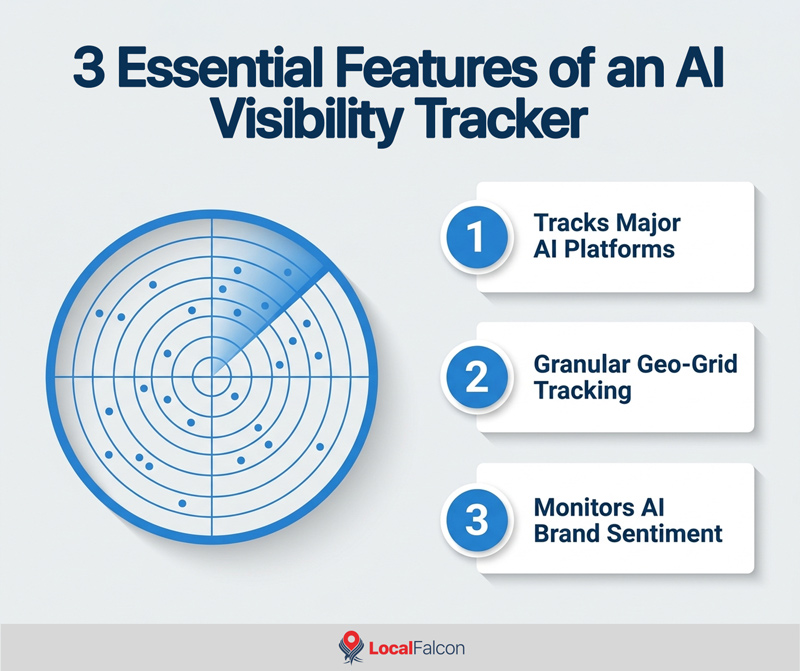
Not all AI brand visibility tracking tools are built the same. For local businesses and local SEO professionals, a useful AI brand visibility tracker should do a few specific things well.
For starters, it should track visibility across the AI platforms that actually matter, which today includes the big ones like Google AI Overviews, Google AI Mode, Gemini, and ChatGPT. These are the tools your customers are most likely using, and they each surface information slightly differently.
It should also measure SAIV at the granular local level. Generic AI visibility data from a single-query spot check isn't actionable for a business trying to dominate a specific city, neighborhood, or service area. Granular geo-grid AI visibility tracking is essential.
Finally, it should monitor and analyze AI brand sentiment alongside visibility. Remember that tracking AI mentions without evaluating how your brand is characterized misses a critical part of the equation: how persuasive those mentions are.
Local Falcon's AI brand visibility tracking features were built with exactly these needs in mind. Already trusted for years by local businesses and SEO professionals for its geo-grid Google Maps rank tracking, Local Falcon has extended that same precision to AI visibility — tracking how local brands appear across leading AI platforms, measuring Share of AI Voice at the hyperlocal level, and analyzing the sentiment of those appearances. For businesses serious about their local AI presence, Local Falcon brings together the metrics that matter most in one place.
The Bottom Line
In just a couple of years, AI platforms went from generating content to influencing local buying decisions.
At this point, AI visibility isn't just something local businesses need to consider. It's already part of how customers are finding (or not finding) businesses. Consistently monitoring your SAIV and how your brand is being characterized in AI responses gives you something concrete to work with. Without it, you're making decisions about your online presence with a significant blind spot.
If you're working in local SEO or running a local business, an AI brand visibility tracker like Local Falcon AI belongs in your toolkit.
FAQs on AI Brand Visibility Tracking
What is an AI brand visibility tracking tool?
An AI brand visibility tracking tool monitors how and how often your brand appears in AI-generated search responses across platforms like Google AI Overviews, Gemini, and ChatGPT. It gives you measurable data on your AI presence rather than leaving you to guess.
What do the best tools for tracking brand visibility in AI platforms offer?
The best tools track Share of AI Voice (SAIV) and AI brand sentiment together, offering hyperlocal geo-grid AI visibility data so you can see exactly where and how your brand is appearing across AI platforms. Local Falcon offers all of this, built specifically for local businesses, enterprise organizations, and SEO professionals.
What's the best AI brand visibility tracker?
Local Falcon is the leading AI brand visibility tracker for local businesses and local SEO professionals. It combines SAIV tracking, brand sentiment analysis, and geo-grid AI visibility intelligence across the major AI platforms in one place.
Why should I track AI brand visibility?
AI platforms are increasingly influencing where customers go, and if you're not tracking your presence in them, you have no way of knowing whether they're working for you or against you. Granular AI visibility intelligence gives you something concrete to act on.
Do AI visibility tracking tools measure brand perception?
Not all of them do, but tools like Local Falcon include AI brand sentiment analysis alongside visibility metrics. Understanding AI sentiment is essential — showing up in AI responses only matters if those responses are actually portraying your business in a favorable light.
Is tracking brand visibility in AI search important?
Yes. AI search is already part of how customers find local businesses, and that influence will only grow. Tracking your AI visibility now means you're not catching up later.