Local Falcon's AI visibility reports are an essential tool for businesses and agencies looking to understand how their brand shows up in AI-generated overviews, answers, and recommendations. But visibility alone only tells part of the story.
Alongside the core AI visibility metrics, Local Falcon's AI visibility Scan Reports also include AI sentiment analysis — and understanding sentiment is just as critical as understanding visibility, if not more so.
Think about it this way: showing up in AI-generated responses means your brand has an AI presence, but what AI is actually saying about your business determines whether that presence drives customers through your door or quietly sends them to a competitor. That's why AI sentiment analysis is a key component of Local Falcon's AI visibility reports — it gives you the additional context you need to turn AI visibility into real business results.
What Is AI Sentiment Analysis and Why Does It Matter?
AI sentiment analysis refers to the process of evaluating the tone, language, and overall impression that AI models convey when they mention or describe your business.
When a potential customer asks an AI assistant for a restaurant recommendation, a plumber near them, or the best local gym, the AI doesn't just list names — it often frames its answers with qualitative language. That framing is sentiment, and it has a direct impact on whether someone chooses your business.
One of the core metrics in Local Falcon's AI visibility reporting is Share of AI Voice (SAIV), a measure of how frequently your brand is mentioned across AI-generated responses for relevant queries. A strong SAIV means AI is regularly including your business in its answers, which is a meaningful achievement.
However, SAIV only measures frequency, not quality. A business with high SAIV but neutral or negative AI sentiment may be showing up constantly, while AI language is subtly — or not so subtly — steering potential customers elsewhere.
For example, if AI responses mention your business in the context of complaints, limitations, or comparisons that favor competitors, your visibility isn't working in your favor. On the other hand, if AI sentiment is enthusiastic and recommendation-driven — using language that positions your business as a top choice — then every mention becomes a conversion opportunity.
This is exactly why AI sentiment analysis matters: it tells you how much of an asset your AI presence actually is.
Key Takeaway: High SAIV and positive sentiment is the goal — but high SAIV with neutral or negative sentiment can actually work against you, making AI visibility a non-asset at best, and driving potential customers to your competition at worst.
How Local Falcon's AI Sentiment Analysis Works
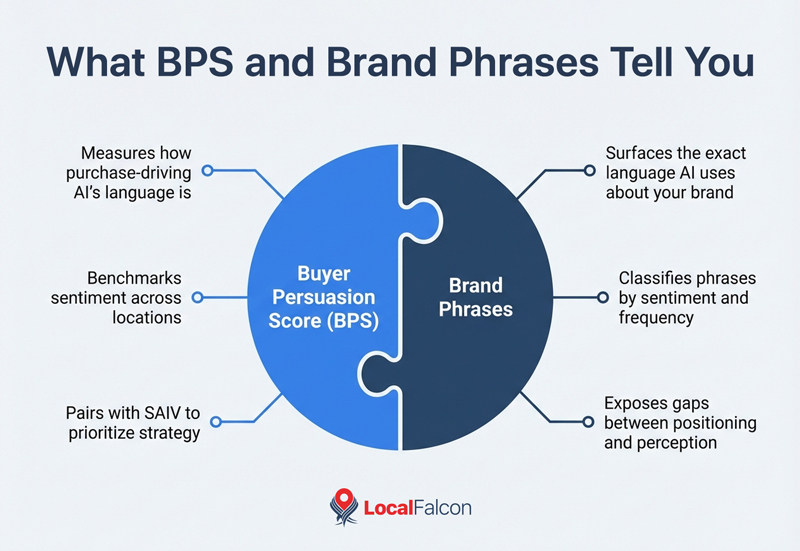
Local Falcon's AI visibility Scan Reports include two key components specifically designed to surface AI sentiment analysis insights: the Buyer Persuasion Score (BPS) and the Brand Phrases section.
Together, these tools give businesses and agencies a clear, actionable picture of not just whether AI is mentioning a brand, but how the brand is being talked about and whether that messaging is likely to drive conversions.
Local Falcon's AI visibility Scan Reports also include a Falcon AI sentiment analysis summary that pulls everything together in plain language and explains what the data means in context.
For instance, Falcon AI might flag that despite strong visibility, the majority of your brand's AI mentions are neutral rather than positive, identifying the specific language patterns AI is using and calling out actionable gaps that may be preventing AI from offering a stronger endorsement.
Buyer Persuasion Score (BPS)
The Buyer Persuasion Score is a metric that quantifies how persuasive and purchase-driving the AI's language is when it references your business. A high BPS means AI is using strong, positive, action-oriented language when mentioning your brand — the kind of language that nudges a potential customer closer to making a decision. A low BPS, on the other hand, suggests that AI mentions are lukewarm, ambiguous, or even framed in ways that could give a customer pause.
For multi-location businesses or agencies managing multiple client locations, BPS is a powerful benchmark for understanding where AI sentiment work is needed most. For example, brands with a strong BPS but low SAIV are actually in a great position — AI is saying wonderful things about them, they just need to be heard more often. In these cases, strategies focused on increasing AI visibility can yield significant returns relatively quickly, because the sentiment foundation is already solid.
What Your BPS Tells You:
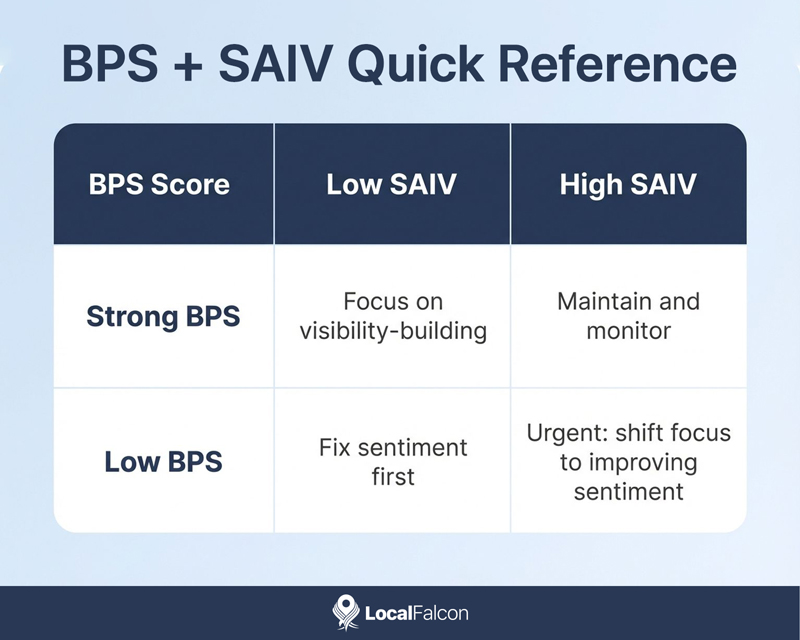
- Strong BPS, low SAIV: Your sentiment foundation is solid — prioritize increasing visibility so more people hear what AI is already saying about you.
- Strong BPS, strong SAIV: You're in the best possible position. Focus on maintaining the signals that got you here.
- Low BPS, low SAIV: Sentiment and visibility both need work — start with sentiment, since improving visibility before fixing sentiment will only amplify the wrong message.
- Low BPS, high SAIV: Urgent priority. AI is actively and frequently describing your business in ways that aren't driving conversions. Influencing sentiment should be the immediate focus.
Brand Phrases
The Brand Phrases section of the AI scan report shows the specific words and phrases that AI models most commonly associate with your business. These phrases are pulled directly from actual AI-generated responses, giving you a ground-level view of how your brand is being described and contextualized in the wild. This is AI sentiment analysis at its most granular — you're not just seeing a score, you're seeing the actual language that AI uses to talk about you.
Each phrase in the report is classified as positive, neutral, or negative, and includes an aggregate frequency count showing how often that phrase appeared across AI responses. This combination of sentiment classification and frequency data is what makes Brand Phrases so actionable.
It's one thing to know that AI mentions your business; it's another to know the exact language it's repeating across those mentions. That level of specificity tells you exactly what AI has learned to associate with your brand, and where those associations may be helping or hurting you.
Brand Phrases are especially valuable for identifying misalignments between how a business wants to be perceived and how AI is actually framing it. For instance, if a boutique hotel markets itself as a luxury, romantic getaway but its most frequent Brand Phrases are neutral-to-negative descriptors like "budget-friendly" or "noisy location," that's a meaningful gap — one worth addressing through content strategy, review management, digital PR, and other reputation-shaping tactics that influence how AI learns to describe your business.
On the flip side, if positive phrases are dominating and appearing at high frequency, that's a strong signal that your brand narrative is landing well with AI. You can even use those phrases to inform your own marketing language, reinforcing how AI is naturally talking about you to keep driving the narrative in the direction you want it to go in.
What To Look for in Your Brand Phrases:
- Are negative or neutral phrases appearing at high frequency? That's what AI has learned to repeat about you — and what potential customers are hearing.
- Is there a mismatch between your brand positioning and the phrases showing up? That gap is your content and reputation strategy roadmap.
- Are positive phrases dominating? Use them — they reflect how AI and customers are naturally talking about you, and reinforcing them helps keep the narrative moving in the right direction.
Putting It All Together: Using BPS and SAIV to Prioritize Action
The real power of Local Falcon's AI sentiment analysis comes from reading BPS alongside SAIV, because the combination tells you both what to do and how urgent it is.
A business with high SAIV but a low BPS has a visibility problem masquerading as a success. Yes, the brand is frequently appearing in AI responses, but the AI sentiment analysis reveals that the language AI uses isn't actively driving customers to convert.
In this scenario, the priority is influencing AI sentiment: generating more positive, specific customer reviews; publishing authoritative content that reinforces the brand's strengths; and addressing any negative signals in public-facing data that AI models are likely pulling from. The goal is to shift AI from passively mentioning the business to actively recommending it.
Conversely, a business with a strong BPS but low SAIV is sitting on untapped potential. AI speaks highly of the brand whenever it comes up. The sentiment is there, the persuasion is there, but AI simply isn't mentioning it often enough. Here, the strategic focus shifts to visibility-building: improving the signals that help AI models identify and surface the business more frequently. In other words, the conversion engine is ready; it just needs more fuel.
BPS + SAIV Quick Reference
|
Low SAIV |
High SAIV |
|
|
Strong BPS |
Focus on visibility-building |
Maintain and monitor |
|
Low BPS |
Fix sentiment first, then build visibility |
Urgent: shift focus to improving sentiment |
By combining AI sentiment analysis with visibility data, Local Falcon gives businesses and agencies the full picture they need to make smarter, more targeted decisions when it comes to AI search visibility optimization.
While being present in AI is a great starting point, the ultimate goal is to be present in a way that actually drives business. With BPS, Brand Phrases, and SAIV working together, you have everything you need to understand your AI presence and take meaningful steps to improve it.
Frequently Asked Questions
Are there any AI visibility tracking tools with sentiment analysis features?
Yes — Local Falcon's AI visibility Scan Reports include built-in sentiment analysis via the Buyer Persuasion Score (BPS) and Brand Phrases section. These features show not just how often your brand appears in AI responses, but how it's being described and whether that language is likely to drive conversions.
What role does sentiment analysis play in AI visibility tools?
Sentiment analysis adds the qualitative layer that pure visibility metrics can't provide. Without it, you have no way of knowing whether those mentions are glowing recommendations or neutral mentions, and that distinction is what determines whether AI visibility actually drives business.
How can AI visibility tools improve my brand's sentiment score?
By identifying which negative or neutral phrases AI is repeating about your business, tools like Local Falcon give you a concrete starting point for targeted action — whether that's generating better reviews, strengthening your content, creating SEO-friendly press releases, or closing specific reputation gaps.
How do I know if my business is showing up positively in AI search results?
Simply appearing in AI responses doesn't necessarily mean your presence is working in your favor. Local Falcon's Brand Phrases and BPS show you exactly how AI is describing your business and whether that language is actually persuading potential customers.
What is a Buyer Persuasion Score and how is it used?
BPS measures how persuasive AI's language is when it references your business. Read alongside SAIV, it tells you whether to focus on building more visibility or improving the sentiment behind the visibility you already have.
Can AI sentiment analysis help with local SEO strategy?
As AI-generated responses become a bigger part of how people discover local businesses, what AI says about your business is becoming as important as how you rank in traditional search. AI sentiment analysis helps businesses understand and influence that narrative.