
AI search tools like Google AI Overviews, AI Mode, Gemini, and ChatGPT have changed how people find businesses, products, and services, making AI visibility an essential part of marketing and SEO in the modern era of search.
However, achieving "AI visibility" isn't a one-size-fits-all business goal. A national SaaS company and a five location HVAC contractor franchise are both trying to show up in AI-generated answers, but not exactly the same types of answers. Tracking AI visibility for local businesses and digital brands requires two different approaches.
The first step towards tracking your brand's AI visibility the right way is to ensure you understand the difference between local AI visibility and brand-level AI visibility. That way, you can build an AI search optimization strategy that's focused on the right GEO metrics for your specific business.
What Is Local AI Visibility?
Local AI visibility measures how often and how favorably a business shows up in AI-generated answers to location-specific queries, across a defined geographic area. Just as local search rankings change depending on where a person searches from, AI factors in location when generating responses to local-intent prompts.
This is where geo-grid local AI visibility sampling comes in. A single query run from just one location tells you almost nothing about how an AI platform is representing your business across the areas you actually serve.
A contractor business with a 15-mile service-area radius, or an enterprise franchise brand with locations spread across three states, needs AI visibility data broken out point by point across that footprint, rather than a single snapshot.
Local Falcon's local AI search visibility tracking does exactly this, re-running a given AI prompt across every point in a geo-grid overlaid on a service area or target market, then reporting per-location mentions, Share of AI Voice (SAIV), Buyer Persuasion Score (BPS), sentiment, and specific sources the AI cites across that grid.
This hyperlocal, grid-level detail is what separates local AI search visibility from brand-level data or a single spot check. A business can rank well in AI-generated answers downtown but disappear completely a few miles away, and only a granular, multi-point local AI visibility scan reveals that information.
What Is Brand-Level AI Visibility Data?
Brand-level AI visibility measures how a business or product shows up in AI answers at a high level, especially in response to queries that have nothing to do with geography.
Many AI-based queries aren't tied to a city or service area, and AI responds to these differently than to local-intent queries.
Brand-level AI visibility tracking is still about knowing whether your brand is being mentioned, cited, and recommended by AI platforms, and it still benefits from sentiment monitoring, competitive analysis, and citation intelligence, but it doesn't need geo-grid-based insights.
A brand-level AI visibility report with a national AI visibility score can be enough for businesses that don't operate out of physical locations or within defined service areas.
How To Tell Whether a Business Needs Local or Brand-Level AI Visibility
The easiest way to determine whether a business should focus on improving brand-level or local AI visibility comes down to whether location matters for the answer.
If an AI platform would recommend a different business depending on where the person asking is standing, that's a local visibility question.
If the AI's recommendation would be just as helpful regardless of the asker's location, that's a brand-level visibility question.
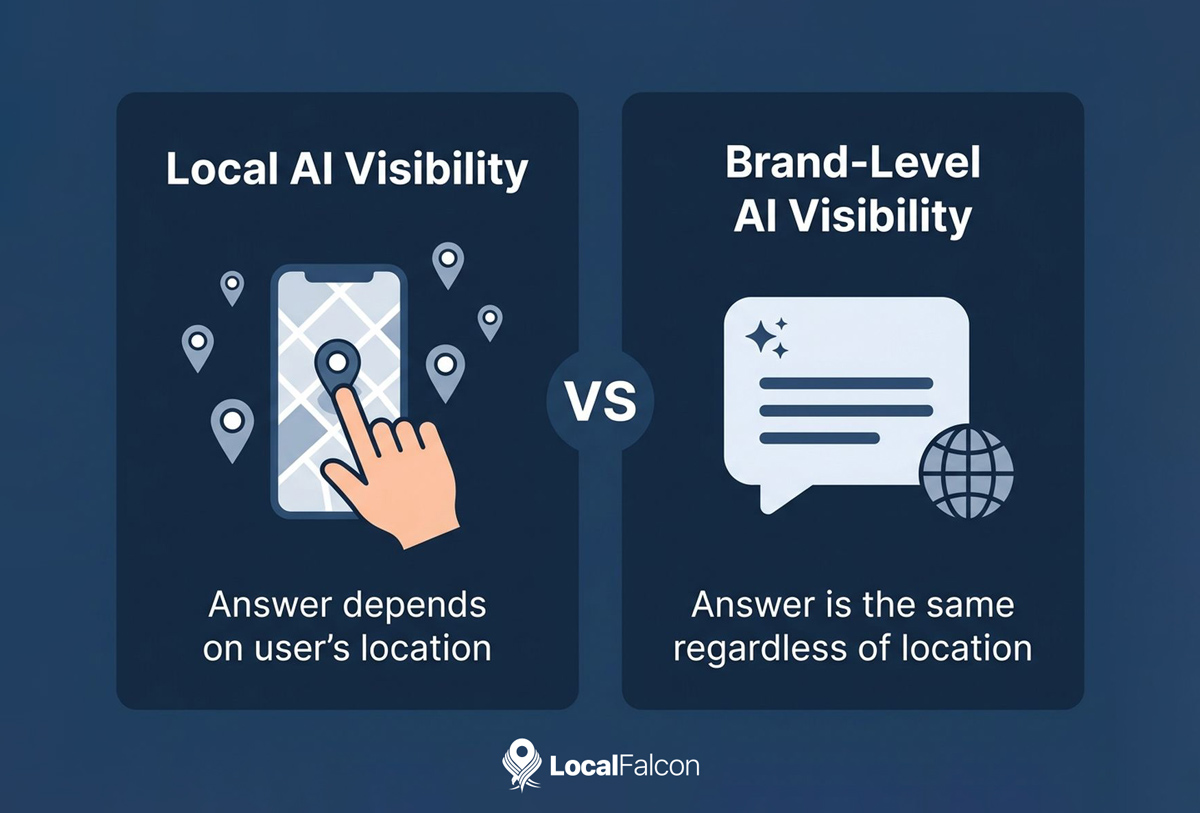
In other words, if the buyer's journey passes through a specific place, local AI visibility is what matters.
A single-location bakery and a 200-location gym franchise are both solving local visibility problems.
A SaaS startup and a publicly traded enterprise software company are both solving brand-level visibility problems, assuming neither has a physical storefront customers walk into.
Who Needs Local AI Visibility Tracking?
Local AI visibility matters most for any business where customers search by proximity. That includes:
- Businesses with one or more physical locations customers visit (restaurants, retail stores, medical practices, gyms)
- Service-area businesses that travel to customers (plumbers, landscapers, home cleaning, pest control)
- Multi-location brands and franchises where performance can vary significantly by market
- Agencies managing local SEO for clients across different cities or regions
For these businesses, an AI platform recommending a competitor because that competitor has stronger local signals in a specific area is a direct revenue problem. Tracking has to happen at the geo-grid level, because a business's AI visibility in one neighborhood can be completely different from its visibility five miles away.
Who Needs Brand-Level AI Visibility Tracking?
Brand-level tracking is the right fit for businesses where geography doesn't factor into the buying decision. That includes:
- SaaS and software companies
- E-commerce brands without physical retail locations
- B2B service providers that work with clients remotely
- Media, publishing, and content brands
- National or global consumer brands where the product is identical no matter where it's purchased
For these companies, the goal is understanding how the brand is being represented, cited, and recommended across AI platforms in general, without needing to break that down by city or zip code.
Can a Business Need Both Brand-Level and Local AI Visibility?
Some businesses straddle the line between needing brand-level and local AI visibility. For example, a national retailer with physical stores cares about both brand-level perception (think: "is [retailer] a good brand for [product]") and local visibility ("where can I buy [product] in [city]").
In that case, both tracking approaches are worth running, but they answer different questions and should be treated as separate parts of an AI search visibility strategy rather than combined into one view.
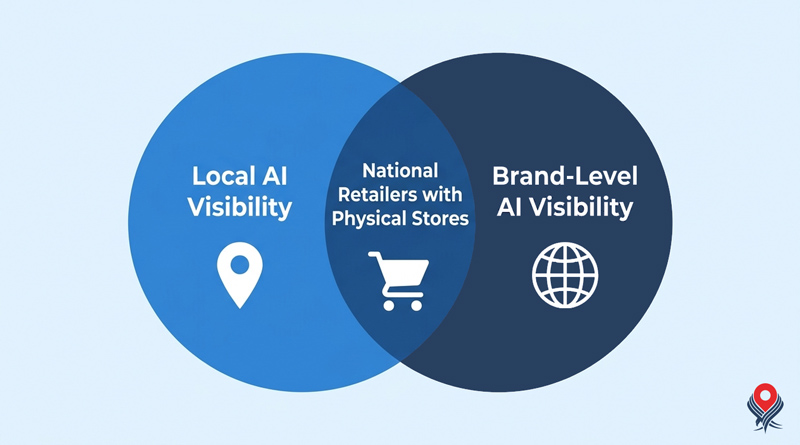
The biggest mistake to avoid is applying brand-level thinking to a business that lives or dies by local search, or applying geo-grid tracking to a business with no physical footprint. Neither produces useful data for the other's situation.
FAQs on Local vs Brand-Level AI Visibility
What's the difference between local AI visibility and brand-level AI visibility?
Local AI visibility tracks how a business appears in AI answers to location-specific queries, across a defined geographic area, and changes based on where the query is made. Brand-level AI visibility tracks how a business appears in AI answers in a more general sense for non-location-based queries.
What types of businesses need local AI visibility tracking?
Any business with physical locations or a defined service area: multi-location brands, franchises, and local service providers like contractors, medical practices, and retail stores. If it has a Google Business Profile, it needs to track local AI visibility alongside Google Maps rankings.
What types of businesses can benefit from brand-level AI visibility tracking?
Businesses without a location-dependent buyer journey, such as SaaS companies, e-commerce brands, B2B service providers, and national or global brands selling an identical product everywhere.
Does Local Falcon track AI visibility at the location level?
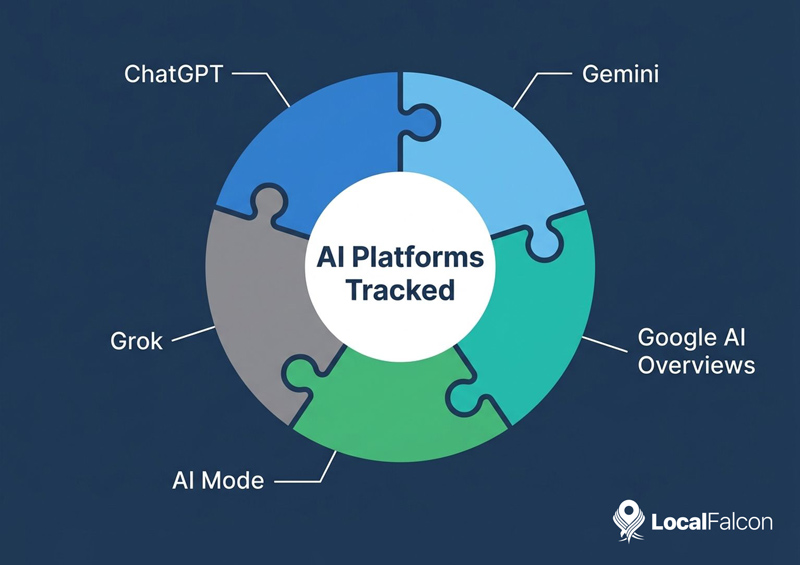
Yes. Local Falcon's AI search visibility tracking runs geo-grid scans across ChatGPT, Gemini, Google AI Overviews, AI Mode, and Grok, reporting on Share of AI Voice, Buyer Persuasion Score, sentiment, and sources found across the scanned area. Clicking an individual point on the local AI visibility heatmap pulls up the specific response, brand rankings, and sources for the response generated at that point.
The Bottom Line
Local AI visibility and brand-level AI visibility are two related yet different goals. Understanding how they're different and matching your tracking method to how customers actually find your business is the key to building an AI visibility strategy that actually drives business.