
Local businesses have traditionally competed for visibility on Google Search and Google Maps, and to a lesser degree, Apple Maps and Bing Maps. These platforms help customers discover businesses, compare information, read reviews, and decide which options best meet their needs.
However, AI-powered search is changing the comparison process. Google's generative AI search experiences and conversational AI tools like ChatGPT can recommend specific local businesses, explain why they are worth considering, and guide customers toward a decision without requiring them to research every option themselves.
For businesses, this creates a new challenge: earning visibility means more than ranking prominently in traditional, map-based local search results. Businesses also need to understand when AI recommends them, which competitors appear alongside them, and what information influences those recommendations.
Although Google's AI and ChatGPT can both help customers discover local businesses, they do not necessarily present recommendations in the same way. Understanding the differences in brand visibility across ChatGPT and Google's AI search experiences can help local businesses develop a more effective AI visibility optimization strategy.
This guide explores how local business recommendations appear in both platforms, how AI search can influence customer decisions, and what businesses can do to monitor and improve their visibility.
What Does Local AI Visibility Look Like in ChatGPT vs. Google?
Consider a customer searching for a coffee shop nearby where they can work on their laptop for a few hours. They want more than a list of business names. They need a place with suitable seating, a comfortable atmosphere, accessible outlets, reliable Wi-Fi, their favorite beverage, and perhaps convenient access to public transit.
Google and ChatGPT can both help this customer find a suitable coffee shop, but the experience differs.
How Google's AI Recommends Local Businesses
In Google's AI-powered search experiences, a query like "recommend a coffee shop near me where I can go work from my laptop for a few hours" can produce a selection of local businesses within an AI-generated response.
The customer may see approximately four recommendations, each accompanied by information that helps them assess the options. Depending on the search experience and the results returned, this information can include business names, descriptions, Google Business Profile links, website links, and shortcuts for actions such as calling a business or getting directions.
The customer can also select an option to see more businesses or ask a follow-up question through Google AI Mode. This creates an opportunity to refine the recommendations based on additional preferences, such as finding a quieter environment, staying within walking distance, or choosing a location with outdoor seating.
As the conversation progresses, Google's recommendations may become more specific. A customer who initially receives several options might ask which coffee shop is best for working for three hours and receive a more focused recommendation.
That narrowing process matters for brand visibility. A business that appears in the initial recommendations has an opportunity to enter the customer's consideration set. A business that appears in a subsequent, more targeted response may have an even stronger opportunity to win the customer, particularly if the recommendation addresses their specific needs.
How ChatGPT Recommends Local Businesses
ChatGPT can approach the same query as a conversational discovery experience. Rather than presenting a conventional search results page, it may return approximately three coffee shops, provide an embedded map, and include links that let users view businesses on Google Maps or explore each option individually from the map. Some recommendations may also include links to sources supporting the information in the response.
ChatGPT can then continue the interaction with a follow-up question of its own, such as asking which major intersection or metro station the customer is near. The purpose is to identify the best option within walking distance rather than recommend somewhere across the city.
This conversational approach allows customers to refine their requirements without starting a new search. They can explain that they need power outlets, prefer a quiet atmosphere, or want somewhere they can comfortably spend several hours. ChatGPT can use this additional context to tailor its recommendations.
The resulting experience can make a recommendation feel more like personalized guidance than a list of businesses to investigate independently. Instead of opening several websites and comparing their offerings, customers may rely on the AI's explanation of why a particular coffee shop suits their needs.
As with Google, the exact number of recommendations, available business details, map integrations, and source links can vary by query, location, product version, and available information.
Comparing the Two Experiences
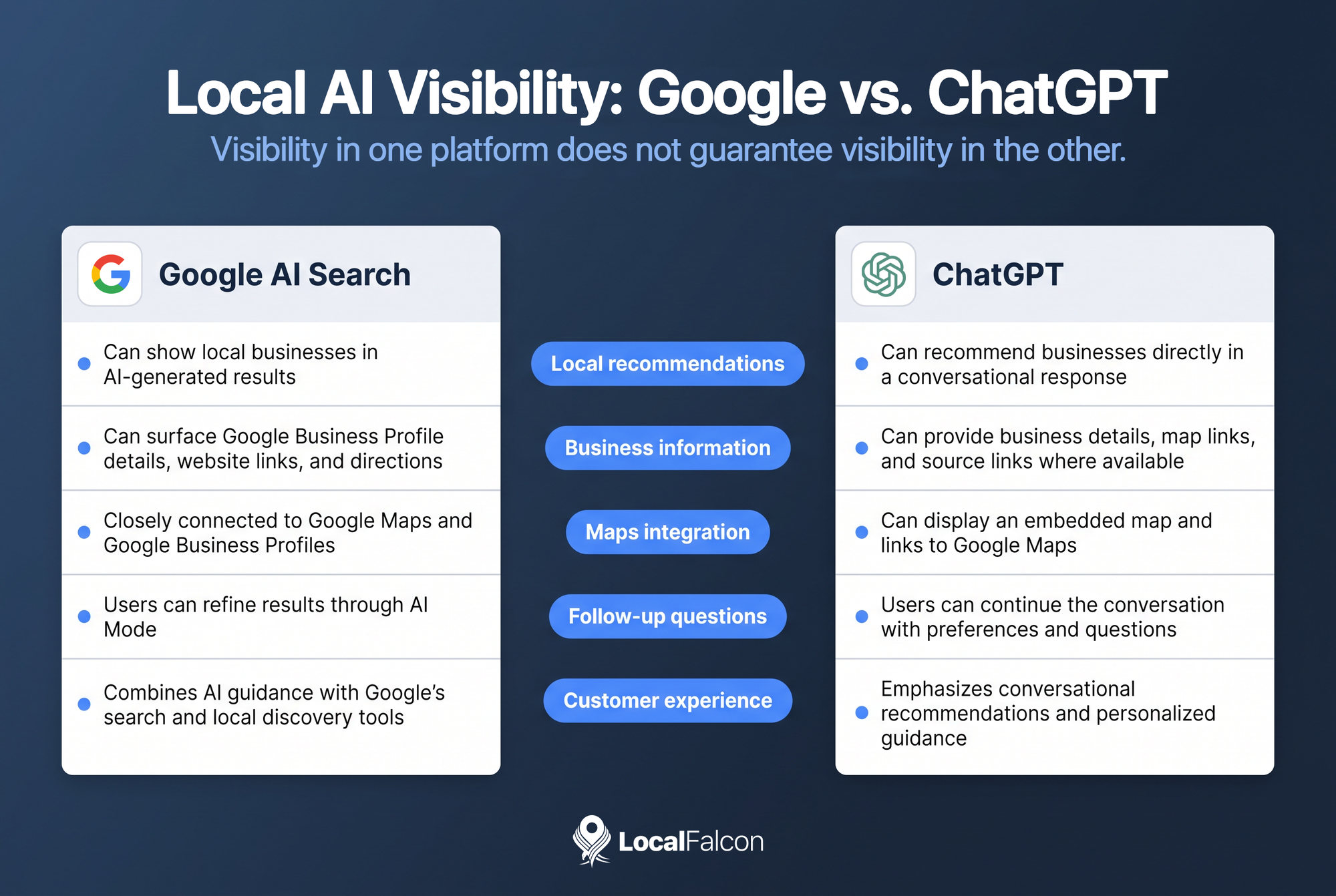
Both platforms can connect customers with local businesses, but there are meaningful differences in how they present information and guide decisions.
|
Feature |
Google AI Search |
ChatGPT |
|
Local recommendations |
Can display local businesses in AI-generated results and related search experiences |
Can recommend businesses directly within a conversational response |
|
Business information |
Can surface Google Business Profile details, website links, directions, and other actions |
Can provide business details, map links, and supporting source links where available |
|
Maps integration |
Closely connected to Google Maps and Google Business Profiles |
Can display an embedded map and links to view businesses on Google Maps |
|
Follow-up questions |
Users can refine results through AI Mode and related search interactions |
Users can continue the conversation with additional preferences and questions |
|
Customer experience |
Combines AI-generated guidance with Google's broader search and local discovery tools |
Emphasizes conversational recommendations and personalized guidance |
|
Visibility considerations |
Businesses need to understand their presence across Google's local results and AI experiences |
Businesses need to understand when and how they are selected for conversational recommendations |
Neither platform guarantees that the same businesses will appear for an identical query. Their recommendations can vary because of differences in the information available, the search context, the customer's location, and how each system interprets the request.
For local businesses, the key takeaway is that visibility in one platform does not automatically translate into visibility in the other. A business can perform well in Google Maps and still be absent from a particular ChatGPT recommendation, while another business may be selected because the available information makes it a particularly relevant answer to the customer's question.
Why Brand Visibility in AI Search Matters
Traditional local search gives customers several opportunities to evaluate businesses independently. They can browse listings, compare review scores, inspect photographs, read website content, and decide which businesses deserve further consideration.
AI search can compress that process. Instead of reviewing ten listings, a customer might receive three recommendations accompanied by explanations of why each business is suitable. They may then ask the AI to narrow those options down to one recommendation.
This changes how local businesses compete for attention.
AI Recommendations Can Influence Which Businesses Customers Consider
When an AI system recommends a business, it does more than make that business visible. It can also frame the customer's understanding of why the business is worth visiting.
For example, a coffee shop might be described as a good choice for remote workers because it has a relaxed atmosphere, convenient seating, and a location near public transit. A competing coffee shop might not appear at all, even if it is equally suitable.
The recommended business has an advantage because it has already been introduced as a relevant option. The customer may still investigate its reviews or website, but the AI has helped determine which businesses receive that attention in the first place.
In both ChatGPT's and Google's AI-driven local search experiences, being recommended can influence which businesses enter a customer's consideration set. In a conversational interaction, however, a sequence of follow-up questions can further narrow the options until the customer receives a highly specific recommendation.
The effect is not necessarily that customers stop comparing businesses. Rather, the AI can influence which businesses they compare and how much additional research they feel they need to conduct.
Fewer Recommendations Can Mean Greater Competition for Attention
A business might rank prominently in traditional local search results but fail to appear in an AI-generated shortlist. Conversely, a business that is not the most prominent result in a conventional search could still be recommended when an AI system identifies it as a suitable match for the customer's needs.
This creates a visibility challenge beyond traditional rankings. Businesses need to understand not only whether they can be found, but also whether they are selected for relevant recommendations.
The distinction is particularly important for queries with specific requirements. A search for "restaurants near me" has broad intent, while "find a quiet restaurant near me for a business lunch with vegetarian options" gives the AI more criteria to consider.
Businesses that can demonstrate their relevance to particular customer needs have an opportunity to earn recommendations for those searches. However, simply mentioning a keyword on a website does not guarantee inclusion. The AI must have sufficient relevant information to identify the business as a suitable choice.
AI Visibility Can Influence Traffic and Conversions
A recommendation can lead customers to visit a website, open a map, request directions, call a business, or visit in person. It can also influence a decision without generating a website visit that the business can easily attribute to AI search.
For example, a customer might ask ChatGPT to recommend a nearby plumber, receive a short list of options, and click a button to call the plumber at the top of the list. The customer may never visit the company's Google Business Profile or website, resulting in a zero-click conversion from AI visibility.
Similarly, someone might use Google AI Mode to identify a suitable restaurant and then navigate directly to it.
This means clicks and traffic alone may not fully capture the impact of AI-driven discovery. Local businesses should consider a broader set of indicators, including referral traffic, calls, direction requests, leads, bookings, and changes in branded search activity.
These metrics do not independently prove that AI recommendations caused a particular outcome. However, together with AI visibility data and other marketing measurements, they can help businesses build a clearer picture of how customers discover and choose their locations.
What Influences Brand Visibility in ChatGPT vs. Google AI Search?
Understanding why an AI system recommends one business over another is essential to improving local brand visibility. However, businesses should avoid assuming that either platform relies on the same ranking factors or that the same optimization tactics will produce identical results across both. Several areas deserve particular attention.
Google Business Profile and Local Business Information
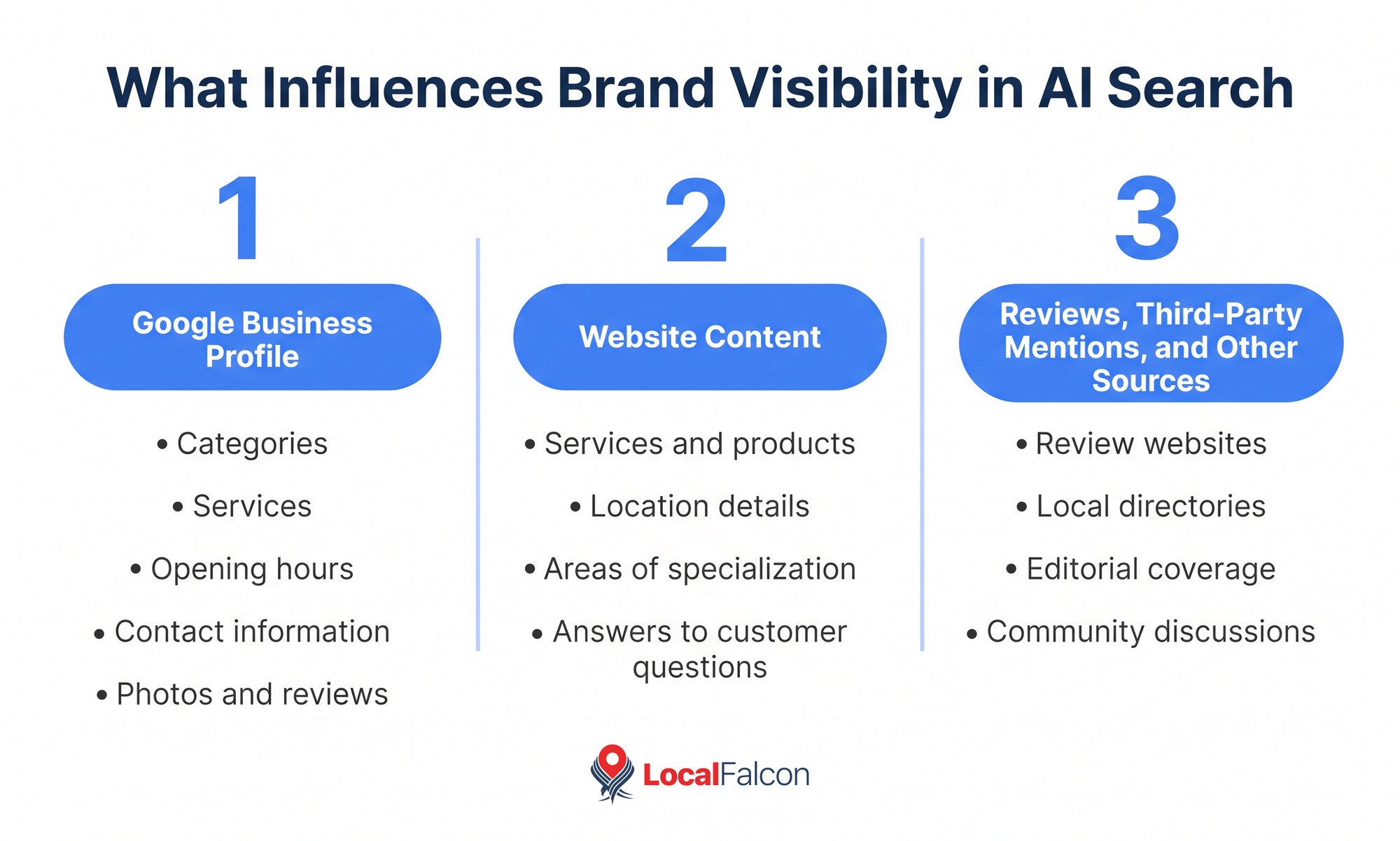
An accurate, complete Google Business Profile remains an important part of local search optimization. Business categories, services, opening hours, contact information, photographs, and reviews help customers understand what a business offers and whether it meets their needs.
These details help communicate a business's offerings and location, which may inform how Google represents it in relevant search experiences. For example, a coffee shop with accurate information about its location, opening hours, and amenities may be easier to evaluate when a customer is looking for somewhere to work remotely.
Businesses should keep their profiles up to date and ensure that the information accurately represents their offerings. However, they should not assume that a complete profile guarantees inclusion in Google's AI responses or ChatGPT recommendations.
Website Content and Relevant Business Details
A business website gives AI systems another source of information about its services, products, location, and areas of specialization.
Generic website content may do little to distinguish one business from its competitors. More useful content answers the questions customers actually ask. A hotel, for example, could provide clear information about parking, accessibility, pet policies, meeting facilities, and nearby attractions.
For multi-location businesses, location pages can help communicate the distinct characteristics of individual branches. Each page should contain accurate, useful information rather than simply repeating the same generic copy with a different city name.
This approach helps customers evaluate the business while giving search systems more context about its offerings and suitability for particular queries.
Reviews, Third-Party Mentions, and Other Sources
AI-generated recommendations can draw on information beyond a business's own website and Google Business Profile. Depending on the platform and query, relevant sources may include review websites, local directories, editorial coverage, community discussions, and other third-party references.
These sources can help establish what a business is known for and how customers perceive it. For example, recurring reviews that mention a restaurant's family-friendly atmosphere or a service provider's responsiveness may provide useful context about the customer experience.
Businesses should encourage genuine customer feedback, respond professionally to reviews, and maintain accurate information across relevant directories. They should also look for opportunities to earn legitimate mentions in local publications, industry resources, and community websites.
There is no guarantee that a particular mention will influence an AI recommendation. Nevertheless, developing a consistent, credible presence across relevant sources can make it easier for customers and search systems to understand the business.
How To Monitor Brand Visibility in ChatGPT vs. Google
One of the biggest challenges with AI search is that businesses cannot reliably evaluate their visibility by running a single query and assuming the results represent every customer's experience.
Recommendations can change according to the query wording, location, conversational context, and platform. A business might appear for one set of customer needs but not another, or be recommended in one neighborhood while remaining absent from similar searches elsewhere. Monitoring therefore requires a repeatable approach.
Track Relevant Customer Queries
Start by identifying the questions potential customers are likely to ask when looking for your products or services.
For a local restaurant, these might include:
- What are the best Italian restaurants near me?
- Where can I find a family-friendly restaurant with outdoor seating?
- Recommend a restaurant for a business lunch near downtown.
- Which restaurants nearby have good vegetarian options?
The most useful queries reflect actual customer needs rather than simply repeating the business's primary keywords.
Test relevant queries in both Google's AI search experiences and ChatGPT. Record which businesses appear, how they are described, which sources are linked, and whether the AI identifies specific strengths that differentiate the recommendations.
Repeat these tests over time to identify patterns. A single response provides a snapshot, while ongoing monitoring can help reveal whether visibility is improving, declining, or changing across different types of searches.
Measure Visibility Across Locations
For businesses with multiple locations, visibility should be evaluated at the individual-location level. A brand may perform well in one market but struggle to earn recommendations in another, even when the locations offer similar services.
This is particularly important for franchises, retail chains, healthcare networks, and other multi-location businesses competing across distinct geographic markets.
A location-based monitoring strategy can help identify where a brand appears consistently, where competitors receive more visibility, and which markets may need additional optimization work.
Local Falcon helps businesses measure local visibility using geo-grid scanning, which evaluates search performance across multiple geographic points rather than relying on a single location. Its AI visibility capabilities extend this approach to supported AI search platforms, helping businesses understand how their locations appear in AI-generated recommendations.
By tracking visibility across locations and relevant queries, businesses can move beyond anecdotal testing and develop a more structured understanding of their local AI search performance.
Monitor Which Competitors AI Recommends
Knowing whether your business appears in an AI response is only part of the picture. It is equally important to understand which competitors appear instead.
For example, a coffee shop might discover that ChatGPT regularly recommends a competitor for searches related to remote work. Investigating that competitor's website, reviews, business information, and third-party mentions may reveal useful differences in how each business communicates its offerings.
The goal is not to copy a competitor's marketing or assume that one particular factor explains the recommendation. Instead, competitor monitoring can help identify gaps in your own business information and areas where your brand could better demonstrate its relevance.
Local Falcon's AI visibility tracking can help businesses assess their presence in ChatGPT and Google's AI search experiences and compare it with competing businesses. This information can inform decisions about content development, local SEO, and other visibility optimization activities.
How To Improve Your Brand Visibility in ChatGPT and Google AI Search
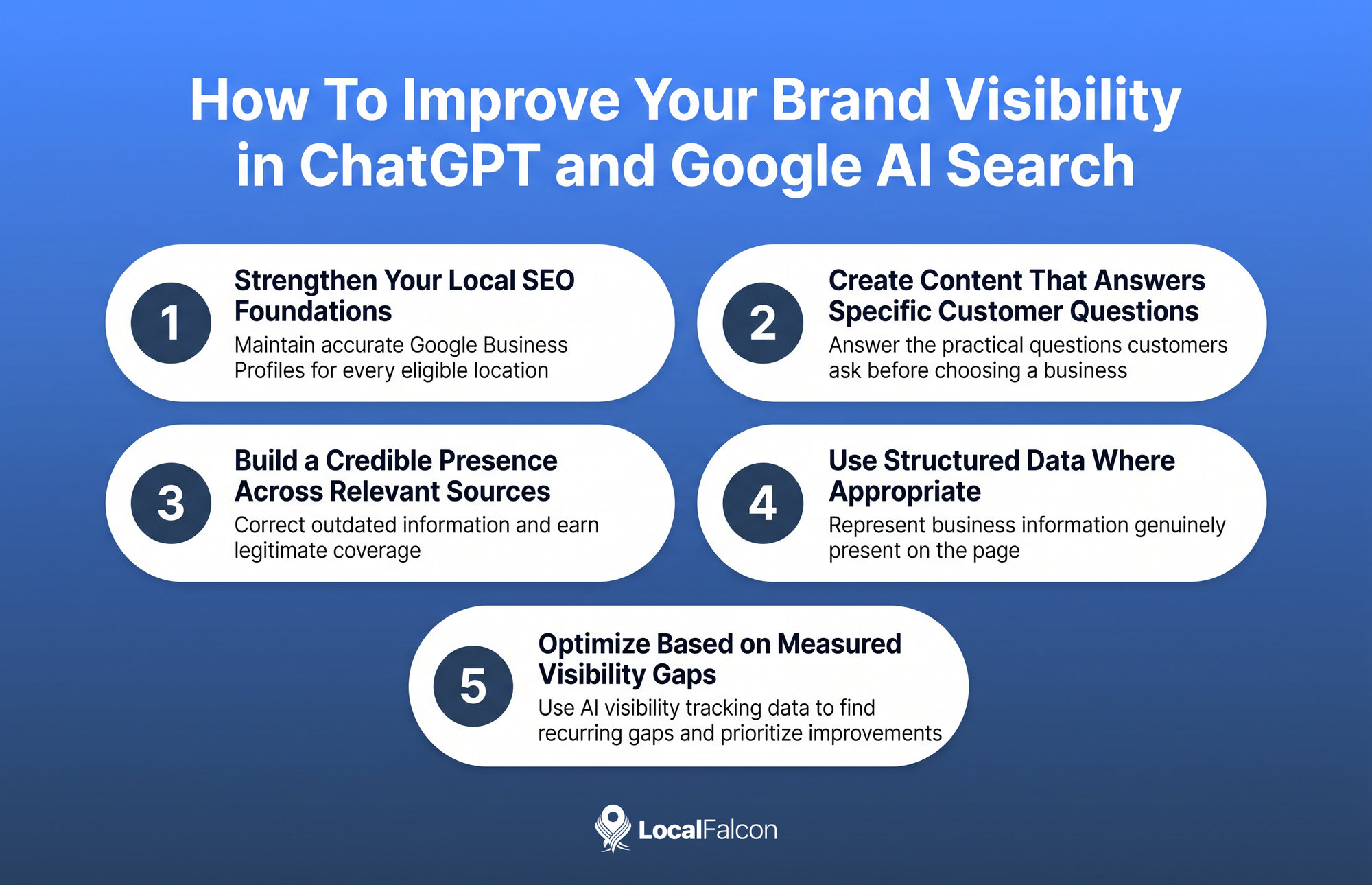
Although Google and ChatGPT have different AI search experiences, many foundational optimization practices support discoverability across both. The key is to make your business information accurate, comprehensive, and useful while building a credible presence across the sources customers and AI systems may consult.
1. Strengthen Your Local SEO Foundations
Maintain accurate, optimized Google Business Profiles for every eligible location. Check business categories, addresses, phone numbers, opening hours, services, and other relevant details regularly.
Keep your website's contact information consistent with your business listings, and ensure that search engines can access and understand important pages. For multi-location businesses, give each location a useful, accurate landing page that communicates its services and relevant local information.
These practices support traditional local discovery while helping establish a clearer understanding of each business.
2. Create Content That Answers Specific Customer Questions
Think beyond broad service keywords and identify the practical questions customers ask before choosing a business.
A dental practice, for example, could explain its available treatments, appointment process, accessibility, and approach to serving nervous patients. A hotel could provide detailed information about parking, family amenities, and transportation connections.
Answer these questions clearly and accurately. Use descriptive headings, straightforward language, and specific details that help customers determine whether the business meets their needs.
For multi-location businesses, distinguish between brand-wide information and location-specific details. Do not publish claims about amenities, services, or accessibility unless they are accurate for the location in question.
3. Build a Credible Presence Across Relevant Sources
Review your business's presence across important directories, review platforms, local publications, and industry websites. Correct outdated information and pursue legitimate opportunities to earn coverage or references from sources relevant to your market.
Encourage customers to leave honest reviews without attempting to manipulate ratings or sentiment. Respond to feedback constructively and use recurring comments to identify opportunities to improve both the customer experience and the information available about your business.
A consistent, credible presence across multiple sources can help reinforce your brand's identity and reputation. However, no particular directory listing, review score, or number of mentions guarantees AI visibility.
4. Use Structured Data Where Appropriate
Structured data can help search engines interpret important information about a business. Relevant schema types may include LocalBusiness and more specific subtypes, depending on the business.
Use structured data to represent information that is genuinely present on the page, such as the business's name, address, telephone number, opening hours, and website. Keep it accurate and consistent with other published information.
Structured data is not a shortcut to AI recommendations, and adding schema does not guarantee that a business will appear in an AI-generated answer. It is one part of a broader approach to making business information accessible and understandable.
5. Optimize Based on Measured Visibility Gaps
Avoid making broad changes based on a handful of AI responses. Instead, use local AI visibility tracking data to identify recurring gaps and prioritize improvements.
If a business rarely appears for relevant service queries, review whether its website and business listings clearly communicate those services. If competitors consistently appear in a particular geographic area, investigate differences in local relevance, reputation, and the quality of available business information.
If a business is frequently recommended for one service but not another, examine whether the second service is adequately represented across its website and other relevant sources.
After making changes, continue tracking performance. This helps distinguish between an optimization hypothesis and a measurable change in visibility.
Measuring the Business Impact of AI Search Visibility
Earning brand visibility in AI search is an important starting point, but it is not the ultimate business objective. Local businesses need to understand whether their search presence contributes to meaningful outcomes, such as calls, bookings, store visits, and sales.
Where possible, combine AI visibility measurement for ChatGPT and Google's AI search experiences with website analytics, lead tracking, booking data, call reporting, and Google Business Profile performance metrics. Monitor referral traffic from AI platforms when available, but recognize that customers may discover a business through AI and convert through another channel.
It is also worth distinguishing between visibility and conversion performance. A business may appear frequently in AI recommendations without generating a corresponding increase in leads. This could reflect the relevance of the queries, the competitiveness of the recommendations, the quality of the customer experience, or limitations in attribution.
Conversely, a business may receive valuable leads from a relatively small number of AI recommendations. The commercial value of visibility depends on which customers are reached and whether the business meets their needs.
For this reason, AI visibility tracking should complement, rather than replace, other marketing measurements. Together, these data points can help businesses assess where they are being recommended, which markets offer opportunities for improvement, and whether their optimization efforts are supporting broader business goals.
Build a Visibility Strategy for Both ChatGPT and Google
Google's generative AI search experiences and ChatGPT are changing how customers discover and evaluate local businesses. Both can recommend specific locations, explain why they are suitable, and help customers narrow their choices through additional questions. However, their recommendations are not interchangeable, and visibility in one platform does not guarantee visibility in the other.
Businesses should therefore approach AI search as an extension of their existing local search visibility strategy. Maintain accurate business information, publish useful content, build a credible presence across relevant sources, and monitor how AI systems represent your brand compared with local competitors.
Most importantly, measure performance consistently across relevant queries and geographic areas. Local Falcon's local AI visibility tracking can help businesses understand where their locations appear in AI-generated overviews and answers, identify competitors earning recommendations, and uncover opportunities to improve their visibility.
Ultimately, the goal of tracking and improving brand visibility in AI search experiences is to increase the likelihood that when potential customers ask for recommendations relevant to your business, your brand is among the options they receive.