
Most AI visibility trackers tell you how often AI mentions your brand, providing brand-level AI visibility data, but they don't break that information down at the location level.
In other words, they give you a high-level understanding of how visible your brand is in AI-generated search results overall, but they don't tell you how AI talks about your brand across a specific city, neighborhood, or service area (or from one city, neighborhood, or service area to the next).
That's where Local Falcon is different. Local Falcon offers local AI visibility tracking, providing granular, location-based data on exactly where your business is visible across a given geographic area, how your visibility compares from location to the next, and where competitors are outperforming you in AI search at the hyperlocal level.
Key Takeaways:
- Local Falcon offers precise location-level AI visibility data (local AI visibility tracking)
- Local AI visibility tracking works alongside traditional local rank tracking, featuring the same geo-grid ranking heatmaps in Scan Reports
- AI visibility tracking is available with every Local Falcon plan and uses the same flexible credit system as traditional local rank tracking
- AI visibility reports include Share of AI Voice (SAIV), Buyer Persuasion Score (BPS), average rankings, citation information, sentiment analysis, and more
- Scanning your AI visibility simply means selecting any of the available AI platforms (Google AI Overviews, Google AI Mode, Gemini, ChatGPT, Grok) as the data source for a scan
- Users can track unlimited AI search keywords across unlimited AI platforms, for multiple locations, in a custom geographic area anywhere in the world
- For each keyword, Local Falcon runs the same prompt from a different GPS point across the specified area, generating unique local AI visibility data for each point (response, brand list, rank position, citations)
- Local Falcon's AI visibility data goes deeper than a single per-location visibility score, tracking performance at dozens of individual GPS points within a target area
How Does Local AI Visibility Tracking Work in Local Falcon?
Local AI visibility tracking runs on the same geo-grid framework as Local Falcon's traditional rank tracking. Instead of checking where your Google Business Profile ranks across a set of points on a map, it checks how often and how favorably AI mentions your business at each of those same points.
To run a local AI visibility scan with Local Falcon, you select an AI platform such as Google AI Overviews, Google AI Mode, Gemini, ChatGPT, or Grok as the data source, then choose your keyword(s) and geographic area.
Local Falcon then runs the same search prompt through the selected AI platform from every GPS point across that grid, just as it would for a standard local rank tracking scan.
At each data point, the platform returns a unique result: the AI-generated response, the list of brands mentioned, your business's rank position within that list, and any citations (sources the AI links to) backing up the response.
Local Falcon aggregates all of this into an AI visibility Scan Report, complete with the same ranking heatmap-style visualization used for traditional local rank tracking, so you can see at a glance which parts of your service area you're winning in AI search and which need work.
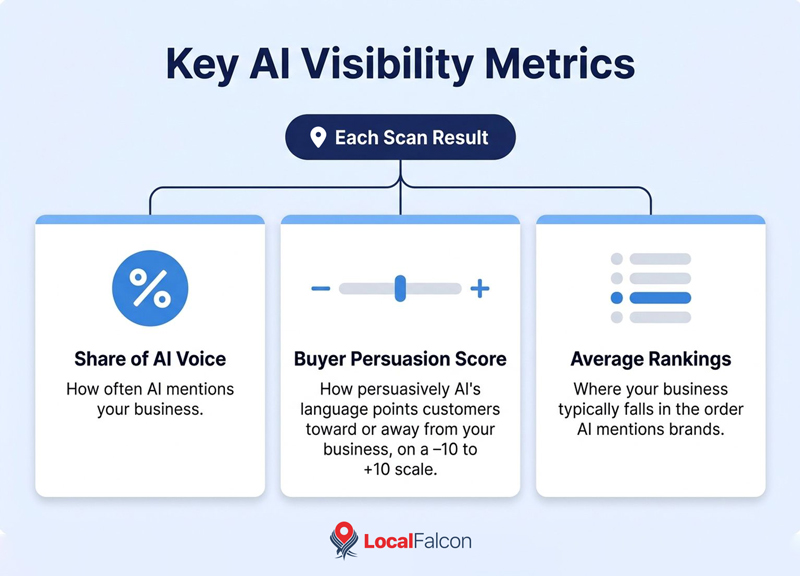
Each individual scan result gets factored into your Share of AI Voice, your Buyer Persuasion Score (BPS, a -10 to +10 scale measuring how persuasively AI's language points customers toward or away from your business), and average rankings, which are a sort of pseudo-ranking based on sequence of mention rather than a formal rank position.
Because it uses the same credit system and scan structure as Local Falcon's standard local rank tracking, local AI visibility tracking can be run on its own or layered directly into your existing Campaigns, so you get AI-based visibility, citation, and sentiment data alongside your traditional ranking insights, rather than as a separate workflow.
You can specify which keywords get tracked for which platforms, too, and there's no cap on how many keywords you track per location. Each combination of location and keyword generates a unique Scan Report.
Because Local Falcon's AI visibility data lives inside the same platform as your traditional Google Business Profile ranking data, you're not toggling between a separate AI visibility tracking tool and your local rank tracking dashboard.
Location-Level Isn't Always the Same as Grid-Level
Some tools that claim to offer location-level AI visibility data only give you a single visibility score per address: one number telling you whether AI mentions your business at that location, period. That's not much better than national brand-level visibility data, and it's certainly not hyperlocal AI visibility data.
Local Falcon's local AI visibility tracking goes a step further. Because every scan runs across a full geo-grid rather than at a single point, you get visibility and sentiment data at dozens of individual GPS points spread across a location's market, instead of just a basic read on the location as a whole.
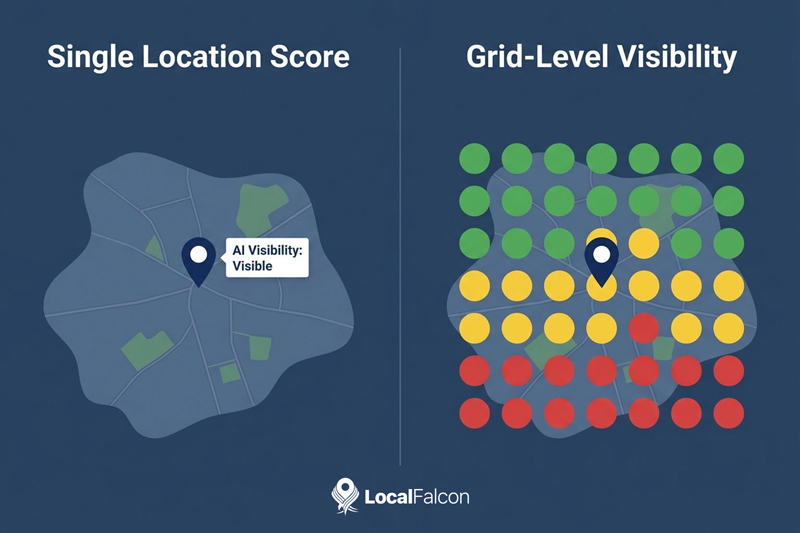
This matters because a local business might show strong AI visibility two miles north of its storefront and be completely absent from AI-generated responses two miles south, something a single per-location score would never surface.
With a grid-level view of AI visibility for each location, you can see exactly where in your target markets you're winning and where you need to focus on improving AI search performance. That's far more useful and actionable than a location merely being marked "visible" or "not visible."
Local Falcon's Local AI Visibility Tracking in Action: A Vignette
To better understand what Local Falcon's local AI visibility tracking workflow looks like in action, consider the following example.
A local SEO agency wants to improve a dental practice's Google AI Overviews visibility.
They first want to run a Quick Scan to set a baseline for the client's AI Overviews visibility. So, they go to the map scan tool, select Google AI Overviews as the data source, and choose the dental clinic from their list of imported locations.
Next, they easily add a few of Local Falcon's suggested AI-style keywords, conversational search terms like:
- "Where are the best dentists near me for emergency tooth pain?"
- "Which cosmetic dentists near me offer professional teeth whitening?"
- "Who are the best family dentists near me accepting new patients?"
The agency user prioritizes the terms to run scans for using Local Falcon's WYN score, which estimates the potential commercial value of appearing for each keyword, while ensuring to only select terms relevant to the services their client actually offers.
Once they are happy with the list of keywords, the user adjusts the scan radius and grid size, choosing a two-mile radius from the business location and a 7x7 grid (49 data points total). The dentist's office is located close to a lake, so they then disable 16 data points over the water, leaving them with 33 data points to scan.
With all the scan settings chosen, the agency runs the scan on behalf of their client and gets a separate AI visibility Scan Report for each keyword.
The reports show the following Share of AI Voice scores:
- SAIV of 28.57 for "where are the best dentists near me for emergency tooth pain?"
- SAIV of 87.88 for "which cosmetic dentists near me offer professional teeth whitening?"
- SAIV of 75 for "who are the best family dentists near me accepting new patients?"
This immediately tells the agency that their client has an AI visibility problem for emergency tooth pain searches, but is performing quite well for teeth whitening and family dentist searches.
Each report also shows average rankings of around four, meaning the dentist is usually mentioned close to fourth out of all the brands Google's AI Overviews mention.
Drilling, no pun intended, into the emergency tooth pain report specifically, the agency can also see which practices are showing up instead. A competing practice with same-day emergency appointment messaging on its Google Business Profile is being mentioned at nearly every grid point where the client is absent, giving the agency a specific competitor to benchmark against rather than a vague sense that "someone else" is winning.
Opening up the individual reports provides additional insights, starting with the geo-grid AI local AI visibility heatmap showing exactly where the client is visible and invisible in AI-generated responses across the area they actually serve.
Individual reports also break down sentiment, providing a BPS score for the term. For emergency tooth pain, the client's BPS comes in low, meaning that even on the rare point where the practice does get mentioned, AI's language isn't doing much to persuade searchers to choose them over the competition, a sign the fix needs to go beyond just getting mentioned more often.
The reports also include Falcon AI analysis and recommendations to improve local AI visibility for target AI search terms, including ways to outrank vulnerable competitors (i.e., get AI to mention the brand more often and prominently). Beyond those recommendations, looking at the sources AI cites in each report can tell the agency where to focus on building citations for their client to increase visibility.
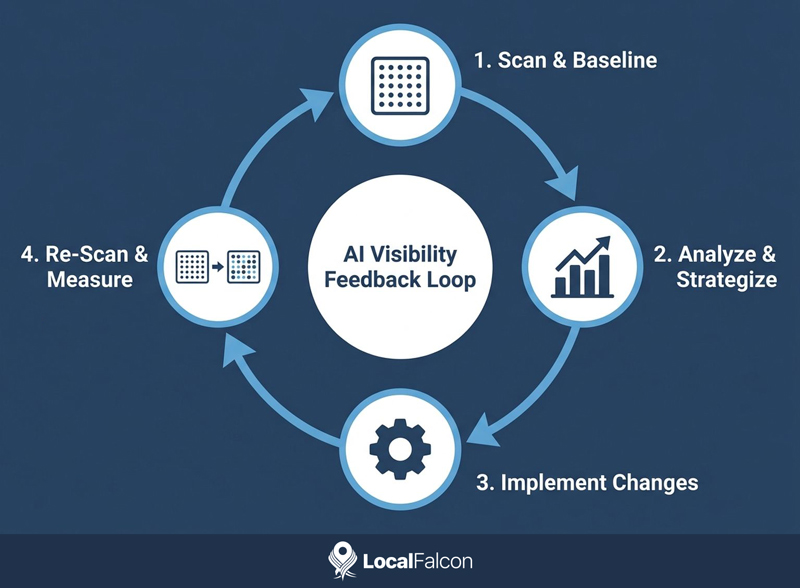
That initial scan is really just a starting point. The real value of local AI visibility tracking comes from running the same scan on a consistent cadence, using the identical location, grid, and keyword set each time, so any change in the numbers can be tied back to something specific the agency did in between.
Say the agency spends the next month building out FAQ content addressing emergency dental care, earning a few local citations from dental directories, and updating the practice's Google Business Profile with more detailed service descriptions.
When they rerun the same scan a month later, they can see whether the SAIV score for "what are the best dentists near me for emergency tooth pain?" moved up from 28.57, whether the average rankings changed alongside it, and whether the heatmap shows new grid points where the practice is now being mentioned. If the numbers move, they know which efforts are working. If they don't, that's a signal to look at what AI platforms are actually citing for that term and adjust the strategy accordingly.
Over time, this turns a single AI visibility snapshot into a feedback loop. Each new scan becomes a way to measure whether listing updates, website changes, or digital PR efforts are actually translating into more AI visibility, not just guesswork about whether they should be helping.
Local Falcon's Local AI Visibility Tracking: FAQs
Who can benefit from Local Falcon's local AI visibility tracking?
Any business with a physical storefront or service area. If you track Google Business Profile rankings, you should track your local AI visibility as well.
Is local AI visibility tracking included with my Local Falcon subscription?
Yes. It uses credits the same way traditional local rank tracking does.
What's a good Share of AI Voice score?
What represents a good SAIV depends on how competitive your local area and business category are. In general terms, a score of 75+ means AI mentions your business most of the time, 50-74 means you're often in the conversation, and below 50 means you're not mentioned in the majority of responses.
How many AI search prompts can I track in Local Falcon?
There's no limit. Each combination of location and keyword uses credits to run a local AI visibility scan, so you can run as many scans as you have credits for.
Can I set up campaigns for local AI visibility tracking?
Absolutely! You can add AI platforms as data sources to any Campaign Scan to automate your local AI visibility tracking across multiple locations.