
If you've ever wanted to know how AI, including Google's AI Overviews and AI Mode, Gemini, and ChatGPT, talks about your business in the areas you actually serve, Local Falcon's local AI visibility grids are the place to start.
Manually checking AI platforms with one-off queries doesn't tell you what AI says about your business from one city, neighborhood, or block to the next, and other AI visibility tools only offer brand-level visibility data, which tells you nothing about how visible your brand is in the areas where your customers are searching.
Local Falcon, on the other hand, provides granular, location-specific AI visibility data, presented in the same beloved local search geo-grid format as our traditional local ranking reports.
Key Takeaways:
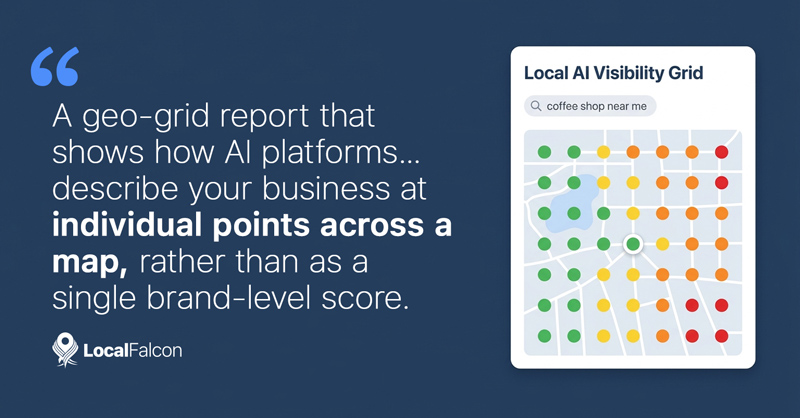
- Local AI visibility grids show how AI platforms describe your business at specific points across the area you serve, not just at the brand level.
- Each grid point reflects a simulated search from that exact location, complete with the AI's response, ranked brand mentions, and cited sources.
- Color coding from green to red makes it easy to spot where your business is winning or missing in AI-generated answers.
- Results roll up into key GEO metrics, including Share of AI Voice (SAIV), Average Rank Position/Average Total Rank Position (ARP/ATRP), and Buyer Persuasion Score (BPS), so you can track location-level AI search performance over time.
- This hyperlocal level of detail matters for any business with a storefront and/or a service area, where AI visibility varies from one neighborhood to the next, influencing who potential customers choose.
What Are Local AI Visibility Grids and How Do They Work in Local Falcon?
A local AI visibility grid is a type of geo-grid rank tracking report that shows you how AI talks about your brand across a given geographic area.
Each pin on the grid represents data from the same query run as if someone were searching live from that specific spot on the map.
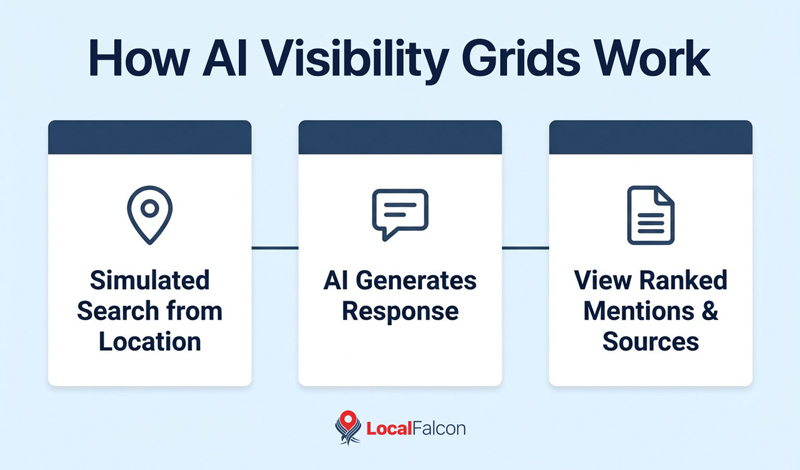
Clicking on any data point in one of Local Falcon's local AI visibility reports shows you the AI's response at that point, a list of brands mentioned by the AI (ranked according to sequence of mention), and all the sources the AI cited (linked back to).
Looking at the local AI visibility grid as a whole, each map pin is color-coded according to your business's ranking (prominence) in the response generated by the AI at that point. The point is a shade of green if the AI mentions you first or second, yellow if it mentions you third, fourth, or fifth, orange if it mentions you sixth or lower, and red if it doesn't mention you at all.
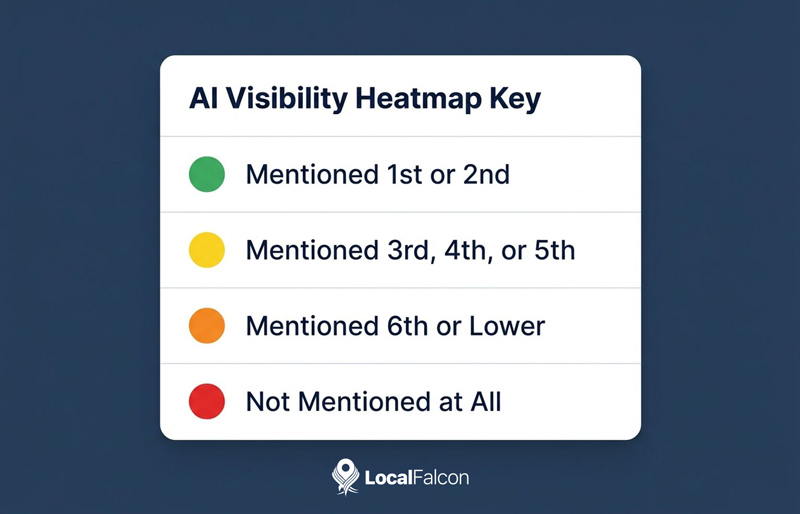
This local AI visibility heatmap format makes it easy to see exactly how visible your business is across an area you serve when customers ask AI for local business recommendations or solutions.
All of the local AI visibility data from individual grid points scanned also gets aggregated into Share of AI Voice (SAIV), Average Rank Position/Average Total Rank Position (ARP/ATRP), and Buyer Persuasion Score (BPS) for the report, giving you a set of GEO metrics you can track over time to understand brand lift and performance in AI search.
Why This Matters (And Who It Matters For)
Local AI visibility data, rather than brand-level data, is essential for any business with a physical storefront or service area, from restaurants and retailers to contractors and home services businesses.
Customers are already using AI to choose local businesses, often reading a Google AI Overview or asking ChatGPT or another AI tool directly to help them find a local business or service provider.
Knowing what AI says about your business where potential customers are actually searching from is key to optimizing your presence in AI-generated search results.
Local Falcon's local AI visibility tracking reports are built for agencies, local SEO service providers, enterprise organizations, and business owners who want to understand and improve their performance across AI search platforms at the location level.
It's the same concept as tracking your Google Business Profile ranking and Google Maps visibility across a city, neighborhood, or service area.
Whereas Local Falcon's traditional local ranking grids provide insights into how to optimize your Google Business Profile and citations to improve rankings and outrank vulnerable competitors, local AI visibility grids show you how those same location-based factors translate into AI-generated answers, and where you need to focus optimization efforts to improve your presence in them.
Location-based AI visibility insights matter because ranking well in traditional local search doesn't guarantee visibility in AI search. Tracking your local rankings is important, but the trends don't transfer directly to AI search performance.
AI platforms pull from a mix of signals, including your Google Business Profile, website content, reviews, and third-party citations, then decide which businesses to mention and in what order. Not all AI pulls from the same sources, either, which is why the source information found in Local Falcon's AI visibility reports is so crucial.
For multi-location businesses and agencies managing several clients, this level of detail also makes it possible to prioritize. Instead of treating AI visibility as a single, brand-level score to improve, you can see which specific neighborhoods, service areas, or locations need attention first, and measure whether the changes you make actually improve results there.
Conclusion
As AI platforms become a bigger part of how customers find and choose local businesses, brand-level visibility data isn't enough on its own.
Knowing how AI describes your business today, down to the block, neighborhood, and city level, gives you the information you need to close gaps in your AI presence before competitors do.
Local Falcon's local AI visibility grids present that location-specific data in a geo-grid rank tracking format you already know how to read and act on.
FAQs
What is a local AI visibility grid?
A geo-grid report that shows how AI platforms like Google AI Overviews, AI Mode, Gemini, and ChatGPT describe your business at individual points across a map, rather than as a single brand-level score.
How is a local AI visibility grid different from a traditional ranking grid?
Traditional local ranking grids track your position in local search results and Google Maps. AI visibility grids track how and whether AI mentions your business in answers generated for local AI search queries.
What do the colors on the AI visibility grid mean?
Green means AI mentions your business first or second, yellow means third through fifth, orange means sixth or lower, and red means it isn't mentioned at all. In short, the closer to bright green, the better your local AI visibility is, and the closer to red, the worse.
What metrics does Local Falcon calculate from location-specific AI visibility data?
Share of AI Voice (SAIV), Average Rank Position and Average Total Rank Position (ARP/ATRP), and Buyer Persuasion Score (BPS). Reports also include citation (source) intelligence and AI brand sentiment analysis.
Who should use local AI visibility grids?
Any business with a physical storefront or service area, along with the agencies and enterprise teams that manage local search performance for them. Local AI visibility is now just as important as traditional local rankings.