You Googled something. Or you typed a question into ChatGPT. Something like "best [your service type] near me" or "who should I call for [your business category] in [city]?" An AI-generated response came back — an AI Overview at the top of Google's results, or a direct answer from your AI assistant — and your competitor's name came up. Yours didn't. It's a gut-punch moment, and it raises a very legitimate question: Why them and not me?
The honest answer is that there's rarely a single cause. AI recommendations are built on a combination of overlapping factors: your digital footprint, your brand signals across the web, the language people use when they talk about you online, and how consistently all of that information surfaces across sources AI actually trusts. Before you can fix the problem, you need to understand it. And before you can understand it, you need to make sure you're measuring it correctly.
Are You Sure You're Not Being Recommended by AI?
This might feel like a strange place to start, but it's important to be sure that your business isn't being recommended by AI before you proceed to do something about it.
Many business owners first notice they're "not in AI" the same way: they run a few Google searches and scan the AI Overviews that appear, or ask ChatGPT a question, don't see their business mentioned, and conclude their AI visibility is zero. This is an easy assumption to make — and it's often wrong.
Manual spot checks are a low-accuracy way to measure your presence in AI results. AI responses are highly variable by nature. The same search query, run by two different people in two different locations — or even run by the same person in the same location — can return completely different answers. Run it again a few minutes later or tomorrow, and the results may shift again.
The reality is that AI-generated business recommendations almost never repeat exactly, so a handful of manual checks tells you almost nothing about your actual presence across the full range of queries your potential customers are running every day.
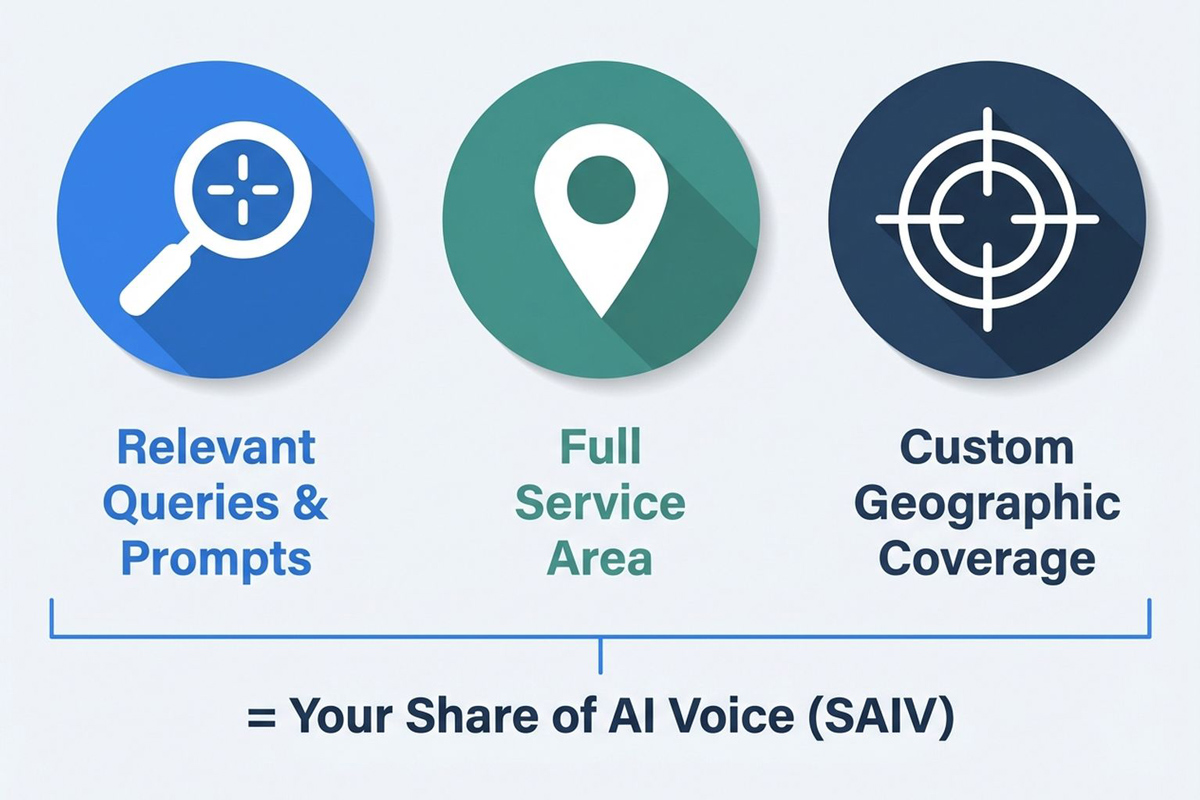
What you actually need is a Share of AI Voice (SAIV) measurement — a quantified score that reflects how often your brand appears across a large, representative set of AI queries in your market. This transforms an anecdotal impression into a real data point you can act on.
Local Falcon is built to provide exactly this kind of measurement. Rather than relying on spot checks, Local Falcon measures your local AI visibility across:
- A wide range of relevant queries and prompts — as many as you want to monitor
- Your full service area or target market (multiple for multi-location businesses)
- Customizable geographic coverage, from hyperlocal to regional
The result is a clear, data-backed picture of how often AI is actually surfacing your brand where it matters.
In some cases, you'll discover your SAIV is actually reasonable — you're appearing in AI results more than your manual checks suggested, and the issue is something else entirely. In others, the data confirms that your AI visibility genuinely is low, and there's real work ahead.
Either way, you can't improve what you can't measure. Getting an accurate baseline of your AI visibility, or Share of AI Voice, is step one.
Potential Reasons Why AI Is Recommending Competitors Instead of You
Reason #1: AI Doesn't Have Enough Information About Your Brand
If your SAIV data confirms you have little to no AI visibility, the most common underlying cause is a thin or fragmented digital footprint.
AI learns about businesses in much the same way search engines do: by scanning and processing information from across the web. If there isn't much written about your brand, or if what does exist is inconsistent, outdated, or spread across low-authority sources, AI simply won't have enough to confidently recommend you.
Think of it this way: AI is essentially assembling a portrait of your business from what the internet says about you. If the internet isn't saying much, or if what it does say is generic and unverifiable, you'll be overlooked in favor of competitors whose digital presence gives AI something more concrete to work with.
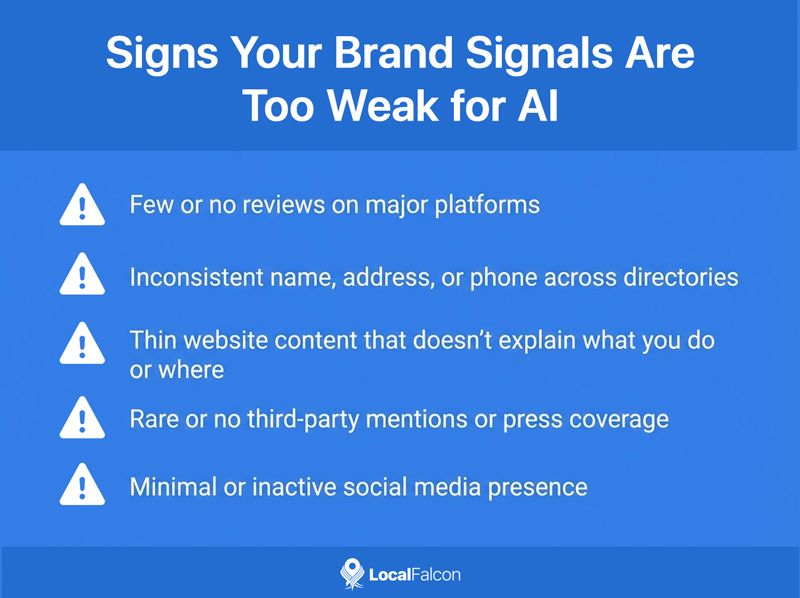
Common signs your brand signals are too weak for AI to recommend you:
- Few or no reviews on major platforms (Google, Yelp, Facebook, industry-specific directories)
- Inconsistent business information across directories — especially mismatched name, address, or phone number
- A website with thin content that doesn't clearly explain what you do, where you do it, and who you serve
- Rare or no mentions in third-party articles, local news, or industry publications
- Minimal or inactive social media presence
The good news is this is fixable, but it helps to know where to focus your energy. Not all platforms carry equal weight in AI responses, and that weight varies by business category, market, and even from one AI platform to the next.
This is where the Source Information section of Local Falcon's AI visibility reports is indispensable: it shows you which specific platforms and websites AI is actually referencing when generating responses for the queries and prompts you're tracking.
Once you know which sources matter most for your business and its competitors, you can identify citation gaps and prioritize building your presence there first, rather than spreading effort thinly across every possible platform.
Reason #2: You Have AI Visibility, But AI Sentiment Isn't Strong
Here's a scenario that surprises a lot of business owners: it's entirely possible to have solid AI visibility — to appear regularly in AI-generated responses — and still not drive meaningful business from AI search.
How? Because there's a critical difference between being mentioned and being recommended.
AI-generated local search results don't just list names. They describe businesses using specific language, and the language AI uses when talking about your brand has a direct influence on whether a potential customer chooses you over a competitor mentioned right alongside you.
Consider two possible AI responses:
- "[Business Name] is a local option with a range of residential services, but some customers highlight difficulties making an appointment."
- "Customers consistently describe [Business Name] as exceptionally fast to respond, with technicians who explain the problem clearly, don't upsell unnecessarily, and leave the job site cleaner than they found it."
Both businesses got mentioned, but which one are you calling?
The second response doesn't just inform — it persuades. The language is specific, trust-building, and emotionally resonant in a way that moves someone toward a decision. If AI describes your competitor the way the second example reads and describes you like the first, you're losing customers even when you're technically showing up.
This distinction — between visibility and persuasion — is what AI brand sentiment analysis is designed to address. Local Falcon's AI visibility Scan Reports include two particularly powerful features for this:
- Buyer Persuasion Score (BPS): A quantified measure of how persuasively AI is describing your brand to potential customers. It effectively rates how likely AI's language about you is to convert a searcher into an actual buyer.
- Brand Phrases: The specific words and phrases AI consistently associates with your business and the sentiment behind them. This reveals the narrative AI has built around your brand — and whether that narrative is working in your favor or quietly undermining you.
When you can see both the Buyer Persuasion Score and the specific language AI uses when it mentions your business, as well as the sentiment behind that language, you have real insight into the gap between how AI talks about you versus how it talks about your most successful competitors. That level of clarity helps you turn a vague frustration into an actionable plan.
How To Improve What AI Says About Your Business
Once you understand your AI brand sentiment, you have a roadmap for improvement. The language AI uses to talk about your business doesn't emerge from nowhere — it's synthesized from signals spread across your entire digital presence. That means you have more influence over it than you might think.
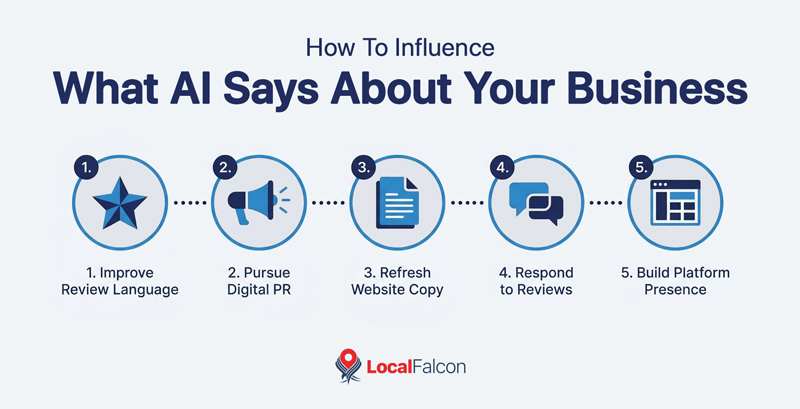
Here are some key tactics for influencing what AI says about your business:
- Improve the language in your reviews. AI draws heavily on the specific words customers use when reviewing your business. Generic reviews like "great service, highly recommended" don't give AI much to work with. Encourage satisfied customers to describe their experience in detail: What problem did you solve? How did your team communicate? What made the experience stand out? These specifics become the raw material AI synthesizes into its descriptions of your brand.
- Pursue digital PR to shape third-party coverage. Articles, features, and mentions in reputable publications carry significant weight in how AI describes businesses. If the only third-party content about your business is directory listings, you're missing a major opportunity. Proactively pursue local press coverage, contribute expert commentary to industry publications, and build partnerships that generate substantive, positive written content about your brand from sources AI respects.
- Refresh your website and directory listing copy. Your website content, your Google Business Profile description, and your listings on platforms like Yelp, Tripadvisor, Facebook, and Bing Places are all sources that AI references. If that content is thin, generic, or hasn't been updated in years, now is the time to rewrite it with specific, benefit-driven language that clearly communicates what makes your business worth choosing.
- Be intentional with how you respond to reviews. Your review responses are public and can influence how AI perceives your brand's character and customer service ethos. Thoughtful, specific responses signal credibility and genuine engagement — qualities that often show up positively in AI descriptions.
- Build presence on the platforms AI actually references. Circle back to the source data from your AI visibility reports and concentrate your optimization energy on the platforms that carry actual weight in your category. Not all directory listings are equal.
What To Do Next: A Practical Action Plan To Get AI To Recommend Your Business
If you've read this far, you likely fall into one of three situations:
- You're not sure how visible you actually are in AI-powered search and you've been making assumptions based on a few manual spot checks.
- You have genuinely low AI visibility and you need to build your digital presence so AI has the information it needs to recommend you.
- You have some AI visibility but weak sentiment and you need to improve the narrative AI has constructed around your brand.
In all three cases, the starting point is the same: get accurate data.
Here's how to move forward:
- Measure your actual AI visibility first. Use Local Falcon to run AI visibility scans across a representative range of queries and your full service area. Establish your actual Share of AI Voice so you have a real baseline — not an impression.
- Analyze your sources. Review which platforms AI is pulling from when generating responses in your category. These are your highest-priority targets for building and optimizing your presence.
- Assess your brand sentiment. Check your Buyer Persuasion Score and the Brand Phrases AI associates with your business. Compare them directly to how AI describes your top competitors. Look for the gap.
- Close the gap with the right fix. If visibility is low, focus on building brand signals — reviews, citations, web content, third-party mentions. If sentiment is the issue, focus on shaping the narrative through review language, digital PR, updated content and copy, and a stronger digital presence on the platforms that matter.
- Track your progress over time. AI recommendations aren't static. Run AI visibility scans regularly so you can see how your presence and sentiment evolve as you make changes, then adjust your approach based on real data rather than guesswork.
The Bottom Line
Getting your business recommended by AI requires building a strong digital presence that gives AI the information it needs to trust your brand, and then shaping that presence so the story AI tells about you is one that actually wins customers over.
If a competitor gets recommended by AI and you don't, it doesn't mean they're doing something mysterious. They likely have more consistent brand signals across more of the right platforms, and AI has learned to describe them in terms that resonate with buyers. The path to closing that gap starts with understanding exactly where you stand — not through anecdotal spot checks, but through real, quantified data.
Local Falcon gives you that data: the Share of AI Voice measurement to know where you actually stand, the source insights to know where to build, and the AI brand sentiment analysis to know how to shape the story AI tells about you. From there, the steps you need to take to improve both AI visibility and brand sentiment will become more clear.
Despite how mainstream it's becoming, AI-driven local search is still in its early stages. The businesses investing in their AI visibility and brand sentiment now are the ones that will be recommended by default as this channel continues to grow. Don't let a competitor claim that ground simply because they got there first.
Start monitoring your local AI visibility and brand sentiment alongside your Google Maps rankings with Local Falcon today.
Frequently Asked Questions
Why does my business show up in AI sometimes but not others?
AI responses are highly variable — the same query or prompt can and does produce at least slightly different results most of the time. This is why manual spot checks are unreliable and why consistently measuring your AI visibility across a large set of queries is the only way to get an accurate picture of your brand's presence in AI.
Why does AI recommend my competitors instead?
Your competitors likely have stronger brand signals across the web — more detailed reviews, directory information, websites, and third-party mentions — giving AI more to work with when deciding who to recommend. It's also possible you have comparable visibility but weaker brand sentiment, meaning AI mentions you but describes your competitors more persuasively.
How can I get AI to recommend my business?
Focus on building a strong, consistent digital presence across the platforms AI actually references in your category and market. Once visibility is established, pay attention to the language AI uses to describe you and work to shape that narrative through review quality, content optimization, and digital PR.
How often should I be checking my AI visibility?
AI recommendations shift frequently, so a one-time check tells you very little — regular, ongoing monitoring is the only way to track meaningful trends and measure the impact of your efforts. Running scans consistently, ideally with Campaigns that auto-run weekly or bi-weekly, with a tool like Local Falcon gives you the data you need to make informed decisions over time.
Can I control what AI says about my business?
You can't dictate AI's output directly, but you have significant influence over it. The language AI uses to describe your business is synthesized from your reviews, website content, directory listings, and third-party mentions, so improving those inputs is how you shape the narrative.