
Being mentioned by AI is one thing, but actually being convincingly recommended is another altogether.
When AI provides customers with information about local businesses, there's a big difference between the AI including your business as an "OK" option and framing it as the best possible choice for the customer's specific needs at that moment.
In other words, getting your business mentioned by AI is only half the battle. You need to also make sure that AI is persuading customers to choose your business over your competitors. And for that, you need to answer one important question: what is AI saying about your business?
How To Know What AI Is Saying About Your Business
The key metric to understand here is AI brand sentiment — not just whether your business gets mentioned by AI (that's visibility), but what AI actually says about it when it does. Think of it as the difference between just showing up and making a great first impression.
A mention that frames your business as a decent option is very different from one that positions you as the obvious best choice for a customer's specific needs. AI brand sentiment is what tells you which side of that line you're on.
This is an important distinction to draw from Share of AI Voice (SAIV), which measures how frequently your business appears in AI-generated results and overviews. SAIV is an incredibly valuable metric for measuring brand visibility, but frequency alone doesn't tell the whole story.
A business can have strong AI visibility and still be losing customers if the language AI uses to describe it is neutral, inaccurate, or simply not persuasive enough. Tracking AI sentiment fills a crucial gap in visibility intelligence — it tells you what AI is actually communicating about your business when it does include you in a response.
One way to measure this is with Local Falcon's AI visibility scans, which give you a picture of both your AI visibility and your AI brand sentiment in one place. The Scan Reports surface the specific phrases AI consistently associates with your brand, along with the sentiment behind those phrases — whether positive, neutral, or negative. They also include a Buyer Persuasion Score (BPS), which analyzes the language AI uses when talking about your business and quantifies it on a scale from -10 to +10.
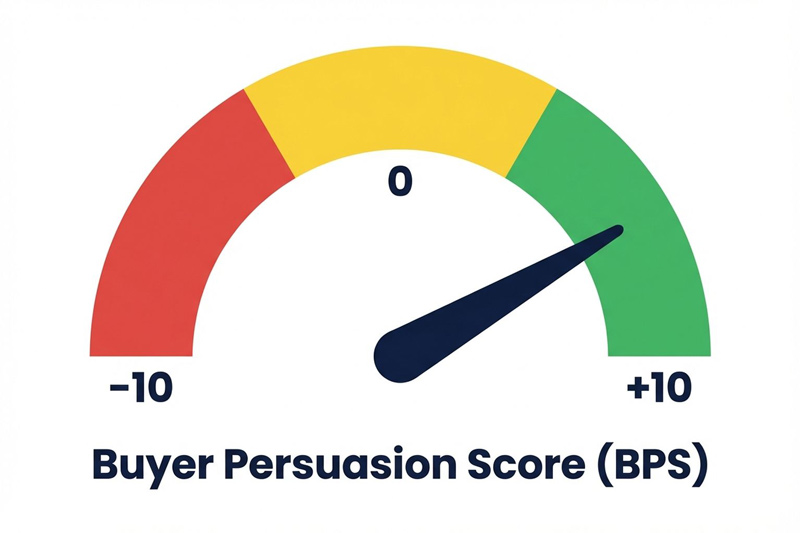
A higher BPS indicates that AI is describing your business in ways that are compelling and likely to drive customers to choose you. A lower score means that even if your business is being mentioned, the language isn't doing much to convert that visibility into business — and in some cases, it may actually be working against you.
It's also critical to measure AI brand sentiment across a wide range of queries and to do so on an ongoing basis, not just as a one-time exercise.
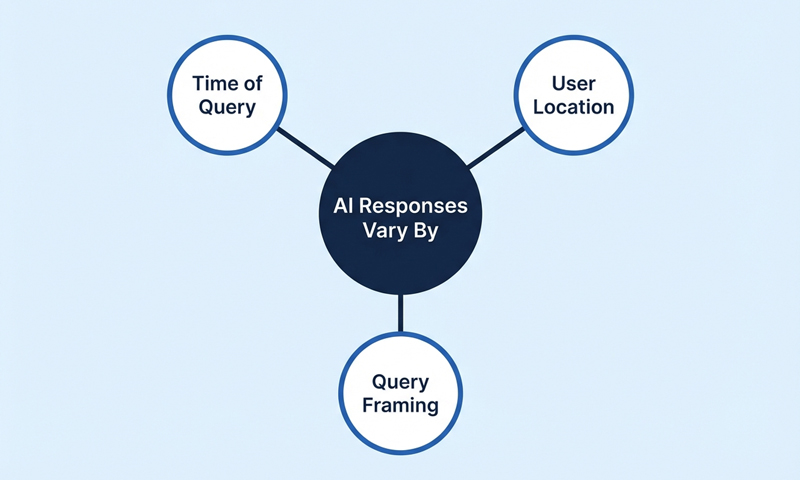
AI-generated answers are highly dynamic — the same local query asked at different times, in different locations, or framed in slightly different ways can (and usually does) produce completely different responses. Because of this variability, you need a large sample size to build a reliable understanding of what AI is saying about your business at scale.
Manual spot checks — occasionally asking ChatGPT, Gemini, or another AI tool about your business and seeing what comes up — simply aren't efficient or statistically meaningful enough to give you that picture. They might surface one interesting data point, but they won't tell you whether that response is representative of what thousands of potential customers are actually seeing.
Why It's So Important To Understand What AI Says About Your Business
AI draws from an enormous and widely varied range of sources when generating responses, which creates both opportunity and risk for businesses.
On one hand, a strong and consistent digital presence across potential inputs can work in your favor. On the other, a single piece of misinformation or a single negative opinion from somewhere like a Reddit thread or an obscure forum can be picked up by AI and relayed back to potential customers as if it were an established fact.
When something like this happens, a customer who asked AI for a recommendation might walk away with a less-than-stellar impression of your business, even if you rank well on Google Search and Maps, have mostly positive reviews on your Google Business Profile, and are generally well regarded in your community.
Having a clear picture of your AI brand sentiment allows you to spot these issues early and get to the root of them, so you can take concrete steps to influence what AI says about your business and shift it in a more positive, persuasive direction — ultimately improving your BPS and driving more customers to pick up the phone or walk through your door.
The process starts with identifying the problem. If AI is repeatedly surfacing outdated information about your business, you can track down where that information is coming from and correct it at the source. If the language AI uses seems to be drawn from a single negative review or comment, you can potentially engage directly with that customer, work to address their experience, and potentially get them to update or remove the review or comment.
Small interventions like these can have an outsized impact on what AI says, because AI is highly sensitive to the sources it pulls from.
It's also worth mentioning that AI, at least in its current stage, is something of a people pleaser. When it doesn't have access to clear, accurate, complete information about your business, it doesn't always acknowledge that gap — it may fill it in on its own, sometimes generating details that are plausible-sounding but inaccurate. This means you need to look not just for negative sentiment, but for gaps and confusion in how AI represents your business.
If AI seems uncertain about a service you offer, vague about the areas you serve, or inconsistent in how it describes what you do, that's a signal that you need to optimize your content to give it better, clearer material to work with. The more directly and explicitly your online presence answers the kinds of questions customers are asking, the less room AI has to fill in the blanks incorrectly.
And then there's the scenario where AI isn't necessarily saying anything wrong or bad about your business, but the language just feels flat. Not negative, just not particularly convincing. In that case, the issue isn't misinformation, it's a lack of strong, positive brand signals across the web.
AI tends to draw from a preferred range of authoritative sources that can differ from one industry or area to the next, so the remedy is building a richer digital presence in the places AI likes to cite for your particular market.
That means cultivating more detailed, specific reviews that go beyond generic praise and speak to what makes your business genuinely worth choosing. It means generating more social media buzz, more engagement, more conversation around your brand. It means pursuing digital PR to earn mentions from third-party publications and websites that carry weight with AI.
The more your business is discussed online — and the more people refer to you as a trusted expert in your business category — the more that authority will come through in what AI says about your business, and the more persuasive its language will become.
Finally, AI sentiment tracking shouldn't be limited to your own business. Keeping an eye on what AI says about your competitors gives you additional strategic insight.
If AI consistently describes a competitor in more enthusiastic, specific, or persuasive terms than it uses for you, that's worth investigating. What are they doing that's generating that kind of language? Are they more active in earning third-party coverage? Do they have a stronger review profile? Are they doing a better job of making their expertise visible across the web?
Identifying those gaps gives you a roadmap — not just to match what they're doing, but to go further, so that over time AI starts recommending you just as compellingly, or even more so.
Conclusion
AI visibility is still a relatively new frontier for most businesses, but it's very quickly changing the way customers discover and choose local businesses. An increasing number of people are turning to AI for "word-of-mouth" recommendations, just as they would ask a friend, family member, or neighbor for tips on what business to call or visit.
Getting mentioned regularly by AI is important to ensure your business is visible when potential customers ask for these types of recommendations, but equally so is ensuring AI is actually persuading them to choose your business. Knowing what AI is saying about your business, and actively working to shape that conversation, is becoming as important as any other part of your local SEO and digital marketing strategy.
What Is AI Saying About Your Business? FAQs
How can I check what AI is saying about my business?
The most reliable way is with Local Falcon's AI visibility scans, which measure both how often your business appears in AI-generated local search results and what AI actually says about it — including recurring phrases, sentiment breakdowns, and your Buyer Persuasion Score. You can also manually query tools like ChatGPT or Gemini, though spot checks alone won't give you a statistically meaningful picture of what customers are actually seeing.
How often should I be checking my AI sentiment?
Given how dynamic AI-generated responses are, sentiment tracking should be ongoing rather than sporadic. Think of it less like an audit and more like monitoring — something you want continuous data on so you can catch shifts, spot new issues, and measure whether the changes you're making are actually having an impact. Aim to track AI visibility and brand sentiment as often as your traditional rankings, ideally with automated Campaigns.
Can I actually influence what AI says about my business?
Yes, though it's indirect. AI generates responses based on what it finds across the web, so the lever you have is your broader digital presence. Correcting inaccurate information at the source, earning more detailed reviews, building third-party mentions, and creating content that clearly and explicitly describes what your business does, where it does it, and who it serves all feed into what AI has to work with — and therefore what it says.