
When someone asks an AI platform to recommend a local business, does it take the searcher's location into account the same way traditional local rankings do? This is a question many business owners and marketers are asking right now.
The short answer is yes. AI search platforms do factor in location when they recommend local businesses. If someone asks ChatGPT for a restaurant near them, or asks "Where should I eat in downtown Toronto tonight before a show?," the AI takes into account how close each option is to the searcher's actual location or to the location named in the question.
However, what proximity's impact on AI search results looks like is a different matter. In traditional local search results, a business tends to rank highest at its own address and slip lower the farther the searcher is from it. AI-generated results don't follow that tidy pattern, which makes the impact of proximity harder to predict and harder to judge, especially from a single search.
Key takeaways:
- AI platforms account for both a user's physical location and any location named in the query.
- Proximity is a less predictable ranking factor in AI results than in traditional local rankings.
- Local AI visibility reports can show businesses appearing consistently, only near their address, or at scattered points with no clear cluster.
- A query right at your business location doesn't guarantee a mention, especially in a crowded market.
- You need location-specific AI visibility tracking to see how proximity affects your presence in the areas your customers actually search from.
How AI Platforms Use Location To Generate Answers
There are two main ways location factors into an AI-generated answer. The first is the searcher's own physical position when they perform the query. A query like "best plumber near me" gives the AI nothing to go on except where the person is. The second is a location written into the query itself, such as "recommend a cosmetic dentist in [city]."
In both cases, the businesses the AI mentions reflect where the searcher is or where they said they want to be.
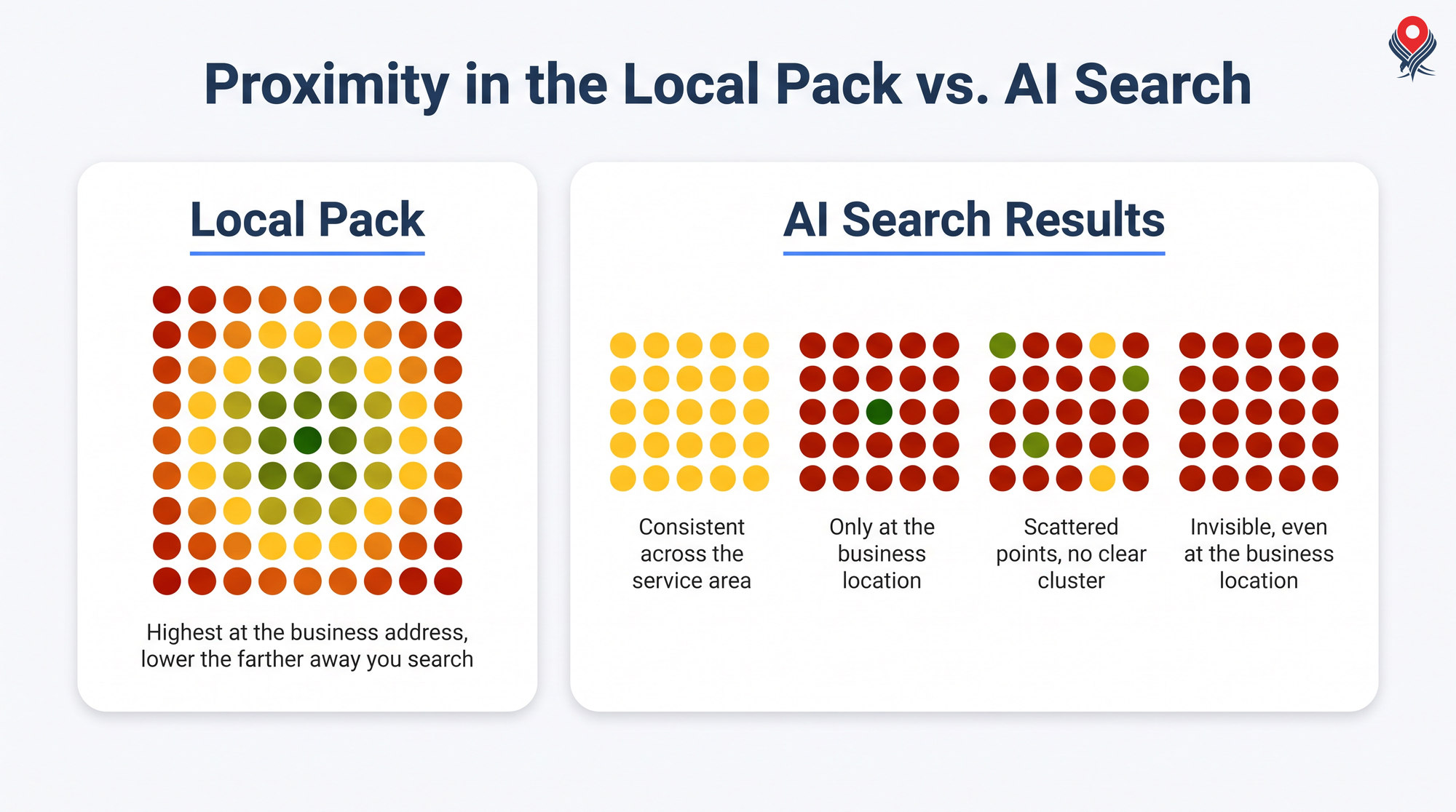
Proximity in AI Search Results vs. the Local Pack
In the local pack, the visibility pattern is relatively predictable. A business usually shows up at or near the top of the pack at its own location, then falls lower in the rankings as you get further away.
If you've read a traditional local search grid, you've probably seen this as a bright green center transitioning gradually outward into duller green, then shades of yellow and orange, and eventually red.
AI visibility reports don't reliably produce that gradient. A business's visibility across a geo-grid can fall into a few different patterns, for example:
- Some businesses are mentioned in the same position across virtually their whole service area. A brand might be named fourth in nearly every response, regardless of where the search originates.
- Some appear in AI-generated responses only at their own location and are absent everywhere else.
- Some show up at a handful of scattered points (they're missing from most responses and present in a few with no cluster around the business address).
- Others are completely invisible from AI, even for a query performed right at their location.
What Proximity's Impact on AI Search Results Looks Like in Real Scans
A dentist visible nearly everywhere, but never mentioned first
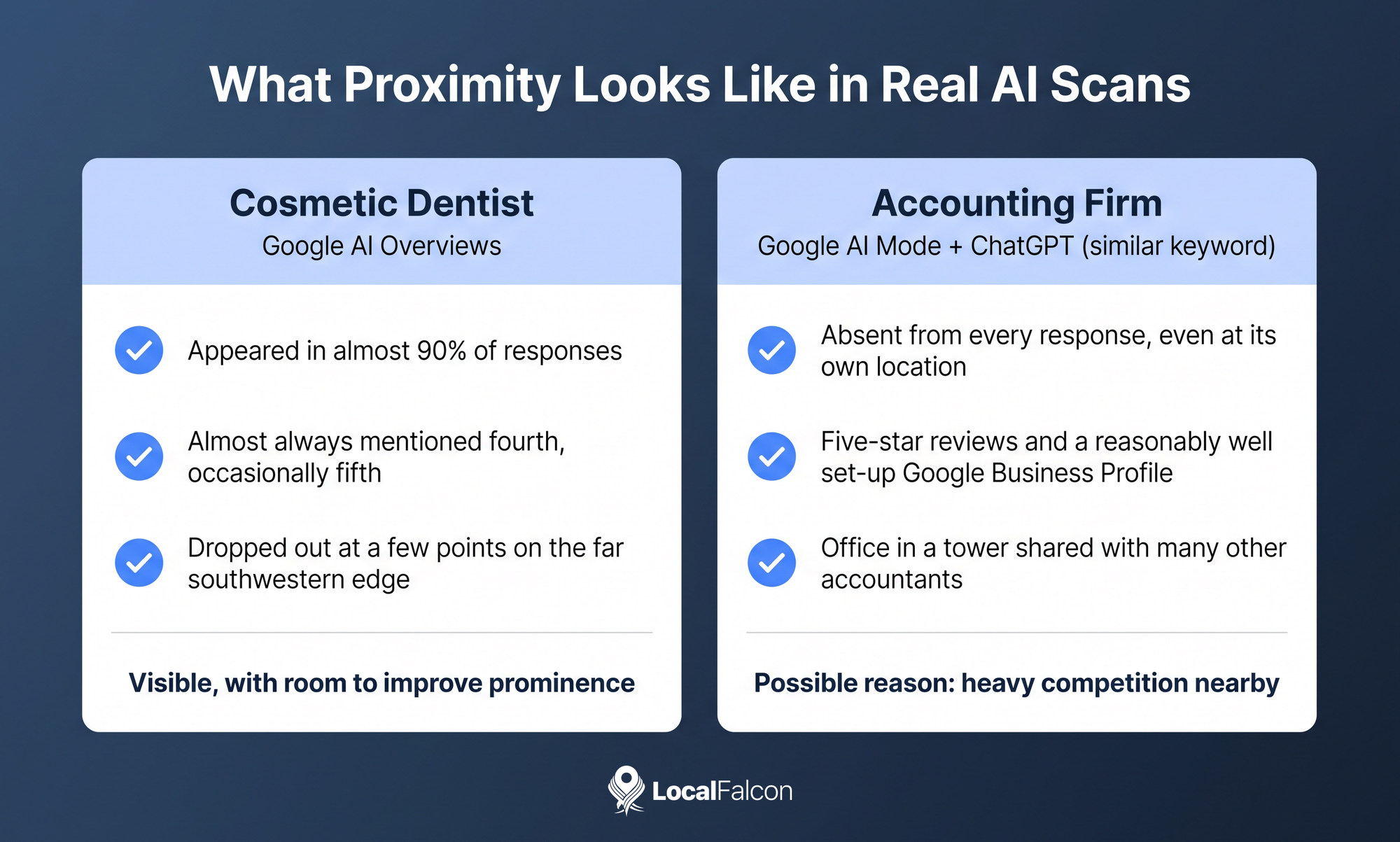
One example of how proximity's impact on AI search visibility is different from its impact on traditional local rankings comes from a scan for a cosmetic dentist in a small city of under 100,000 people. The keyword was "which cosmetic dentists near me offer professional teeth whitening," tracked on Google AI Overviews.
The dentist appeared in almost 90% of responses across the grid, so it had a very good Share of AI Voice. However, it was almost always mentioned fourth, occasionally fifth, and it dropped out of the response entirely at a few points along the far southwestern edge of the grid.
That is strong coverage with a very consistent rank, yet it doesn't resemble a traditional local ranking grid. Because of how dynamic AI-generated search results are, there's no clean explanation for why the business landed in the same spot so often, or why it fell out where it did, but it's something the business can keep monitoring and optimizing for.
Without grid-level data, it would have looked like a simple "yes, this dentist shows up in AI Overviews," and nothing more. However, knowing that they're visible, but have room to improve in terms of prominence in responses, gives them a goal to work towards.
An accounting firm that is missing from AI search even at their front door
Another example went the other way. An accounting firm was absent from every response generated by Google AI Mode, including at its own business location, which left the grid fully red. A similar keyword on ChatGPT produced the same result.
On paper, the firm's local ranking factors looked healthy. Its reviews were all five stars and included a steady stream of recent ones, and its Google Business Profile was set up reasonably well. Despite that, its Google Business Profile rankings were also low.
One potential explanation for the lack of visibility across both AI-generated and traditional local search results, even for close-proximity searches, is that the problem is competition. The firm's office is in a tower shared with many other accountants, in a neighborhood full of accounting firms.
When dozens of similar businesses sit within a few blocks of each other, being close to the searcher doesn't set a business apart. This theory fits what the AI visibility grid showed, especially since the firm's traditional local search visibility was low as well.
Competition may not be the whole story, though. AI platforms draw on their own set of sources, and those don't always line up with the factors that drive traditional local rankings. A business with strong reviews and optimized listing profiles can still be missing from the sources an AI relies on when it builds a local answer.
In a local AI visibility report in Local Falcon, clicking a grid point shows the sources the AI cited, so you can see where the competitors that do appear are being pulled from and confirm whether the firm shows up in those places as well.
Why You Need Location-Specific AI Visibility Tracking
Checking an AI platform by hand tells you what it says from one spot at one moment. As the examples above show, that single result can mislead you in either direction. A business that looks highly visible overall may not be the AI's top recommendation anywhere on the map, and a business that looks invisible may be missing for reasons tied to its surroundings.
A local AI visibility grid in Local Falcon runs the same query from many points across your city, neighborhood, or service area. Each point represents a separate AI query sample, run as if someone were searching from that spot. Clicking a point shows the AI's response, the brands it mentioned in order, and the sources it cited. Pins are color-coded. Green means you were mentioned first or second, yellow means third through fifth, orange means sixth or lower, and red means you weren't mentioned at all.
The grid also rolls up into metrics you can follow over time, including Share of AI Voice (SAIV), Average Rank Position and Average Total Rank Position (ARP/ATRP), and Buyer Persuasion Score (BPS), which rates from -10 to +10 how persuasively AI recommends your business, based on the language it uses about your brand.
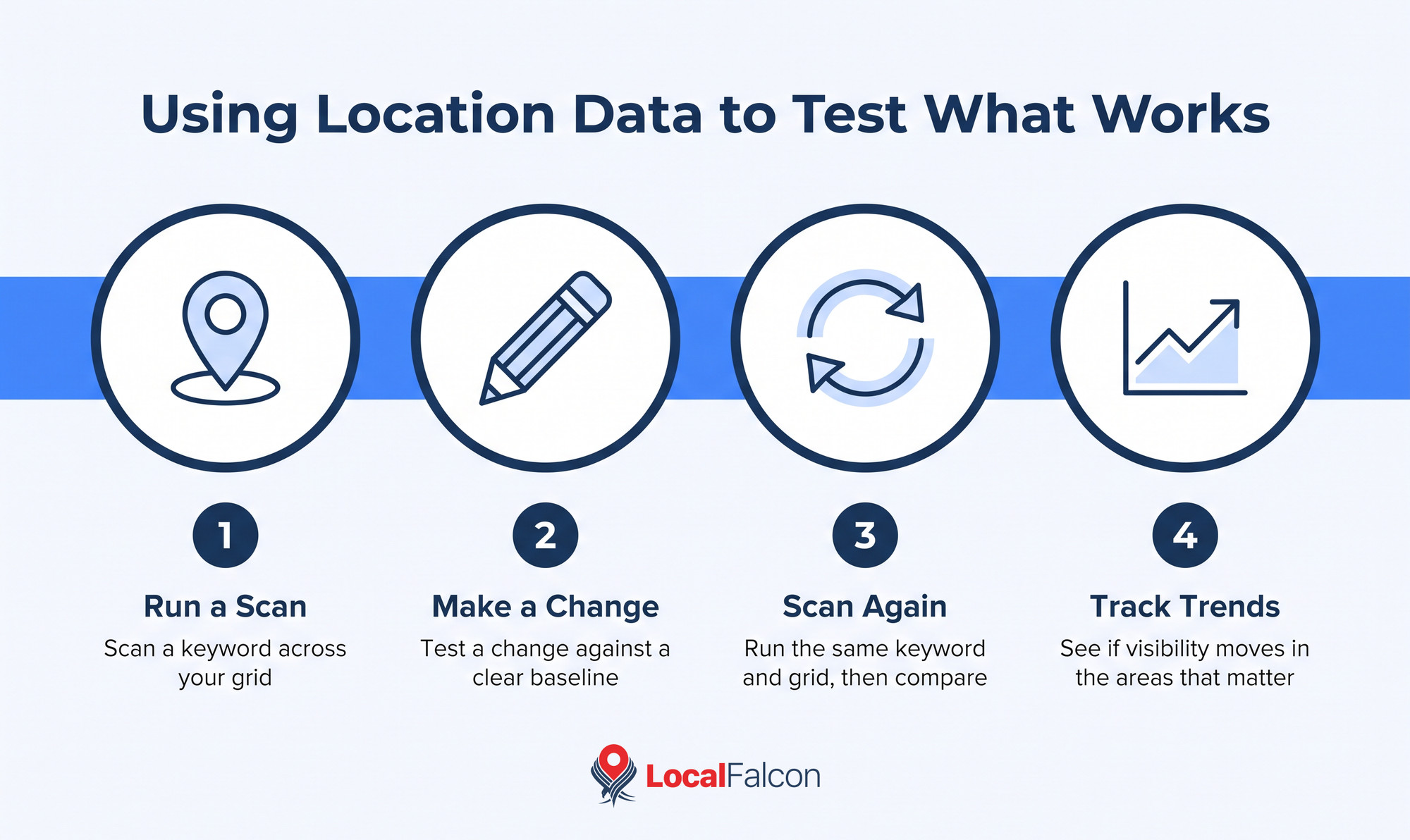
Using Location Data to Test What Works
Once you can see where proximity helps and where it doesn't, you can test changes with a clear baseline. Run a scan for a keyword and grid, make a change, then scan the same keyword and grid again and compare. Over time, a Trend Report shows whether optimizations are moving your visibility in the areas that matter.
This applies to every kind of user, for example:
- Business owners can see which parts of their target market AI overlooks them in.
- Independent local SEO professionals can show clients proof of what changed and where.
- Agencies can automate local AI visibility tracking for clients and prioritize their time.
- Multi-location and enterprise teams can spot weak markets across a whole portfolio.
The Bottom Line
Proximity does influence AI search results, but it doesn't necessarily behave the way it does in the local pack. Visibility can be uniform, concentrated at your address, or scattered, and sometimes a business is missing from AI search results altogether, even at its own front door.
The only way to know how proximity is affecting AI search visibility for your business is to look at how AI responds across the areas your customers search from.
FAQs On Proximity and AI Search
Does proximity affect AI search results?
Yes. AI platforms factor in the searcher's location and any location named in the query when recommending local businesses.
Is proximity less important in AI search than in the local pack?
It is less predictable. A business may rank highest at its own address in the local pack, but AI mentions can be uniform, concentrated near the business, or scattered.
Why would a business be missing from AI results at its own location?
Heavy competition nearby is one possible reason. It could also be missing from the sources the AI draws from, since AI and traditional ranking factors aren't always the same.
Can I check proximity effects by searching AI platforms myself?
A manual search shows one location at one moment. It can't show how your visibility changes across your service area.
How do I see how proximity affects my AI visibility?
Run a local AI visibility scan, which shows how AI platforms respond to a given query at multiple points across the areas your customers come from.