
Patients are increasingly turning to ChatGPT, Google AI Overviews, Google AI Mode, Gemini, and similar AI search tools to find a dentist, urgent care clinic, or medical specialist before they ever open Google Maps. That makes generative engine optimization (GEO) a top priority for healthcare marketers.
However, there's no one-size-fits-all GEO tool for healthcare industry businesses. A multi-location dental group, a hospital network, and a digital healthcare startup all need very different things from a generative engine optimization tool.
Below are a few of the top generative engine optimization tools recommended for medical and health industry marketers, organized by which type of healthcare business each one serves best.
6 of the Best Generative Engine Optimization Tools for Healthcare Industry Businesses
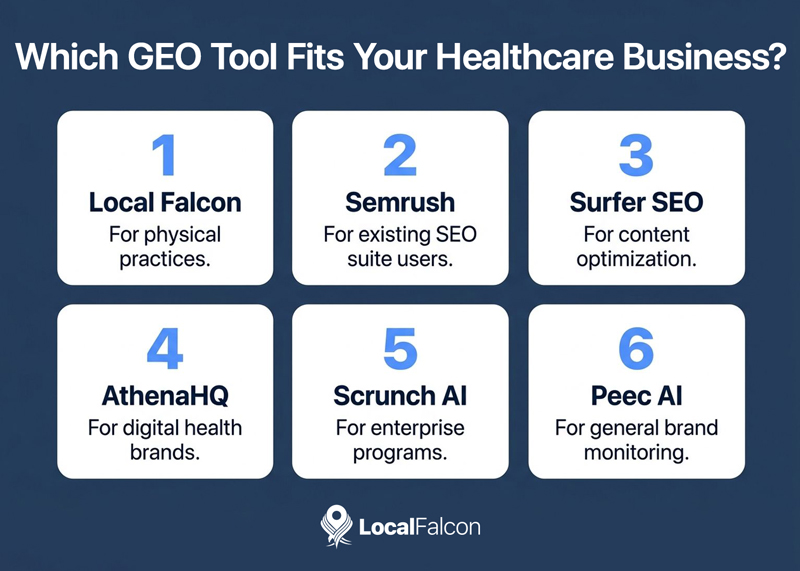
1. Local Falcon (Best for Physical Healthcare Practices)
For healthcare providers with a physical location, including urgent care centers, dental practices, medical spas, physical therapy clinics, multi-location healthcare networks, and others, Local Falcon is the only tool built around the geography patients actually search from.
Local Falcon runs geo-grid AI visibility scans across a service area, collecting multiple response samples accordingly, to show how consistently a practice gets mentioned by AI (and what the AI says about the business) at different points across a city or region rather than relying on a single query result. Each response sample in an AI visibility report includes the full list of sources cited by the AI.
This geographic granularity matters for healthcare businesses because a patient asking an AI assistant for an "urgent care near me" or "pediatric dentist in [neighborhood]" is going to get a different answer depending on where they're standing, and a practice that shows up strong downtown but disappears in the suburbs needs to know that, and understand why (i.e., the sources AI is citing).
Local Falcon offers AI visibility data alongside its existing Google Maps and Apple Maps rank tracking, and tracks Share of AI Voice (SAIV) against nearby competitors, so a healthcare marketing team can see the full local visibility picture, traditional and AI-driven, in one place.
Best for: Medical practices, dental groups, urgent care chains, med spas, physical therapy clinics, and any healthcare brand with one or more physical locations.
Main differentiator: It's the only generative engine optimization tool for healthcare brands built around the patient's actual location, not just brand-level visibility.
Potential downside: It's built specifically for location-based visibility, so it's not the best fit for telehealth or digital-only healthcare brands without a physical location/service area to track.
2. Semrush (Best for Healthcare Organizations Already Using the SEO Suite)
Large healthcare organizations and hospital systems often already run their SEO, content, and competitive research through an established platform like Semrush, and adding a separate GEO tool isn't always necessary.
Semrush has expanded its existing SEO ecosystem to include AI-search visibility tracking, so a healthcare marketing team can monitor how the organization appears in AI-generated answers alongside the keyword, backlink, and content data it's already using.
Best for: Hospital systems, health insurance brands, and healthcare organizations that want AI visibility tracking bundled into an existing SEO platform rather than managing a separate tool.
Main differentiator: GEO data lives inside the same platform healthcare marketing teams are likely already using for SEO.
Potential downside: Its AI visibility features are an extension of a broader SEO suite and designed for brand-level insights, so healthcare organizations that need deep, granular GEO metrics and optimization recommendations across markets may find a better fit in another tool.
3. Surfer SEO (Best for Optimizing Healthcare Content for AI Search)
Surfer SEO is a content optimization platform that's relevant as a generative engine optimization tool for healthcare industry businesses because of its AI Search Score and Facts Coverage features, which flag missing entities and factual gaps that AI systems look for when deciding whether to cite a page.
For healthcare content specifically, where factual accuracy and topical completeness carry extra weight, that kind of content-level optimization is especially important for GEO. Surfer also includes its own AI Visibility Tracker for monitoring brand mentions across leading generative AI answer engines.
Best for: Healthcare content teams and agencies optimizing blog posts, service pages, and patient education content for AI search.
Main differentiator: It helps brands optimize their content rather than just reporting on visibility, making it easier to tie optimizations to performance.
Potential downside: Its AI visibility tracking isn't location-based, so single- or multi-location healthcare practices won't get the geographic, service-area-level insight that they need.
4. AthenaHQ (Best for Digital Health and Health Tech Brands)
Telehealth platforms, health tech SaaS companies, and digital-first healthcare brands don't have a waiting room for patients to walk into, so a location-based AI search rank tracking tool isn't the best fit. AthenaHQ is built more for how these companies actually get discovered, focusing on brand sentiment, narrative tracking, and how AI systems describe a company when a buyer or patient asks about it.
Best for: Telehealth companies, health tech SaaS, and digital health brands without physical locations.
Main differentiator: It's built around brand reputation and narrative in AI answers.
Potential downside: It doesn't offer the geographic tracking that physical practices need, so it's a poor fit for any healthcare brand with physical locations and service areas.
5. Scrunch AI (Best for Enterprise Healthcare GEO Programs)
Scrunch AI is a dedicated GEO infrastructure platform for large organizations that want AI search treated as its own program rather than an add-on to existing SEO reporting. It covers a wide range of AI engines and includes the ability to serve AI-optimized content at the CDN edge, tailoring what AI crawlers see without rebuilding the underlying site.
Best for: Large healthcare organizations building a dedicated, ongoing GEO program across many AI engines.
Main differentiator: Infrastructure-level control over how AI crawlers interact with a healthcare brand's content.
Potential downside: Its enterprise-oriented pricing and setup complexity may be more than smaller practices or single-location providers need.
6. Peec AI (Best for General Healthcare Brand Monitoring)
For healthcare marketing teams or agencies that need straightforward AI visibility monitoring across a handful of brands without the complexity of an enterprise platform, Peec AI is a reasonable middle ground. It covers prompt tracking, visibility monitoring, and competitor comparisons with unlimited seats, which works well for agencies managing several healthcare clients at once.
Best for: Healthcare marketing agencies and brands that want general AI visibility monitoring without a heavy enterprise-grade platform commitment.
Main differentiator: A simpler, more affordable way to keep an eye on high-level AI visibility across multiple healthcare brands.
Potential downside: It's built for general monitoring rather than the deeper optimization recommendations or location-specific tracking that larger or physical-location healthcare brands may eventually need.
Generative Engine Optimization Tools for Healthcare Industry Businesses: FAQs
What generative engine optimization tools are recommended for medical and health industry brands?
It depends on the specific type of business. For healthcare providers with physical locations, Local Falcon is the best option, since it offers granular, location-specific visibility tracking and optimization recommendations. For digital healthcare brands, more general-purpose tools can work for understanding and optimizing overall brand visibility.
What is generative engine optimization for healthcare industry brands?
Generative engine optimization, or GEO, for healthcare is the practice of improving how a healthcare brand appears when patients ask AI tools like ChatGPT, Gemini, or Google AI Mode for recommendations. For practices with physical locations, that includes making sure a business shows up accurately and consistently across the geographic area it serves, not just in a single search result.
Is generative engine optimization different for local medical practices than for larger healthcare brands?
Yes. A local practice needs visibility tracking and optimization tied to specific neighborhoods and service areas, since patients typically search for care close to home. A national health system or digital health brand is more concerned with overall brand visibility and reputation across AI platforms, regardless of location.
Do healthcare practices still need traditional SEO if they're investing in GEO?
Yes. Generative engine optimization works alongside traditional SEO to improve AI visibility, which is separate from traditional search rankings. Most patients still use a mix of traditional search, maps, and AI tools, so healthcare brands generally need visibility across all of them.
How does patient trust factor into generative engine optimization for healthcare?
AI systems tend to favor sources that appear accurate, well-sourced, and consistent, which makes factual accuracy and content quality especially important for healthcare brands. Content with clear credentials, correct medical information, and complete answers is more likely to be cited than thin or vague pages.