
Generative engine optimization (GEO) is no longer optional for enterprise brands. ChatGPT, Gemini, Perplexity, Google AI Overviews, AI Mode and other generative answer engines are providing business recommendations that traditional search engine results pages used to. If your brand isn't part of the conversation, you won't even be considered as an option, and a competitor who is recommended will get the conversions you're missing out on.
This roundup of the best GEO platforms for enterprises is published by Local Falcon, and yes, we're one of the platforms on this list. What we want you to take away from this article is a clear picture of how some of the top enterprise-grade GEO platforms actually differ, so you can pick the one that best fits your business needs.
Top GEO Platforms Integrating With Enterprise SEO Workflows
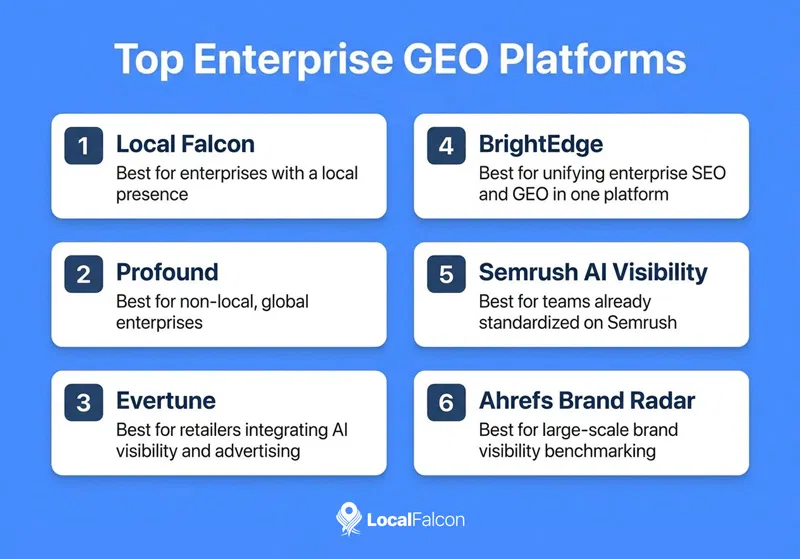
1. Local Falcon (Best for Enterprises With a Local Presence)
Most GEO platforms answer one key question: does AI mention my brand? Local Falcon answers a more useful one for any business with a physical footprint: does AI mention my brand the same way in one city as it does in another? What about across different neighborhoods we serve?
Local Falcon's AI search visibility tracking tracking tells you how ChatGPT, Gemini, Google AI Overviews, AI Mode, Grok, and other leading AI platforms describe a brand down to the hyperlocal level, using geo-grid scanning tied to real GPS points rather than a single brand-level snapshot.
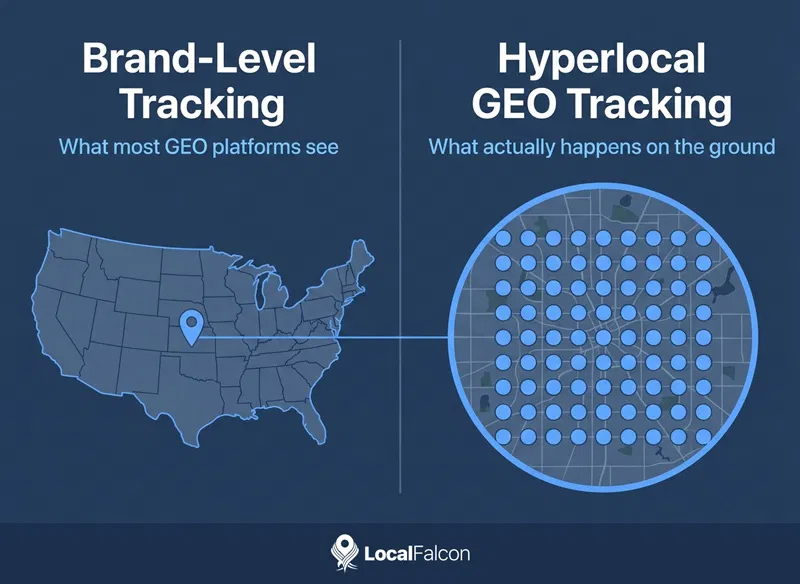
For enterprises with storefronts or service-areas, that level of granularity is important. A national plumbing brand doesn't need to know its aggregate AI sentiment. It needs to know whether AI is recommending a specific location over a local competitor when someone asks AI to recommend an emergency plumber near them.
Local Falcon built its AI visibility tracking and GEO features, including citation information, sentiment analysis, and competitor analysis, into the same platform enterprise teams already use to monitor Google Business Profile rankings, Apple Maps presence, Google Review sentiment, and GBP performance metrics. That means one dashboard for local and AI search optimization, instead of stitching together a rank tracker and a separate AI monitoring tool.
2. Profound (Best for Non-Local, Global Enterprises)
Profound is built for enterprises that need to know how they show up in AI answers at a global scale, without granular, localized insights. It tracks real user prompts across up to nine AI engines, and its read/write model pairs visibility tracking with AI-optimized content generation and recommendations.
Where Profound stands out for global enterprise brands is governance. SOC 2 Type II compliance, single sign-on, role-based access, hallucination detection, and audit trails are built into its Enterprise tier, which is aimed squarely at large organizations where AI citations can carry regulatory or reputational risk. Its Conversation Explorer also gives teams access to real user conversations with LLMs, useful for understanding not just whether a brand is mentioned, but how.
Again, Profound doesn't offer a local or geo-grid tracking layer, which is exactly why it's a good fit for non-local enterprises. Think: SaaS companies, national B2B brands, and any business where local AI visibility doesn't matter as much.
3. Evertune (Best for Retailers Integrating AI Visibility and Advertising)
Evertune takes a different approach than most platforms on this list: it treats AI visibility as something you can measure and then buy your way toward improving. It's the only enterprise GEO platform with direct integrations with programmatic advertising networks, letting brands run paid ads on platforms like ChatGPT to close visibility gaps its tracking identifies.
Evertune is best suited to retail brands focused on the customer buying journey, with a budget for an integrated AI brand intelligence and advertising strategy.
4. BrightEdge (Best for Unifying Enterprise SEO and GEO in One Platform)
BrightEdge has been an enterprise SEO platform for close to two decades, and its AI Hyper Cube module extends that same infrastructure into generative search.
Rather than bolting AI tracking onto a separate tool, BrightEdge folds citation monitoring, AI share-of-voice reporting, and content attribute analysis (which structural patterns correlate with AI citations) into the same system enterprise teams already use for keyword research, technical audits, and content optimization.
Its DataMind engine and Data Cube give BrightEdge one of the larger proprietary datasets in enterprise search, and its executive dashboards are built to translate AI citation data into reporting formats CMOs already recognize. For enterprises that want AI visibility as one more data layer inside an existing enterprise SEO system of record, BrightEdge is a strong fit.
5. Semrush AI Visibility Toolkit (Best for Teams Already Standardized on Semrush)
For enterprise teams already running Semrush across their organic and paid channels, the AI Visibility Toolkit adds AI tracking without introducing a new platform. It monitors brand mentions and sentiment across major AI surfaces like ChatGPT, Gemini, Perplexity, and Google AI Overviews, alongside features like prompt tracking and side-by-side competitor comparison.
The toolkit is available standalone or bundled into Semrush One, which combines it with the full SEO suite. That bundling is the appeal: one login, one billing relationship, and AI visibility data sitting next to the keyword and backlink data teams are already using.
6. Ahrefs Brand Radar (Best for Large-Scale Brand Visibility Benchmarking)
Ahrefs built Brand Radar on top of its existing crawler and prompt index, and that heritage shows in what it does best: cross-referencing AI mentions against the same backlink and organic data Ahrefs customers already rely on.
When an AI answer cites a source that mentions a brand, Brand Radar shows the referring domain's authority and organic traffic in the same view, which is useful for enterprise teams running digital PR or content strategies aimed at AI citations.
For enterprises already deep in the Ahrefs ecosystem who want directional AI visibility data next to their existing SEO reporting, it's a logical extension. For anyone wanting Ahrefs-caliber AI tracking as their primary GEO tool, it's worth confirming coverage and accuracy against your specific use case first.
Enterprise GEO Platform Pricing and Feature Comparison
|
Platform |
Hyperlocal Tracking |
AI Engines Tracked |
SEO Suite Integration |
Starting Enterprise Pricing |
|
Local Falcon |
Yes, GPS-level geo-grid |
ChatGPT, Gemini, Google AI Overviews, AI Mode, Grok, and others |
Built into existing GBP and Apple Maps rank tracker with other local SEO features |
From $499/mo (see Local Falcon's enterprise pricing) |
|
Profound |
No |
Up to 9 answer engines |
Standalone GEO platform |
Custom |
|
Evertune |
No |
ChatGPT, AI Mode, AI Overviews, Claude, Gemini, and others |
Standalone, complements existing SEO stack |
Custom |
|
BrightEdge |
No |
ChatGPT, Google AI Overviews, others |
Full enterprise SEO suite (Data Cube, ContentIQ) |
Not available (must request demo) |
|
Semrush AI Visibility Toolkit |
No |
Not specified |
Bundled into Semrush One suite |
Depends on annual subscription price (standalone toolkit for $99/mo) |
|
Ahrefs Brand Radar |
No |
AI Overviews, AI Mode, ChatGPT, Copilot, Gemini, Perplexity, Grok |
Add-on to Ahrefs SEO suite |
$699/month for all-platform access |
Most enterprise-grade GEO platform pricing models include some level of customization. Confirm current numbers directly with each vendor before budgeting, since figures shift as platforms adjust tiers.
FAQs on the Best GEO Platforms for Enterprises
What should enterprises look for in a GEO platform?
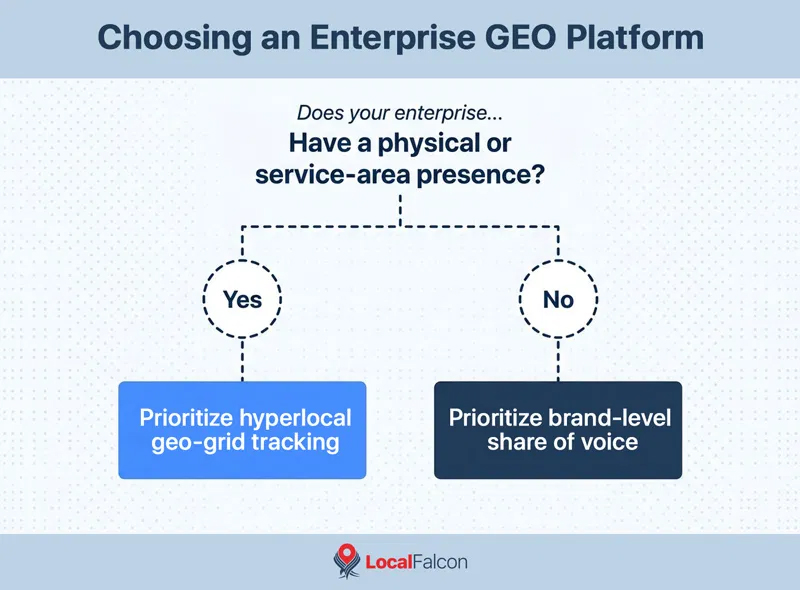
Coverage across the AI engines your customers use, share of AI voice and sentiment tracking, citation tracking, and whether it fits into workflows your team already runs. Enterprises with a physical or service-area presence should also confirm whether a platform can track visibility by location, not just by brand.
How do enterprise-grade GEO platforms pricing models typically work?
Most offer custom pricing for enterprise deployments, based on factors like AI engine coverage, prompt volume, and number of brands or locations tracked.
Can GEO platforms integrate with existing enterprise SEO workflows?
Several of the top geo platforms for enterprise SEO integration, including Local Falcon, BrightEdge, Semrush, and Ahrefs, build AI visibility directly into their existing SEO suites. Others, like Profound and Evertune, operate as standalone platforms that run alongside an SEO stack rather than inside it.
What enterprise GEO platform features matter most for AI search visibility?
Multi-engine coverage, share of AI voice metrics, sentiment analysis, source information (citation intelligence), and competitor analysis. For businesses with physical locations, hyperlocal tracking that shows how visibility and sentiment change by geography is a feature most platforms (apart from Local Falcon) don't offer at all.
Do multi-location or local enterprises need a different kind of GEO platform?
Yes. Brand-level (global or national) AI visibility tracking treats an enterprise as a single entity, which misses the reality that AI answers about a business can vary significantly from one market to another. Multi-location brands need geo-grid or location-based tracking to see that variation.
Conclusion
There's no single best GEO platform for every enterprise. The right one depends on many factors, such as whether you're managing AI visibility for a single national or global brand or one with hundreds of local locations or service areas, and whether you'd rather bolt GEO onto a broader SEO suite or run it as a dedicated tool.
What's important to remember when comparing enterprise-grade generative engine optimization platforms is that AI search visibility isn't uniform, and treating it that way is a mistake. Enterprises with a local presence, whether that's storefronts, service areas, or a mix of both, need a GEO platform built to help them see that variation and optimize market by market.