
Google Maps has taken another step toward becoming less of a map in the traditional sense and more of an AI-powered assistant for all things local.
Google recently announced a major expansion of Ask Maps, the conversational, Gemini-powered AI feature built into Google Maps, adding agentic capabilities that let it complete complex, multi-step tasks on the user's behalf.
Users can now Ask Maps to order food, compare and surface hotels to book for an upcoming trip, or find local events with direct links to buy tickets, all from a single conversational prompt.
This update doesn't come as a huge surprise, considering Google has made agentic AI one of its top priorities across the board in 2026.
The new agentic Ask Maps features are launching alongside other agentic pushes like Gemini Intelligence, which is coming to the next generation of Pixel phones running Android 17 and to Google's upcoming Googlebooks laptop line.
Along with Google's ongoing work on the Universal Commerce Protocol (UCP) for Food, an agentic commerce framework it's co-developing with partners, the new Ask Maps features are part of a broader company-wide effort to bring agentic commerce directly into the products people already use to plan their activities.
What Is the Google Maps Ask Maps Feature?
Ask Maps launched in March 2026 as what Google called its biggest transformation of Google Maps in over a decade. The feature combines Gemini's conversational AI with Google Maps place and location data, allowing users to ask complex, real-word questions instead of simply typing in keywords and scrolling through results.
For example, instead of searching for "coffee shops near me" and reading reviews to choose a business to visit, a user might Ask Maps something like "where can I have a dirty chai latte while working on my laptop in peace for an hour or two," and get a direct, personalized answer paired with a customized map.
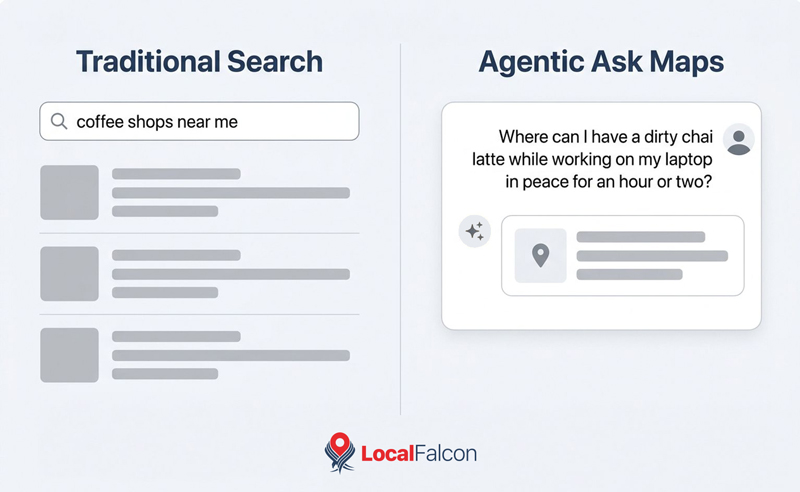
From the start, Ask Maps was built to personalize results using a user's saved places and search history, and to help turn answers into action, whether that meant making a restaurant reservation, saving a place to a list, or getting directions with a couple of taps.
The original launch also introduced Immersive Navigation, a companion overhaul of the Google Maps driving experience featuring 3D visuals, clearer lane guidance, and route tradeoff information.
What Can Ask Maps Do Now With Agentic Features?
The August update pushed Ask Maps from answering questions to actually completing tasks that would normally take a number of clicks for a user to complete. In its announcement, Google highlighted agentic capabilities in three areas in particular: food ordering, hotel discovery, and finding things to do (i.e., ticketed events).
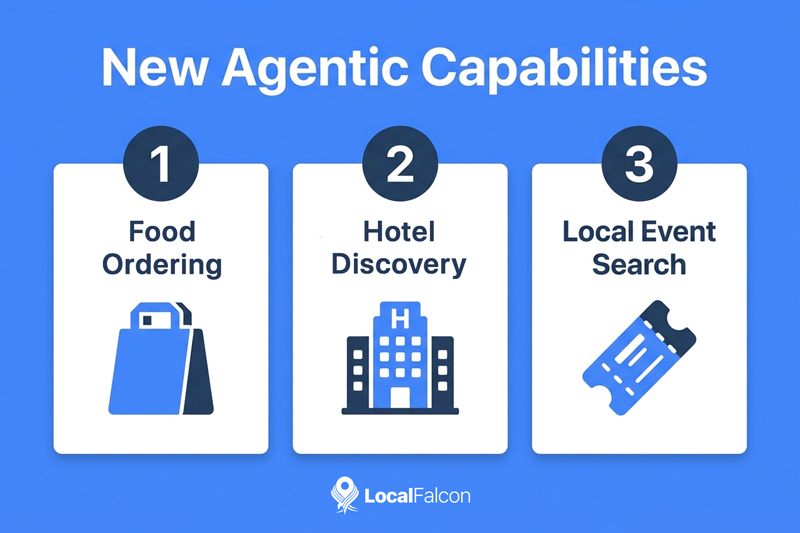
Food ordering is the most transactional of the new Ask Maps capabilities. Users can Ask Maps something like "find me a burger and fries spot on my route home that's open right now that I can grab some food from on my way home from work," and the agentic tool will search for nearby restaurants along the route that meet the criteria. Once a restaurant is selected, the user can have Ask Maps add food items to their cart, and then only needs to review the order and pay.
Hotel discovery works in a similar way. Someone planning a work trip might say "I need an affordable hotel near downtown Montreal for a conference next month, ideally boutique-style and close to good restaurants," and Ask Maps will compare real-time pricing and availability before surfacing short-listed options based on provided criteria.
The third use case Google highlighted covers events and things to do. Ask a question like "what's happening this weekend near the waterfront that I could grab last-minute tickets for," and Ask Maps will pull together options ranging from concerts to comedy shows, each with a direct link to buy tickets.
Layered on top of these new agentic Ask Maps capabilities is a feature Google calls Personal Intelligence, along with conversation memory. Personal Intelligence lets users securely connect Gmail, with Calendar support coming later, so Ask Maps can factor in things like an upcoming flight or dinner reservation without being told about it directly. This feature is off by default, and users can opt to turn it on.
Conversation memory means Ask Maps can recall previous exchanges, so someone planning a trip, for example, could Ask Maps something different days after an initial conversation and pick up right where they left off. This is useful for any type of planning that unfolds over time, like building a multi-day itinerary or narrowing down date night options over a few conversations throughout the week. Note that this feature requires history settings to be turned on.
Google is also rolling out a live transit widget inside Ask Maps for real-time delay information on buses, trains, and ferries, along with a conversational way to contribute updates to Google Maps, like reporting a store's new hours or flagging a permanently closed location directly in the chat. Submitted changes still go through Google's standard review process before appearing on Maps.
Wrapping Up
Ask Maps moving quickly from a question-answering tool to one that can actually place an order or virtually hand someone a ticket fits squarely into where Google has been steering its AI products all year. For local businesses, it also raises the stakes on how they show up in agentic results.
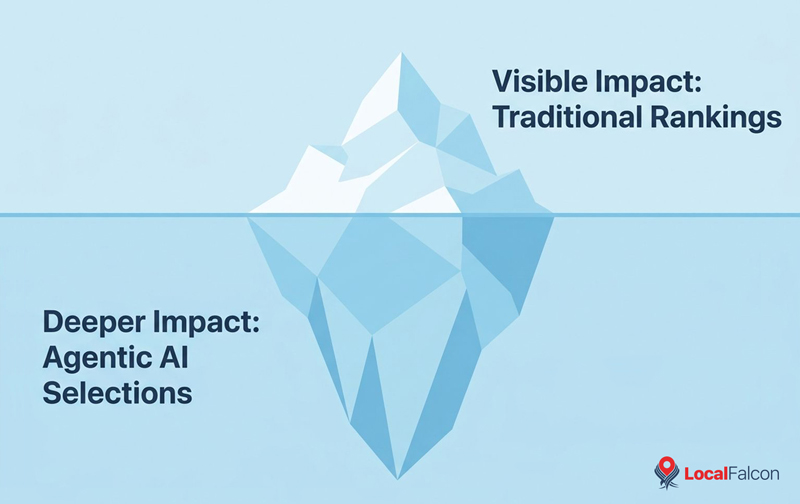
If Ask Maps is choosing which restaurant gets the order or which hotel gets the click, accurate business information, complete menus, and up-to-date availability are more important than ever. An optimized Google Business Profile now not only determines where you rank on Google Search and Maps, but also how likely Google's own agentic AI features are to help a customer purchase from your business.
This is a trend that's worth watching closely as agentic commerce continues to work its way into everyday local search.