
Retail is one of the most competitive verticals in local search. Ask anyone you know if they've ever used Google Search, Maps, or another search engine to find local retailers, and you're unlikely to find someone who hasn't.
But consumers aren't just using local search to research nearby options anymore. AI agents are now enabling agentic commerce, allowing potential customers to automate direct purchases from retailers near them who offer online ordering.
Agentic commerce doesn't just apply to traditional retail ecommerce experiences either. It can be used to complete other types of local purchases, from buying tickets to booking travel accommodations. Think: purchasing movie tickets, making hotel reservations, or even ordering from a restaurant for takeout or delivery.
Understanding what agentic commerce actually involves, and how it changes the way many types of local products and services get discovered, is the starting point for making sure your business still shows up when the shopper on the other end is an AI agent instead of a person.
What Is Agentic Commerce?
Agentic commerce definition: Agentic commerce describes a model of online buying and selling in which AI agents, rather than people, do the legwork of a purchase. These agents research options on a person's behalf, weigh them against stated needs and constraints, and in many cases complete the transaction directly, with little ongoing input required once the initial request is made.
AI agents are the systems making this possible. Unlike a basic shopping chatbot that responds to scripted prompts, an AI agent can reason through a problem, plan a sequence of steps, and carry out actions across multiple tools and platforms without a person walking it through each one. That distinction is what separates an agent that can actually complete a purchase from one that can only answer questions about a product.
Traditional ecommerce still puts the work on the shopper. Someone has to search for products, open multiple tabs to compare options, read through reviews, and manually enter their information at checkout. Agentic commerce moves most of that work to the agent.
Instead of a person browsing site by site, an agentic AI platform gathers the shopper's requirements, checks multiple retailers in real time, evaluates the results against price, availability, and other preferences, and either makes the purchase or presents a short list of recommendations for approval.
This isn't confined to online shopping in the traditional sense. Agentic commerce also applies to travel bookings and ticketing and any other digital transactions that connect back to physical business locations, which is exactly why it matters so much for local search. A shopper doesn't need to type "shoe stores near me" into Google anymore if an agent can already tell them which nearby store has their size in stock and place an order.
How Agentic Commerce Works
Agentic commerce generally moves through a few connected stages, starting with a person and ending with an autonomously completed transaction.
It begins with the shopper defining what they want, along with any constraints that matter to them: a budget, a delivery window, a brand preference, dietary restrictions, whatever applies. A request might sound as simple as "find me a hotel for a family of four for next weekend within a 10-minute drive of [address]." From there, the agent takes over.
The agent searches across available providers in real time, pulling from structured product or service data rather than relying on a person to browse page by page. It compares options against the stated constraints, factoring in things like price, availability, delivery or pickup timing, and reviews. For low-risk purchases, the agent can complete the transaction without further approval. For larger or more sensitive purchases, most systems are built to pause and confirm with the person before finishing the transaction.
None of this works unless merchants make their systems readable by machines. Retailers and local businesses increasingly need to expose product catalogs, pricing, real-time availability, and policies (returns, cancellations, shipping) through APIs that an agent can query directly.
This is where standards like the Agentic Commerce Protocol (ACP) or Model Context Protocol (MCP) come in: shared frameworks that define how agents and merchants exchange this kind of structured information, so an agent doesn't need a custom integration for every business it might interact with.
Payment happens through delegated authentication systems built specifically for agent-led transactions, such as tokenized credentials or agent payment protocols from providers like Google and Visa. These systems are built to create an audit trail so both the retailer and the payment provider can verify that the transaction was legitimate.
Once a purchase is complete, some agents stay involved: tracking a shipment, handling a return, or flagging a complementary product. For a local business, this means the relationship with an agent-referred customer doesn't necessarily end at checkout.
Benefits of Agentic Commerce for Local Businesses
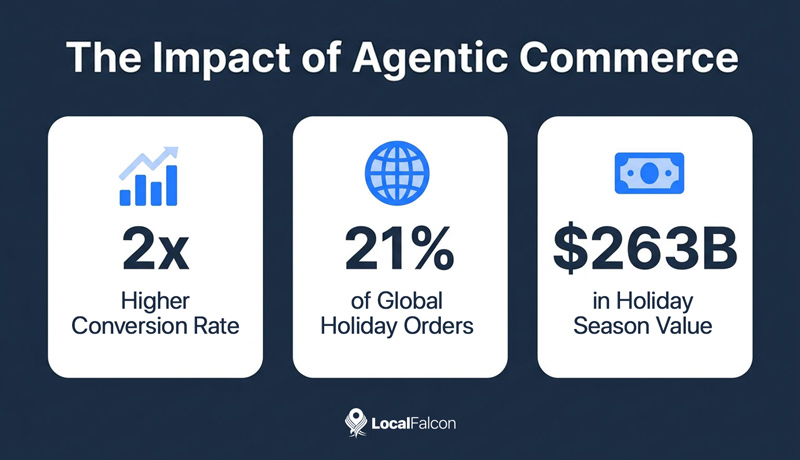
The scale of this change is already showing up in consumer behavior. Some agentic commerce implementations have shown that AI- and agent-referred shoppers convert at roughly twice the rate of shoppers arriving from other channels, and last holiday season, that traffic accounted for an estimated 21% of all holiday orders globally, worth roughly $263 billion. For local businesses, that represents a meaningfully larger pool of potential customers than the ones typing "near me" queries directly into Google Search or Maps.
The core benefits carry over from ecommerce generally: faster transactions, less checkout friction, and the ability to serve real-time, personalized offers without a person having to dig for them. But the way those benefits play out depends heavily on the type of local business.
Retailers With Online Ordering
An agent comparing options for a specific product can factor in which nearby stores actually have it in stock, how quickly it can be picked up or delivered, and the price, then complete the purchase directly. Visibility here depends less on ranking position and more on whether a business's inventory, pricing, and product data are structured and accurate enough for an agent to trust and act on.
Restaurants
Agents can already place takeout or delivery orders based on cuisine, dietary needs, price range, or how quickly the food will arrive. For a restaurant to get selected in that process, its menu, hours, delivery radius, and dietary information need to be represented in a format an agent can parse accurately, not buried in a PDF menu or an image.
Ticket-Based Businesses
Movie theaters, event venues, and local attractions benefit from agents that can check real-time seat or ticket availability against a person's schedule and location, then book it. This depends entirely on that availability data being exposed to the agent in the first place.
Travel and Hospitality Businesses
Local hotels, inns, and short-term rentals can be booked, rebooked, or canceled by an agent monitoring rates and conditions on a traveler's behalf, all within whatever approval limits the traveler has set. Independent and boutique properties that don't have the marketing budget of major chains stand to gain the most from being discoverable in this way, provided their availability and rate data is accessible.
Other Local Service Businesses
Gyms, salons, meal kit providers, and appointment-based services that already handle online bookings or subscriptions are natural fits for agentic commerce, since an agent can manage recurring purchases, monitor usage, and make adjustments without repeated manual input from the customer.
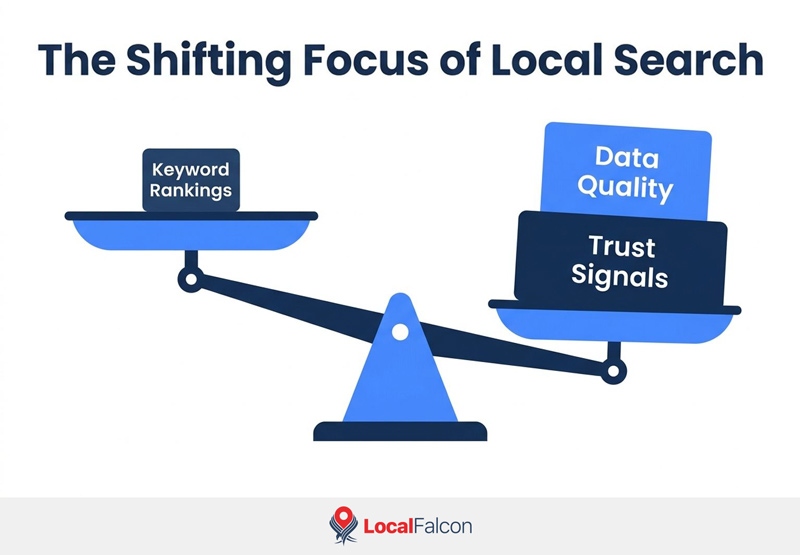
Across all of these categories, the common thread is that competing for visibility and conversions becomes less about ranking and more about whether an agent can find, trust, and act on your business's data at all.
Google Agentic Commerce
Google has been building out agentic commerce infrastructure specifically for this shift in how people shop, and much of it applies directly to local businesses.
The centerpiece is the Universal Commerce Protocol (UCP), a new open standard developed with retailers and platforms including Shopify, Etsy, Target, and Walmart. UCP is designed to give agents and merchants a shared way to communicate across the entire shopping journey, from discovery through post-purchase support, rather than requiring a custom connection for every agent a business wants to work with.
The most immediately relevant piece for retailers is agentic checkout. UCP will power a checkout feature built directly into eligible Google product listings in AI Mode in Search and the Gemini app, letting a shopper complete a purchase from an eligible retailer without leaving the research experience.
Payment runs through Google Pay, using shipping and payment details already saved in Google Wallet, with PayPal support coming as well. Retailers remain the seller of record and can customize the integration to their needs, which matters for businesses concerned about losing control over pricing, fulfillment, or customer data.
Google frames this primarily as a way to reduce abandoned carts and capture sales at the exact moment a shopper is ready to buy, rather than losing them to another tab or a competitor.
Alongside agentic checkout, Google is rolling out Business Agent, a branded AI agent that lets shoppers chat directly with a retailer on Search, similar to a virtual sales associate. It's already live for retailers including Lowe's, Michael's, and Reebok, and eligible businesses can activate and customize it through Merchant Center.
Google has said upcoming updates will let retailers train the agent on their own data, offer related products, and support direct purchases, including agentic checkout, inside that same chat experience.
Google is also adding new data attributes to Merchant Center built specifically for conversational and AI-driven discovery, going beyond standard keyword-based feeds to include things like answers to common product questions and compatible accessories. And it's piloting Direct Offers, which let advertisers surface exclusive discounts directly inside AI Mode results when a shopper appears ready to purchase.
None of these tools are exclusive to major national retailers. Any local business with a Merchant Center feed and online ordering capability is positioned to benefit as these features expand.
How Local Businesses and SEOs Can Prepare for Agentic Commerce
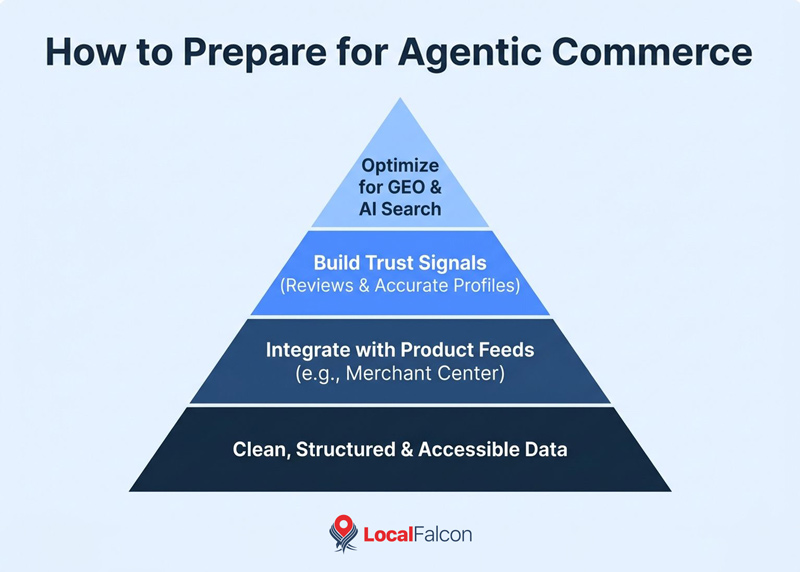
Preparing for agentic commerce starts with the same foundation that matters for AI search visibility in general: clean, structured, accurate, and most importantly, accessible data.
Agents don't browse the way people do. They query structured feeds and machine-readable content, and if a business's product, menu, or service data is incomplete, outdated, or locked inside images and PDFs, an agent is far more likely to skip it in favor of a competitor whose data is easier to read and trust.
That means going beyond the basics of a name, price, and category. Structured data should include specifics that match how people actually phrase requests to an agent: descriptors like "gluten-free," "same-day pickup," or "pet-friendly," along with clear policies for returns, cancellations, or delivery windows. The more specific and verifiable the data, the more usable it is for an agent trying to match a shopper's exact request.
From there, businesses should look at integrating their catalog or availability data directly into the platforms shoppers are already using agents to search and transact, whether that's a Google Merchant Center feed, an OpenAI-compatible product feed, or a UCP-compatible integration. Agents are increasingly built to prioritize structured product feeds over information scraped from a website, so a business without a feed is starting at a disadvantage regardless of how well-optimized its site is otherwise.
Trust signals matter just as much as data structure. Agents evaluate third-party reviews, not just a business's own website, to judge whether a recommendation or purchase is safe to make. Encouraging reviews on the platforms an agent is likely to check, and maintaining accurate, active profiles across those platforms, is part of the same trust-building work that's always mattered for local SEO, just applied to a new audience of non-human shoppers.
This is also where the overlap with generative engine optimization (GEO) lies. Structuring content so AI systems can extract clear answers (specific claims, clear headings, FAQ-style sections) is the same discipline that applies to earning visibility in AI Overviews or ChatGPT responses, and it applies equally to earning a spot in an agent's shortlist during a purchase decision.
Businesses already working on GEO alongside traditional SEO and following current best practices for AI search optimization are already building the foundation agentic commerce requires. The businesses that treat this as a data and trust problem now, rather than waiting until agent-led purchasing becomes the default, will have a real head start once it does.
Challenges and Limitations of Agentic Commerce
Agentic commerce isn't a frictionless transition, and it's important to understand where the potential friction might occur.
Data readiness is the biggest practical hurdle. Many businesses, especially smaller ones, have product or service information scattered across a website, a POS system, and a handful of third-party listing platforms, none of which necessarily agree with each other 100%. An agent won't reconcile those inconsistencies on a business's behalf; it will simply move on to a competitor whose data is cleaner.
Trust is a real barrier on the consumer side, too. Survey data shows the vast majority of consumers share overlapping concerns about privacy, data misuse, and unsolicited marketing tied to AI-driven purchasing. Some shoppers, particularly for higher-consideration purchases, still prefer to complete transactions manually rather than hand that decision to an agent.
There's also a technical gap on the merchant side. Fraud detection and payment verification systems were largely built around human behavior: how someone types, how they navigate a checkout page, how their purchase history looks over time. Machine-led transactions don't follow those same patterns, so businesses adopting agentic checkout need providers and systems built to verify a legitimate agent transaction rather than flag it as suspicious.
These aren't reasons to wait on preparing for agentic commerce. They're reasons to expect the prep work to take longer than a single afternoon of updating a product feed. Cleaning up fragmented data, choosing the right payment and verification tools, and building the trust signals agents look for is a multi-step project, and the businesses that start now will have already worked through it by the time this becomes standard practice.
Agentic Commerce FAQs
What is agentic commerce?
Agentic commerce is a model where AI agents research, compare, and complete purchases on a person's behalf, often with minimal ongoing input from the shopper.
How does an agentic commerce agent work?
An agent takes a person's requirements and constraints, searches and compares options in real time using structured data from merchants, and either completes the purchase or presents recommendations for approval.
How is agentic commerce different from traditional ecommerce?
Traditional ecommerce requires a person to manually search, compare, and check out; agentic commerce shifts that research and decision-making work to an AI agent acting on the person's behalf.
What are some challenges of agentic commerce?
Common challenges include fragmented or poor-quality product data, consumer concerns about privacy and data misuse, and payment and fraud systems that were built for human verification rather than machine-led transactions.
Do I need special technology to participate in agentic commerce?
Not necessarily. Many businesses can start by cleaning up existing product or service data and connecting to feeds like Google Merchant Center, without building custom infrastructure.
Closing Thoughts
Agentic commerce doesn't eliminate local search competition. It changes what certain types of local businesses are competing for, adding a new conversion layer on top of existing local SEO targets.
Traditional local rankings still matter, but they're no longer enough on their own if an agent can't parse a business's inventory, menu, or availability with confidence.
The businesses that treat data quality and trust signals as seriously as they've historically treated keyword rankings will be the ones agents actually recommend, and the ones customers actually find, whether that search starts on Google or inside another agentic AI platform.