
Google Maps and Apple Maps are the two most popular options when it comes to mobile navigation and local search apps.
Although Google Maps still holds most of the global market share by a huge margin, Apple Maps has come a long way since its infamous, error-ridden launch that prompted a public apology from Apple.
With the relatively recent addition to Apple Maps of business listings, ads, and other features aimed at local businesses, it's worth taking a look at how the two platforms compare in 2026, especially in terms of local search features and capabilities.
Google vs Apple Maps: Background
Google Maps launched all the way back in 2005 as a web-based mapping application for desktop devices.
Perhaps coming as no surprise, it being a Google product, Google Maps grew steadily into the default navigation and local search app for most of the world. It came pre-installed on Android devices and was even the default mapping app on the first iPhone in 2007, before tensions between Google and Apple led to Apple launching its own Maps app.
Apple's alternative to Google Maps launched in 2012, and the rollout is still remembered as one of the roughest product launches in Apple's history. Misplaced landmarks, missing points of interest, and inaccurate directions that in one instance pointed people across an active airport taxiway forced Apple's Tim Cook to issue a public apology and even recommend that users try competing apps instead.
Apple then spent years and reportedly billions of dollars rebuilding Apple Maps from the ground up, acquiring mapping and location data companies, deploying its own survey vehicles, and gradually adding navigation features like Flyover, Look Around, and multi-stop routing.
By the early 2020s, Apple had largely closed the gap in functionality and reliability between Google and Apple Maps, turning it into a plausible alternative to Google Maps, especially for iOS users.
Apple Maps vs Google Maps: Navigation
Both Google and Apple Maps now offer solid turn-by-turn directions, real-time traffic updates, transit navigation instructions, and offline maps. For the average navigational use case, either app can get the user to their destination perfectly fine.
However, Google Maps still has an edge in coverage and data depth. It lists roughly 250 million places worldwide, supports more than 70 languages, and benefits from over 20 million daily crowdsourced contributions of edits, photos, and reviews.
While Apple Maps lacks that scale, it has caught up to Google Maps in functionality and even pulled ahead in a few specific areas. Its Flyover navigation feature renders photorealistic 3D views of buildings and landmarks in hundreds of cities, and Apple has continued layering AI-enhanced details on top of that imaging. Google Maps does offer its own immersive aerial views, but they are far less detailed and realistic than Apple's Flyovers.
Apple Maps also has a native integration with Apple Watch that adds and expands upon its navigational features, including Walking Radius that shows you points of interest nearby while on foot, a trail finding feature (for the U.S. only), and watch-based driving notifications that vibrate on your wrist to help ensure you never miss a turn.
Google Maps vs Apple Maps: Local Business Listings
This is where the comparison between Apple Maps and Google Maps starts to really get interesting for local businesses.
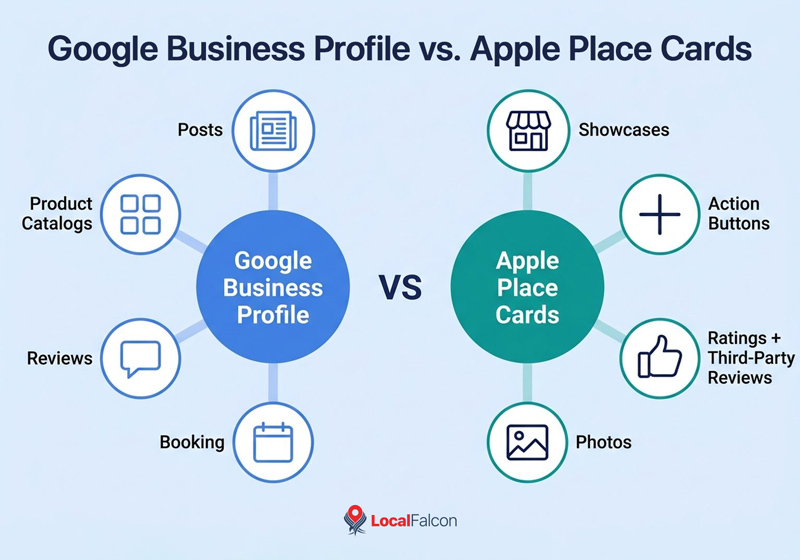
Google Business Profile (GBP), Google Maps' built-in business listing platform, remains the foundation of local (and AI) search visibility. It's free, feeds directly into both Google Search and Maps, and supports posts, product catalogues, menus, booking integrations, reviews, and other customer-business interactions.
Given that Google accounts for approximately 90% of global search traffic, and close to half of Google searches carry local intent, an optimized GBP listing still does more for a local business's visibility than any other listing platform.
Apple's equivalent to Google Business Profile was originally called Apple Business Connect but was recently folded into Apple Business, the company's new all-in-one business management platform.
Businesses can claim their Apple Maps listings, called Place Cards, and optimize them by filling out business details, choosing categories, adding photos, creating Showcases (posts), and adding action buttons to call, get directions, or order, much like GBP listings.
One important thing to note is that reviews function differently on Apple Maps vs Google Maps. Users can rate businesses directly on Apple Maps with a thumbs up or down, but the platform pulls in additional text reviews from third-party platforms.
Unlike Google Maps listings, Apple Maps listings are not currently indexed by Google, so users are only exposed to them directly via the Apple Maps app. Despite the lesser visibility, claiming and optimizing a Place Card is essential for local businesses to ensure they are visible and accurately represented to Apple Maps users.
Google vs Apple Maps: Advertising
Longstanding Google Maps advertising options include Promoted Pins, Local Services Ads (LSAs), and Search Ads that surface a business at the top of relevant queries, all run through Google Ads and tied to keyword bidding.
Apple Maps ads are new in 2026, with placements available in two areas as of launch: at the top of the Suggested Places section before a user searches, and at the top of relevant results after a search. Businesses buy Apple Maps ad placements through the Apple Business platform, with no minimum spend.
Apple has cited more than 1 billion business-related searches happening on Maps each month, with roughly half resulting in some kind of user action like a call or a request for directions, which gives a sense of the intent Apple is now trying to monetize.
Interestingly, certain categories of businesses that can advertise on Google Maps, most notably home services businesses, aren't eligible to advertise on Apple Maps at all.
It seems like Apple is trying to make their Maps ads feel as relevant as organic results for "near me"-type searches, whereas Google essentially treats Google Maps as an additional surface for Google Ads and LSAs.
Apple vs Google Maps: Usage
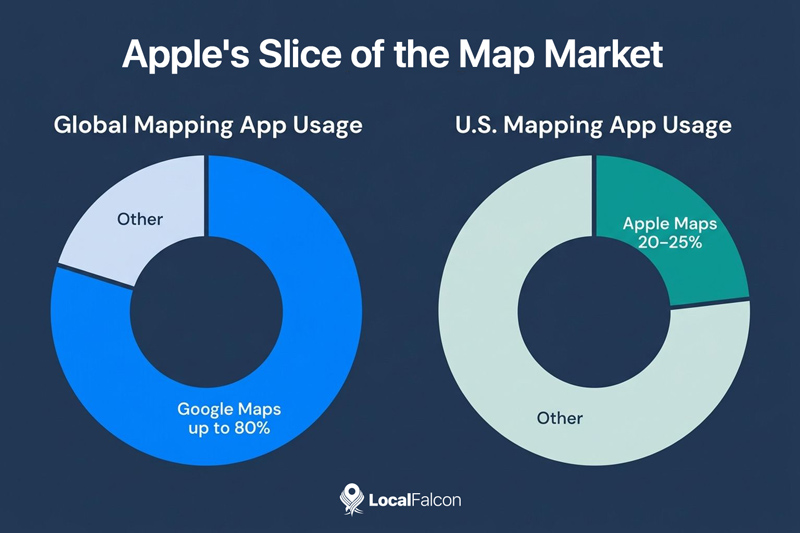
Google Maps remains the dominant mapping app globally, with more than two billion monthly active users and up to 80% of the market share, depending on the source and region. It runs on both Android and iOS, which gives it more reach than Apple Maps, which is only available on iOS or the web.
Despite usage being largely confined to Apple devices, Apple Maps' monthly user base is still large, with estimates placing it between 200 and 500 million. Its U.S. market share is estimated at 20-25%. Because iOS holds roughly 60% of the U.S. smartphone market, and Apple Maps is the default Maps app on every one of those devices, a meaningful share of navigation and local search activity in the U.S. takes place on Apple Maps.
The key takeaway here is not that Apple Maps is now even with Google Maps in terms of usage, but rather that Apple's slice of the market represents a large number of potential customers for local businesses, especially in the U.S.
Apple Maps vs Google Maps: AI Features
This is the area with one of the widest gaps between the two mapping platforms in 2026, and it's one that matters increasingly for local businesses.
Google has been aggressively building out Ask Maps, a Gemini-powered conversational AI feature that has moved well past simple Q&A. Ask Maps offers agentic AI capabilities, meaning it can take action on a user's behalf: ordering food from restaurants, comparing and helping book hotels, and finding tickets to local events, all from a single natural-language prompt. Google has also added Personal Intelligence to Ask Maps, letting it draw on information contained within a user's Gmail and Calendar apps to personalize results.
Apple Maps' AI features are, so far, mostly visual, including AI-enhanced Flyover experiences with more realistic 3D detail. An intelligent feature more relevant to local businesses is Local Lists, which surfaces curated collections of nearby places, trending restaurants, or spots to take kids, based on what Apple describes as "intelligent insights" drawn from trending activity. Apple has been light on technical detail about how much of this is genuinely AI-driven versus rules-based curation, and everything is processed with privacy protections that keep insights untied to individual users.
While Google is the first to build local agentic commerce into its Maps app, it's worth noting that Apple's launch of Siri AI may eventually lead to more AI features available for Apple Maps, though nothing has been announced as of yet.
What This Means for Local Businesses
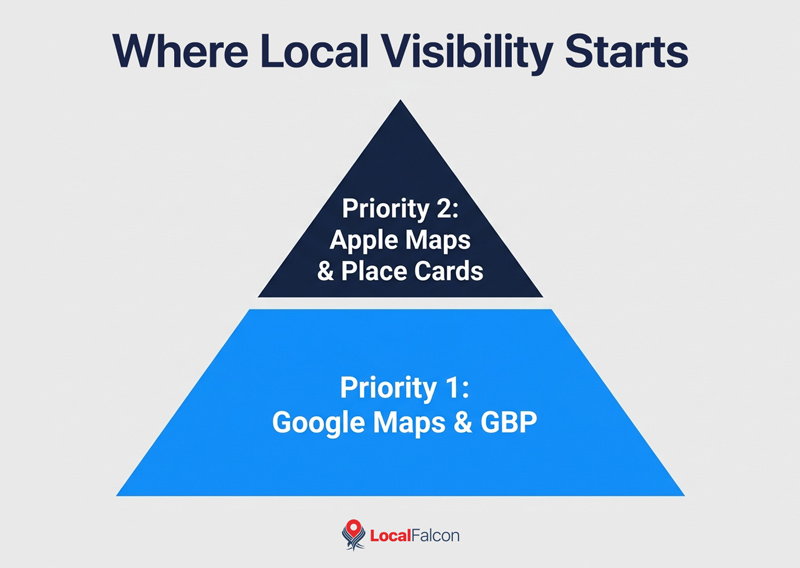
Google Maps is still the platform that matters most for local SEO, and that isn't changing any time soon. It has the largest audience, the deepest listing features, and a rapidly growing AI layer that can influence which businesses get chosen and purchased from. Any local visibility strategy still has to start with Google Maps.
That being said, Apple Maps has moved from being a bit of an afterthought to a legitimate secondary channel for local visibility. Between the growing base of iPhone users who stick with the iOS-native navigation app and an increasing number of local search features, from Apple Business listings to Apple Maps ads, businesses now have real ways to reach potential customers who prefer Apple Maps over Google Maps.
There's also a smaller but growing group of former Google Maps users who are moving away from the platform for various reasons and looking for an alternative, many of whom are choosing Apple Maps.
In other words, treating Apple Maps listings as something to claim and forget is not going to cut it for local businesses going forward. They're worth the same kind of ongoing attention, including regular Apple Maps rank tracking, as GBP listings, scaled to Apple's smaller yet still valuable slice of local search.
Google Maps vs Apple Maps: FAQs
Is Apple Maps as accurate as Google Maps?
For most everyday navigation, yes. Apple closed most of its early accuracy gaps years ago, though Google still has deeper data coverage overall.
Do I need both a Google Business Profile and an Apple Business listing?
Yes, if your customers use both iOS and Android devices. Google Business Profile should stay the priority, but an unclaimed, unoptimized Apple listing means less visibility and potentially inaccurate information reaching iPhone users.
Which platform has more users?
Google Maps, by a wide margin, with more than 2 billion monthly active users worldwide compared to less than a billion for Apple Maps.