
Public relations (PR) began as a structured professional practice sometime in the early 1900s, and experienced something of a "golden age" with the mid-20th century rise of TV and radio.
Over the years, PR has adapted to new forms of media and marketing practices, evolving into digital PR, and most recently experiencing a renewed appreciation due to the advent of generative AI and AI search platforms and features.
This is because AI search visibility is deeply rooted in reputation; precisely the area PR is designed for.
When it comes to AI visibility in local search, digital PR directly impacts not only whether or not a local business gets mentioned in AI-generated search results, but also what the AI says about the brand.
Thus, digital PR is no longer a supporting tactic for improving brand recognition and reputation, but rather a core strategy for earning AI search visibility and improving AI brand sentiment, ultimately helping drive more business through AI-powered search.
Digital PR Campaigns' Impact on AI Search Visibility
For most of SEO's history, backlinks were a primary currency of authority. The more high-quality sites linked to your brand, the more trust search engines extended to it. Digital PR helped earn those links by generating coverage, and that coverage in turn drove rankings. That relationship still holds true in traditional SEO, but digital PR and AI search visibility have a different kind of relationship.
Whereas backlinks signal authority to a search engine crawler, third-party mentions and earned media coverage signal authority to an AI model. So, just as link building has historically anchored traditional local SEO strategy, digital PR now anchors AI visibility strategy.
In fact, digital PR has possibly become even more essential than traditional link building due to the direct impact PR campaigns have on AI visibility and, even more importantly, sentiment.
Some are already calling this new discipline "machine relations," and whether the term sticks or not, the underlying practice of influencing what machines, or AI models, say about a business is real.
AI search tools like ChatGPT, Perplexity, Gemini, and Google's AI Mode are trained on and actively retrieve (and cite) content from across the web. When reputable publications, review platforms, and local media consistently mention a business in a positive or authoritative context, those mentions become the raw material from which AI constructs its understanding of that brand.
This matters in two distinct ways for local brands. The first is straightforward visibility: whether a business gets mentioned at all when a user asks an AI a relevant local query. The second, and arguably more consequential, is sentiment: the specific language, framing, and associations the AI uses when it does mention the brand.
A restaurant chain that earns consistent coverage emphasizing its fresh, locally sourced ingredients will likely be described in those terms by an AI. A competitor with sparse or mixed coverage may not appear at all, or may be described in generic, undifferentiated language that does nothing to convert a prospective customer.
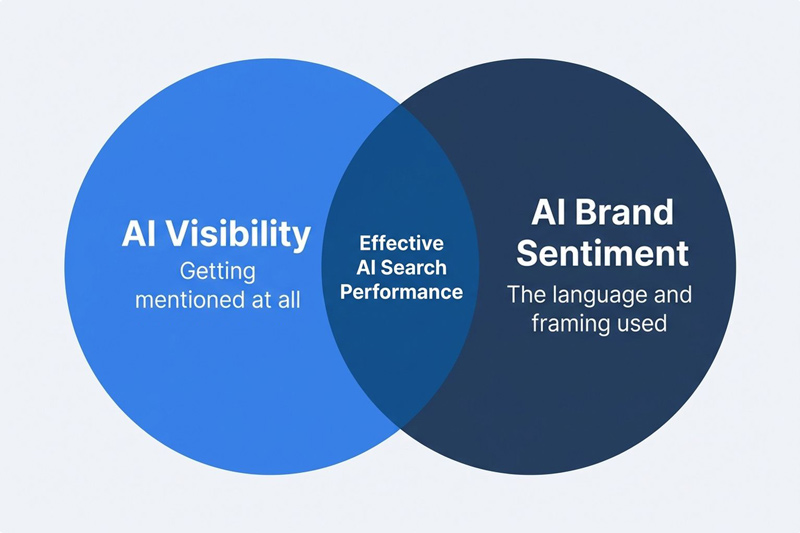
AI visibility and AI brand sentiment are distinct metrics that work together. Getting mentioned is like getting your foot in the door. But the ultimate measure of AI search performance is whether the AI's description of the brand is compelling enough to influence a buying decision. That's where a digital PR strategy comes in.
Digital PR Strategy Examples for Local AI Visibility
The following examples of digital PR strategies are particularly well-suited to local brands looking to build a presence in AI-generated answers.
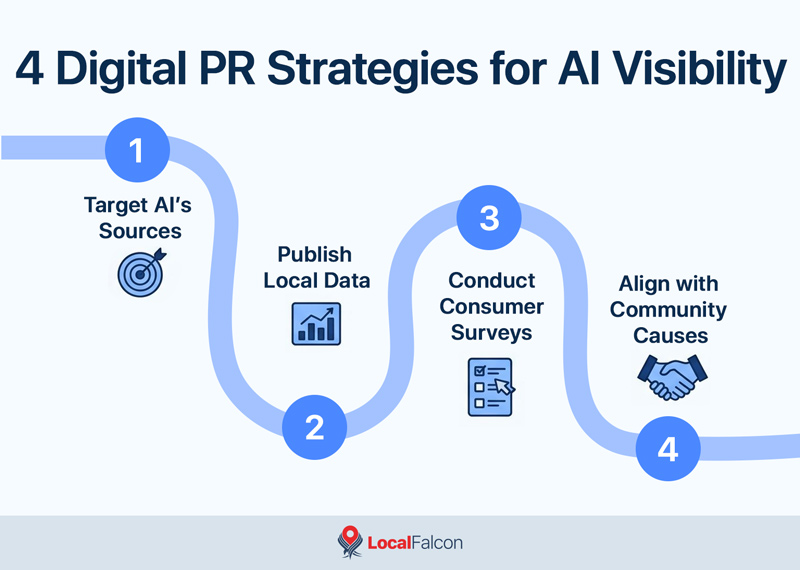
Use Source Intelligence To Target the Publications AI Already Cites
One of the most direct paths to AI citation is identifying which publications AI platforms are already drawing from for your category and geographic area, then pursuing coverage in those outlets specifically.
If you check AI visibility for queries in ChatGPT or Perplexity related to your business type and location and consistently see citations from, say, a regional lifestyle publication or a local business journal, those are your priority outreach targets.
Getting your brand cited in platforms like ChatGPT and Perplexity starts with understanding the sources those platforms trust most, and then doing the PR work to earn placements in them.
Publish Data-Driven Local Studies
Original research with a local angle is one of the most reliably effective formats for earning coverage from the kinds of publications AI platforms cite.
A multi-location home services brand, for example, could commission a study on the most common household maintenance issues by region, then distribute findings to local news outlets in each market. The study gives journalists a ready-made story; the resulting coverage gives AI systems a credible, location-specific source associating the brand with relevant expertise.
For local brands, this kind of geo-targeted data story produces coverage that signals authority in exactly the markets where AI visibility matters most.
Conduct Surveys Tied to Local Consumer Behavior
Surveys give local brands a way to generate proprietary data without significant research infrastructure. A regional restaurant group asking customers about dining preferences, a local gym surveying members on fitness habits, or a multi-location retailer polling shoppers on buying behavior can all produce findings with genuine local news value.
The key is designing survey questions that connect the brand's category to something with broader cultural or community relevance; the kind of hook that gives a local editor a reason to cover it.
Coverage in local media outlets carries particular weight for AI visibility in local search, where geographic authority is part of what AI systems evaluate when deciding whether a brand is relevant to a location-specific query.
Strive for Community and Cause Alignment
Local brands have a structural advantage over national ones when it comes to community-rooted PR: authenticity is easier to establish and harder to fake.
Campaigns that tie a brand to a genuine local cause, such as a neighborhood initiative, a regional environmental effort, or a partnership with a local nonprofit, tend to earn coverage from the community news outlets and hyperlocal publications that AI systems often refer to when answering local queries.
For a local brand, the key is identifying what the community genuinely cares about and building a PR moment around it that journalists in that market will want to cover.
The common thread across all of these examples of digital PR strategies for AI visibility is earned credibility in the sources AI platforms trust for your market, which is, at its core, what PR has always been about.
Digital PR and AI Visibility: FAQS
What is a digital PR strategy?
Digital PR is the practice of earning coverage, mentions, and links from online publications, journalists, and influencers. Unlike traditional PR, it is built around the web, and increasingly, around the AI systems that draw from it to generate answers.
What are the best digital PR strategies for local AI visibility?
For local AI visibility, the highest-return approaches combine original data (studies, surveys) with targeted outreach to the publications AI platforms already cite in your category and geography. Newsjacking trending local topics and pursuing coverage in regional outlets with strong domain authority are also consistently effective.
What's the difference between traditional PR visibility and AI citation visibility?
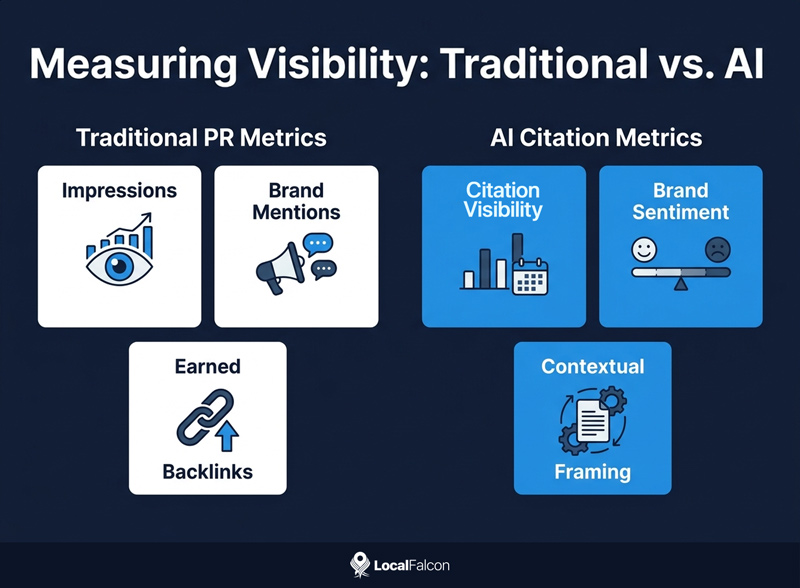
Traditional PR visibility is measured in impressions, brand mentions, and earned backlinks. AI citation visibility measures whether and how a brand appears in AI-generated answers; a distinct outcome that depends on which sources AI platforms trust and how consistently those sources frame the brand.
How can PR and SEO teams collaborate to improve AI visibility?
SEO teams can identify which publications AI platforms are already citing for relevant queries, giving PR teams a prioritized outreach list grounded in actual AI behavior. PR teams can then brief SEO on earned coverage as it lands, so internal content can be updated to reinforce the brand's footprint in those sources.
How can AI visibility insights support content and PR investments?
Monitoring how AI describes your brand surfaces gaps and opportunities that aren't visible in traditional analytics. If AI descriptions are accurate but generic, that's a signal your coverage lacks the specific, differentiated language needed to influence AI brand sentiment, and that PR angles need to sharpen accordingly.