
Search has changed. Millions of people are now turning to AI tools like ChatGPT and Perplexity to find local businesses, get recommendations, and research their options before making a purchase. Instead of scrolling through a list of 10 blue links or map pack results, they're getting a single confident, conversational answer, and that answer either includes your business or it doesn't.
If it doesn't, you're invisible to a growing slice of your potential customers. The good news is that AI citations aren't random. There are real, actionable steps you can take to influence how AI mentions your brand. Here's how to get your brand cited in ChatGPT and Perplexity, and how to build on that visibility over time. The steps can also be applied to other leading AI search platforms, inlcuding Google's AI (AI Overviews, AI Mode, Gemini).
How To Get Your Brand Cited in ChatGPT and Perplexity: Step by Step
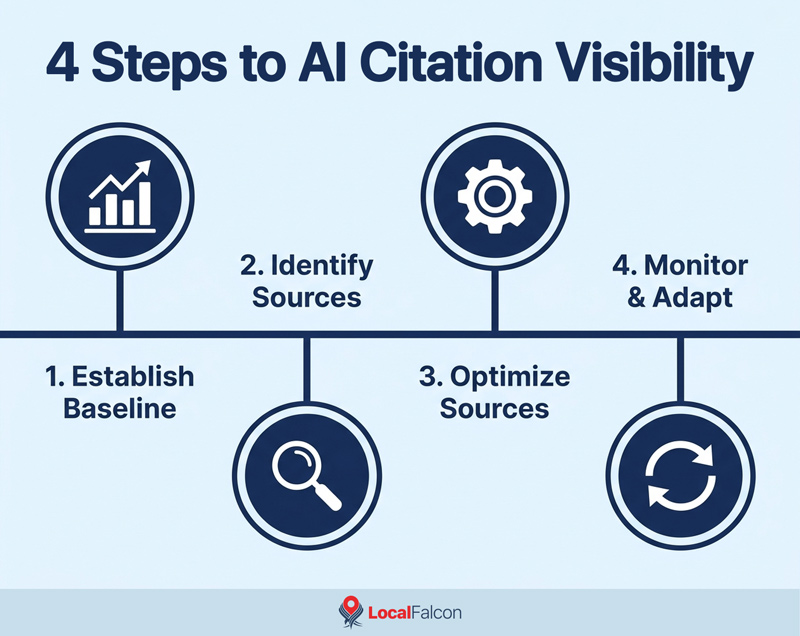
Step 1: Establish your baseline with AI visibility tracking
You can't improve what you don't measure, and that's especially true in AI search. Before you start making changes, you need to understand how visible your brand currently is across AI-generated answers, overviews, and recommendations.
The key metric to track here is Share of AI Voice (SAIV). Unlike traditional search, AI tools don't produce a ranked list of results. Your business is either mentioned or it isn't. SAIV quantifies your presence in AI-generated responses, giving you a baseline to measure improvement against. When your SAIV goes up, it means AI is mentioning your business more often. When it goes down, something has changed, and you need to know about it.
Local Falcon's AI visibility tracking scans give you concrete SAIV data showing how often your brand appears in ChatGPT and Perplexity responses, rather than leaving you to guess.
Step 2: Identify which sources AI is citing
Once you have a baseline, the next step is to dig into how AI is forming its answers about your business and your competitors. More specifically, what sources is it citing?
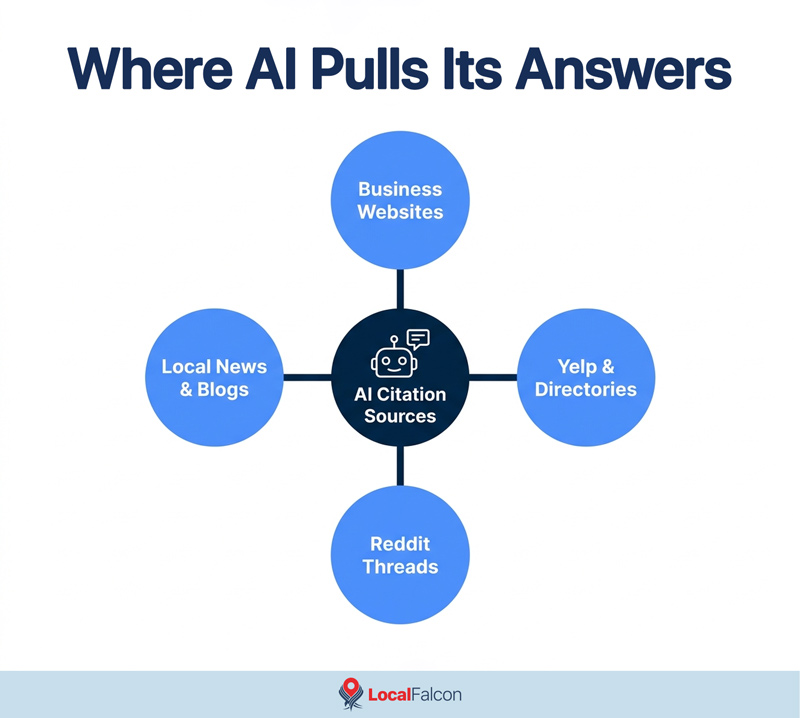
When ChatGPT or Perplexity recommends a business, it typically pulls from sources it considers authoritative, and those sources can vary by industry, location, and query type. You might find that AI is heavily citing your competitors' websites, Yelp profiles, niche industry directories, Reddit threads, or local blog or news coverage. Each of those citation patterns tells you something important: AI is essentially showing you its reference list, and that list tells you exactly where you need to show up across the web if you want to get your brand cited in ChatGPT, Perplexity, or any other AI source you're tracking.
Tracking competitor citations is just as valuable as tracking your own. If a competitor is consistently getting mentioned alongside a citation to a specific directory or publication that you're absent from, you've found a gap that you can close.
Local Falcon's AI visibility reports include source information showing all the links AI cites for your business and its competitors, giving you a comprehensive list of places to work on optimizing your brand footprint for better AI visibility.
Step 3: Optimize the sources AI relies on
After you determine which sources AI trusts in your space, you can start building authority where it actually matters. Learning how you get your brand cited in ChatGPT and Perplexity depends heavily on what's driving citations in your specific industry and location for each of those platforms.
If AI is citing business websites heavily, your own site needs to be built for citability. This means following generative engine optimization (GEO) best practices: clear, factual, well-structured content that answers real questions about your business and industry. Think FAQs, service pages and descriptions written in plain language, location-specific content, and relevant blog posts that cover topics competitors are getting cited for but you aren't.
If AI is pulling from Yelp or niche directories, ensure your listings on those platforms are complete, accurate, and actively maintained. Up-to-date hours, detailed service descriptions, and a healthy volume of recent reviews all signal credibility to AI platforms that draw from these sources.
If Reddit threads are driving citations, consider how your brand engages with relevant communities. Genuine participation in local subreddits, answering questions in your area of expertise, or simply having your business organically mentioned by real users can all increase your Reddit-sourced AI visibility.
If third-party listicles or news publications are appearing frequently, digital PR should be a priority. Reaching out to local journalists, contributing expert commentary, or pitching your business for relevant roundup-style articles can earn you the kind of editorial mentions that AI treats as highly authoritative.
The core insight is that AI citation strategy isn't about gaming an algorithm. It's about becoming genuinely present in the sources these AI tools have already decided to trust.
Step 4: Monitor, adapt, and repeat
Getting your brand cited in ChatGPT, Perplexity, and other AI search platforms isn't a one-time optimization problem. The sources AI cites shift over time. Your content ages and loses relevance. Competitors improve their own visibility. New platforms and search features emerge. What works today may need to be revisited in six months.
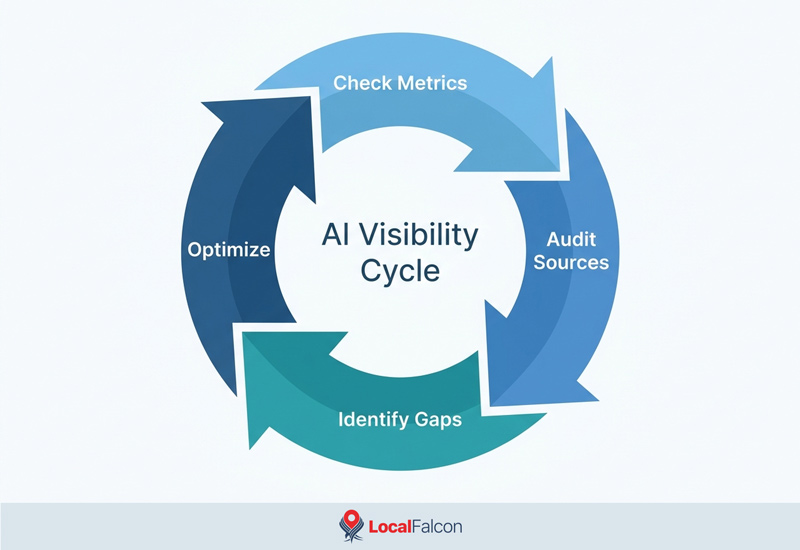
Regularly reviewing your SAIV data lets you catch changes early, understand what's working, and course-correct before your visibility deteriorates. Set a rhythm: check your AI visibility metrics, audit the citation sources, identify new gaps, optimize, and repeat.
Beyond Visibility: Making Sure AI Actually Sells Your Business
Getting your brand cited in ChatGPT or Perplexity is only half the battle. Once AI is mentioning your brand, the next question is: what is it actually saying about you?
AI-generated responses don't just list businesses; they describe them. The language AI uses to characterize your business can meaningfully influence whether a potential customer chooses you over a competitor. A lukewarm or generic description is very different from one that highlights your strengths and speaks directly to customer needs.
This is where Buyer Persuasion Score (BPS), another key metric in Local Falcon's AI visibility reports, comes in. BPS analyzes the language AI uses when mentioning your business and gives you insight into how persuasive (or unpersuasive) that language is likely to be. It's the difference between knowing you're visible and knowing whether that visibility is actually converting searchers into paying customers.
Together, SAIV and BPS give you a complete picture of AI visibility and brand sentiment: how often you're showing up in AI-generated answers, and how persuasively you're showing up.
Start Tracking Your Local AI Visibility Today
For local businesses, AI visibility is now just as important as traditional rankings. Knowing how to get your brand cited in ChatGPT and Perplexity (or any other AI platform) requires building the right presence in the right places, with the right messaging.
Local Falcon's AI visibility tracking features give you the data to do all of that: track your Share of AI Voice, analyze citation sources, benchmark against competitors, and monitor Buyer Persuasion Score and sentiment.
If you're not yet tracking how AI sees your business, and how customers see your business in AI, now is the time to start.