
If you've started paying attention to how your business shows up in AI-generated responses, you've probably encountered two distinct but related concepts: AI brand visibility and AI brand sentiment. They're often discussed together, and for good reason — but they measure very different things, and confusing the two can lead to misreading your performance and making the wrong strategic moves.
This article breaks down what each one means, how to measure both, and why using them together gives you the clearest possible picture of how AI-driven search is impacting your business.
What Is AI Brand Visibility?
AI brand visibility refers to how frequently your business is mentioned in AI-generated responses. When someone asks an AI assistant a question or Googles something and sees a Google AI Overview, AI visibility is simply a measure of whether your brand shows up in the answer, and how often.
Think of it as the AI equivalent of search engine rankings. Just as you'd want your website to appear on the first page of Google results for relevant queries, you want your business to be part of the conversation when AI is answering questions your potential customers are asking.
However, unlike traditional ranked search results, AI-generated recommendation lists almost never repeat in the exact same order. This means that instead of trying to "rank" in AI, the goal is to achieve frequent mentions. The more consistently your brand appears in AI-generated responses, the stronger your AI brand visibility.
For local businesses especially, AI brand visibility is becoming increasingly important. AI-generated overviews and recommendations are now a meaningful part of how people discover and evaluate local stores, restaurants, and service providers, and businesses that don't show up in those responses (and it can be hard to do so) are effectively invisible to a growing segment of potential customers.
What Is AI Brand Sentiment?
AI brand sentiment is a different measure of AI search performance entirely. Rather than tracking whether your business is mentioned, it evaluates the tone, language, and overall impression that AI conveys when it does mention you. Are AI responses enthusiastic and recommendation-driven when they reference your business? Neutral and noncommittal? Or cautious and qualified in ways that might give a potential customer pause?
This is where AI brand sentiment analysis comes in. Monitoring AI mentions and brand sentiment in LLM outputs tells you whether you're being talked about as well as what's being said.
A business can have strong AI brand visibility and still not be earning customers through AI search if the sentiment behind those mentions is working against them. In fact, high visibility with poor sentiment can potentially be worse than low visibility, because AI is actively and frequently framing your business in ways that erode trust or steer customers elsewhere.
For local businesses, AI brand sentiment carries particular weight. When someone asks an AI assistant for a direct recommendation, they're often looking for a single best answer, not just a list of names to choose from themselves (which they could use Google Maps for). The qualitative language AI uses in its response is often the deciding factor in whether a potential customer takes action.
AI Visibility vs AI Brand Sentiment
|
AI Brand Visibility |
AI Brand Sentiment |
|
|
What it measures |
How often your brand is mentioned in AI responses |
The tone and quality of language AI uses when mentioning you |
|
Why it matters |
Determines whether potential customers even encounter your brand via AI |
Determines whether those encounters drive action or erode trust |
|
Key metric |
Share of AI Voice (SAIV) |
Buyer Persuasion Score (BPS) + Brand Phrases |
|
The risk of ignoring it |
Competitors with stronger visibility capture customers you never reach |
High visibility with poor sentiment can actively steer customers away |
How To Measure AI Brand Visibility
Measuring AI brand visibility means tracking how often your brand appears across AI-generated responses for AI-style search queries and prompts relevant to your business. This requires an AI brand visibility tracker that can systematically scan AI outputs and quantify your presence — something that's difficult to do manually at any meaningful scale.
Local Falcon's AI visibility Scan Reports are purpose-built for this. The core metric in Local Falcon's AI visibility reporting is Share of AI Voice (SAIV), which measures how frequently your brand is mentioned across AI-generated responses for your target queries across a map grid. SAIV gives you a clear, quantified benchmark for your AI brand visibility — one you can track over time, compare across locations, and use to evaluate the impact of your optimization efforts.
For multi-location businesses and agencies, using SAIV as a benchmarking tool is especially valuable, since it allows you to compare AI visibility performance across locations and identify where visibility-building efforts are most needed.
How To Measure AI Brand Sentiment
Measuring AI brand sentiment requires going a layer deeper than visibility tracking. You need tools for analyzing brand sentiment in AI-generated search results. More specifically, you need tools that can evaluate the tone and language of AI responses, not just whether your brand appeared in them.
Local Falcon's AI visibility reports include several components designed specifically to surface AI brand sentiment insights and help you evaluate your brand safety in AI search.
Buyer Persuasion Score (BPS)
Local Falcon's Buyer Persuasion Score is a quantified measurement of how convincingly AI recommends your business. A high BPS means AI is using strong, positive, action-oriented language when referencing your brand — the kind of language that moves potential customers toward a decision. A low BPS signals that AI mentions are lukewarm or ambiguous, even if they're frequent.
Brand Phrases and AI Sentiment Classification
This section shows the exact words and phrases AI most commonly uses when describing your business, pulled directly from actual AI-generated responses. Each phrase is classified as positive, neutral, or negative, and includes a frequency count showing how often it appeared across AI outputs.
This is AI brand sentiment analysis at its most granular — rather than a single aggregate score, you're seeing the specific language AI has learned to associate with your brand, along with how often it's repeating it.
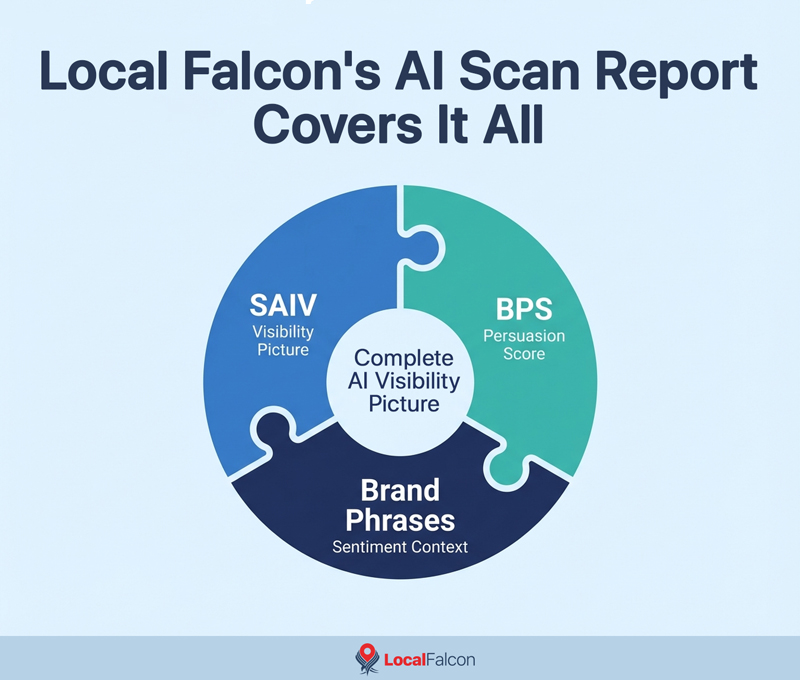
Together, BPS and Brand Phrases give you a comprehensive picture of your AI brand sentiment: BPS tells you how persuasive your AI presence is overall, while Brand Phrases tells you exactly what language is driving that score and where the gaps are.
Local Falcon's AI visibility Scan Reports also include a Falcon AI-generated sentiment summary that contextualizes the data in plain language. Rather than leaving you to interpret the numbers on your own, the summary explains what your BPS and Brand Phrases actually mean for your business — flagging patterns like a high volume of neutral mentions, identifying the specific language gaps preventing stronger AI endorsement, and pointing to the exact areas worth addressing first. It's the connective tissue between your raw sentiment data and your next strategic move.
Why You Need Both AI Visibility and Sentiment Tracking
Understanding either AI brand visibility or AI brand sentiment in isolation is useful. Understanding them together is where the real strategic value lies.
High visibility and strong positive sentiment is the goal — it means AI is frequently mentioning your business and doing so in ways that actively drive customers toward you. But the other combinations tell important stories too.
Strong sentiment with low visibility means you have a solid foundation and simply need to be heard more often. High visibility with weak sentiment means your AI presence is active but not working hard enough for you — and fixing sentiment should be the priority before investing further in visibility. Low visibility and low sentiment means both need attention, and sentiment is the right place to start, since amplifying a weak message only makes the problem worse.
Monitoring AI mentions and brand sentiment in LLM outputs on an ongoing basis is what allows you to catch these dynamics early and respond to them strategically and proactively.
Local Falcon: The AI Brand Visibility Tracker Built for This
For local businesses and the agencies that serve them, Local Falcon's AI visibility Scan Reports offer one of the most complete solutions available for tracking both AI brand visibility and AI brand sentiment in one place. You can even automate your AI visibility and sentiment tracking with Campaigns.
SAIV gives you the visibility picture, while BPS and Brand Phrase sentiment analysis give you the sentiment picture — and the combination gives you everything you need to understand how AI is representing your business and where your biggest opportunities lie.
As AI-generated responses and search results continue to shape how people discover and choose local businesses, having the right tools to monitor brand sentiment in AI platforms isn't optional — it's a core part of any serious local search strategy. Local Falcon gives you those tools, along with the context to act on what you find.
Frequently Asked Questions
What is AI brand sentiment and why does it matter for local businesses?
It's the tone and language AI uses when mentioning your business. For local businesses it matters because whether that language is enthusiastic or cautious can directly influence whether someone chooses you over a competitor.
What's the difference between AI visibility and AI brand sentiment?
AI visibility measures how often your brand appears in AI responses. AI brand sentiment measures the quality and tone of those mentions. One gets you in front of customers; the other determines whether that exposure drives conversions.
How do I monitor brand sentiment in AI platforms?
You need tools that evaluate the actual language AI uses when referencing your business, not just whether you appeared. Local Falcon's AI visibility Scan Reports do exactly that, scoring sentiment and persuasiveness on an ongoing basis.
Are there any tools for analyzing brand sentiment in AI-generated search results?
Local Falcon is one of the few tools purpose-built for this, combining AI visibility tracking (SAIV), sentiment scoring (BPS), and AI sentiment analysis for Brand Phrases — which shows the exact language AI associates with your business along with its positive, neutral, or negative classification.
How often should I be monitoring AI mentions and brand sentiment?
Regularly. AI outputs shift as models update and new information about your business circulates online, so ongoing monitoring is the only way to catch changes early and measure the impact of your optimization efforts.