AI search is no longer a niche channel. Google AI Overviews, AI Mode, Gemini, ChatGPT, and other AI search engines are now answering questions that used to send users to a results page full of links and map pack results.
For local businesses, this creates a specific challenge: how do you get your brand included in AI-generated overviews and responses that are increasingly replacing the traditional local search results your customers once used to find you?
The answer doesn't lie in a single tactic. Brands must focus on building a wide, authoritative brand footprint across the sources AI models trust when they generate answers:
- Your own website and location-specific pages
- Third-party directories and review platforms
- Credible external publications and earned media
- Social media profiles and community forums
The businesses that show up consistently in AI-generated recommendations are the ones that have made themselves visible and credible across a wide range of sources, not just one or two.
What Strategies Improve Brand Visibility in AI Search Engines?
Google's own guidance on how to improve brand visibility in AI search engines provides a useful foundation. Their official guide to optimizing for generative AI features on Google Search confirms what practitioners have largely suspected: there isn't a completely separate SEO strategy for AI visibility.
The best practices for improving brand visibility in AI search are grounded in the same fundamentals that drive traditional SEO performance. Strong technical infrastructure, unique and helpful content, demonstrated expertise, and authentic third-party mentions all carry weight.
Google also makes clear that commodity content does not distinguish your brand in AI-generated results. Generic, common-knowledge coverage of a topic does not compete with content that offers genuine expertise and unique insight. For a local business, that means your website and blog content should address real questions your customers ask, written with the specificity of someone who actually does the work.
A general overview of roof repair, for example, is commodity content. A breakdown of how freeze-thaw cycles in your region damage specific roofing materials, and what homeowners should look for before winter, is not.
Google also cautions against "AEO/GEO hacks," emphasizing that their generative AI features rely on many of the same signals as core Search rankings. For local businesses, this means the same citation-building, review generation, and content investment that supports traditional local SEO also supports AI visibility.
But there is a layer that traditional SEO did not require you to think about explicitly: knowing which sources AI is actually pulling from when it answers queries in your category and market. That requires separate measurement specific to AI search visibility.
How To Improve Brand Visibility in AI Search Engines: 5 Steps for Local Brands
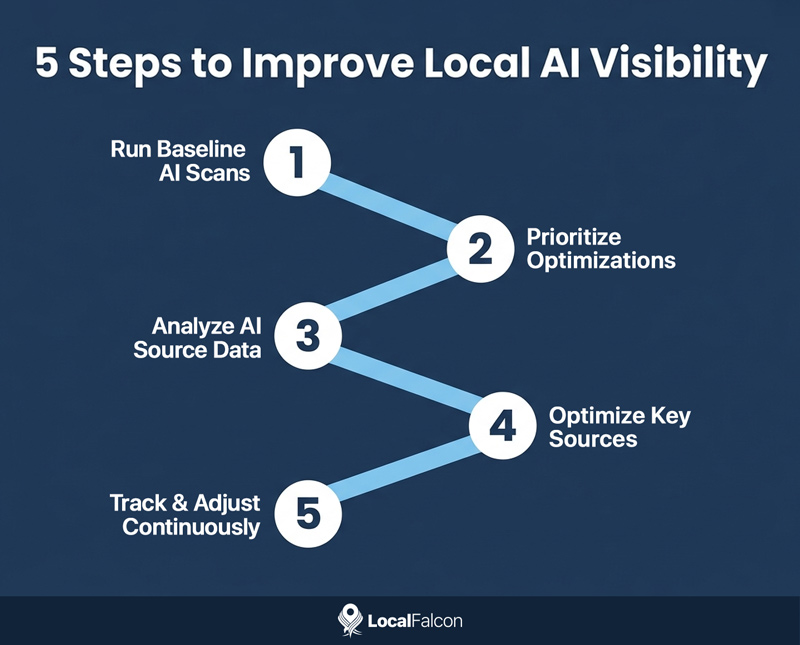
Here's a summary of the steps covered below:
- Run baseline AI visibility scans across all locations and platforms
- Identify high and low performers and prioritize optimizations
- Analyze the sources driving AI citations for your business and competitors
- Optimize your brand presence on the sources that matter most in your market
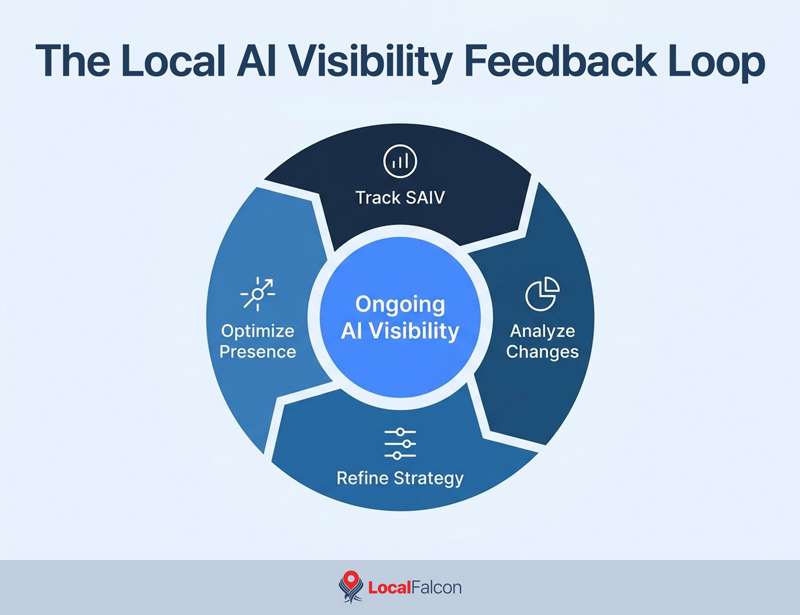
- Track AI search visibility on an ongoing basis and adjust as results change
Step 1: Run baseline AI visibility scans
Before you can improve your AI search visibility, you need to know where you stand. Run AI visibility scans in Local Falcon for all of your locations and for the queries that matter to your business. You should be covering the major platforms at minimum: Google AI Overviews, AI Mode, Gemini, and ChatGPT. Different platforms may prefer different sources and use different authority signals, so your visibility can vary significantly across them.
The key metric to establish at this stage is Share of AI Voice (SAIV). SAIV measures how often your brand appears in AI-generated responses for a given keyword across a given area. It gives you a concrete, trackable number rather than a subjective sense of whether you're "showing up." Each AI visibility report you run in Local Falcon gives you a SAIV score for that location and query combination, which becomes the baseline you'll measure all future optimizations against.
For multi-location businesses, running scans across all locations right away is worth the investment. You will almost certainly find that visibility is uneven, with some locations performing well and others barely registering. That gap is the roadmap for your work ahead.
Step 2: Identify strengths and weaknesses and prioritize optimizations
Once you have baseline AI visibility performance data across your locations, look for patterns. Locations with low SAIV are obvious starting points, but do not dismiss the locations where visibility is already strong. Those are your best case studies.
When a location consistently shows up in AI-generated responses, there is a reason. The sources that AI is citing for that location are working. The content on that location's pages may be more developed. The review volume might be higher. The third-party profile for that location might be more complete. Whatever the reason, the details embedded in your AI visibility reports for high-performing locations give you a replicable model. Take what's working there and apply it systematically to the locations that are underperforming.
Prioritize the optimizations where the potential gain is highest relative to the effort required. A location with near-zero SAIV in a high-value market deserves focused attention. A location already performing well in a lower-priority market can wait.
Step 3: Look at the sources driving AI visibility
This step is where AI visibility tracking for local businesses becomes genuinely different from traditional SEO analysis. When AI answers a query about your business or your category, it draws from specific sources, and Local Falcon's reports show you exactly which ones.
In the Source Information section of your AI visibility scan reports, you can see which sources AI cited for your business and for your competitors. You can click on any data point on the map to see the sources cited for AI-generated results for that specific geographic point, and you can look at the full list to understand the broader picture across your scan area.
This source data tells you where AI's trust is concentrated in your market. You might find that AI consistently cites Yelp profiles and a local business journal for businesses in your category. You might find that a competitor is being cited from a niche industry directory you are not listed in, or that AI is pulling from a local news feature that covered a competitor's new location. Each citation pattern is a specific signal. The sources driving a competitor's visibility that you are absent from are the gaps you need to close.
Step 4: Optimize brand presence on key sources
With your source data in hand, you can direct your optimization efforts to the places that actually influence AI-generated results in your market. The specific work varies depending on what the data shows, but the following categories cover the most common levers for local businesses.
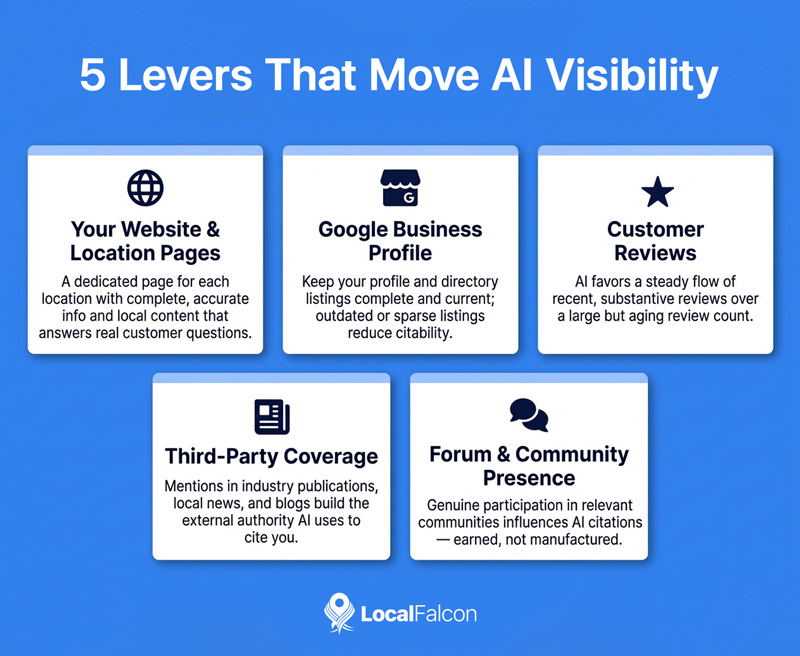
Your own website and location pages are the starting point. Each location you operate should have a dedicated page with complete, accurate, and genuinely useful information. Hours, address, service descriptions, and local-specific content that answers the questions real customers in that area are asking. Thin or overly templated location pages do not compete well against the kind of specificity AI favors when selecting sources.
Your Google Business Profile and other directory listings need to be complete and current. Outdated hours, missing service categories, sparse descriptions, and inactive profiles reduce your citability across platforms, particularly on Google's own AI features (the Gemini AI model gets local business info directly from GBP). The same applies to other directories that appear prominently in your source data.
Reviews matter both in volume and recency. AI platforms drawing from consumer reviews favor businesses with a steady flow of recent, substantive feedback over those with a large but aging review count. Build a consistent process for requesting reviews across your locations rather than running periodic campaigns.
Third-party coverage, which includes industry publications, local news, and blog features, strengthens the external authority that AI uses to validate and cite your brand. A legitimate mention or feature in a relevant publication carries more weight than a dozen directory listings on low-authority sites. If your source data shows competitors being cited from external publications, that is a clear signal that earned media and digital PR are worth investing in for your category.
Forum participation and online community presence, particularly on platforms like Reddit, can also influence AI citations in some industries and markets. Organic mentions from real users in relevant local or industry communities contribute to AI's picture of your brand. This is not something you manufacture; it's a byproduct of genuine engagement and reputation.
Step 5: Keep tracking AI search visibility and optimizing
Improving brand visibility in AI search results is not a one-time task. The sources AI trusts can shift. New competitors enter your market. Google releases updates that alter how AI Overviews and AI Mode surface local results. Platforms like ChatGPT and Perplexity change how they handle local queries. Any of these can move your SAIV up or down without any change on your end.
Running scheduled AI visibility scans in Local Falcon gives you the ongoing data you need to catch those movements early. When SAIV drops for a location or keyword, you want to know quickly so you can investigate whether a source you relied on has changed, a competitor has strengthened their presence, or something else is at play. When SAIV improves, you want to understand why so you can reinforce what's working.
Treat your AI visibility data the same way you treat your traditional rank tracking data: review it regularly, respond to meaningful changes, and use the trends over time to refine your overall strategy.
FAQs on How To Improve Brand Visibility in AI Search
What are the best ways to improve brand visibility in AI search results?
Build a consistent presence across the sources AI trusts in your category, including optimizing your own website and location pages, directory and review platform profiles, and credible third-party coverage. Tracking your Share of AI Voice (SAIV) in Local Falcon gives you the data to establish a baseline and prioritize where to focus.
Does traditional SEO still matter for improving brand visibility in AI search engines?
Yes. Google has confirmed that its own generative AI features on Search run on the same core ranking and quality systems as its traditional Search index, so a strong local SEO foundation directly supports local AI visibility.
Is it harder to improve AI brand visibility in AI-powered search results for multi-location businesses?
It can be, simply because the work scales with the number of locations: each one needs its own optimized presence, and AI visibility can vary significantly from one market to the next even within the same brand. That said, multi-location businesses also have an advantage in that strong-performing locations serve as a built-in benchmark, making it easier to identify what's working and replicate it across weaker ones.