
Local search visibility used to be relatively easy to diagnose for experienced marketers and business owners. By reviewing Google Search results, Local Packs, and Google Maps visibility, it was possible to develop a clear picture of whether a business was discoverable in its market. Strong rankings across priority keywords and geographies generally meant the brand was visible and competitive. Period.
However, with the rise of AI-driven search, many brands that perform well in traditional local search now find themselves absent when users ask AI for recommendations. Despite solid rankings, strong reviews, and optimized Google Business Profiles, they simply do not appear in AI-generated answers, raising an increasingly common question among local SEO professionals: is it harder to gain AI visibility than it is to rank in traditional local search? The emerging data suggests that the answer is yes, and the gap is larger than many expected.
TL;DR
- Many businesses that rank well in Google Search and Maps do not appear in AI-generated local recommendations.
- AI recommends only a very small percentage of possible business locations.
- AI visibility can be up to 30 times harder to achieve than traditional local rankings.
- ChatGPT recommends the fewest local businesses, while Gemini recommends the most.
- Fewer than half of brands that rank well on Google are among the most visible in AI results.
- Strong Google Search and Maps performance does not automatically translate to strong AI visibility.
- Businesses need to actively measure, track, and optimize AI visibility alongside traditional local SEO.
Why Traditional Rankings No Longer Tell the Full Story
For local SEO practitioners, the disconnect between rankings and AI visibility is not just surprising, it changes how they need to approach local visibility.
Traditional local search results are built around ranked lists of results that users can easily scan, compare, and explore further. Even when a business is not in the top three (the Local Pack), it can still be visible when users expand Google Maps results or in the organic (blue-link) results below.
However, AI-generated answers operate on a different premise. Rather than ranking options, AI assistants aim to curate and summarize what they believe to be the best answer to a user's query. This dramatically reduces the number of businesses that surface, regardless of how competitive they may be on Google Maps.
What the Data Reveals About Local AI Visibility
Recent AI visibility findings illustrate just how narrow AI-driven visibility has become for many local businesses. When AI systems recommend local providers, they surface only a small fraction of what is actually available.
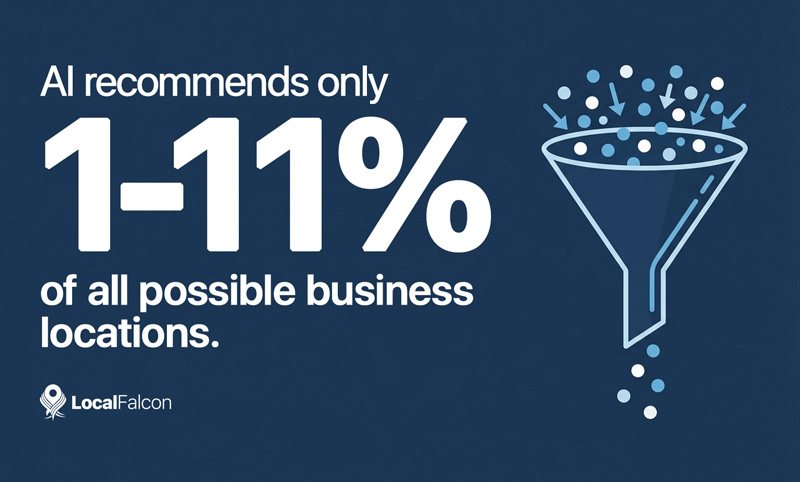
According to estimates, AI recommends only 1-11% of all possible business locations. Even at the high end of that range, visibility is extremely constrained compared to traditional search results. Most businesses, even relevant ones, are excluded by default. For many local businesses, it can be up to 30 times harder to appear in AI-generated answers than to rank in traditional local search.
The data also shows meaningful differences between platforms. ChatGPT reportedly recommends the fewest local businesses, while Gemini recommends the most, a pattern that aligns closely with how each system sources and prioritizes data (Gemini draws directly from Google Business Profiles).
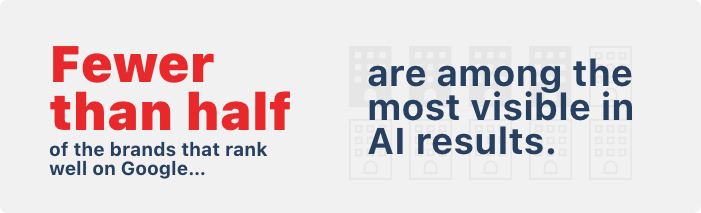
Another key finding is that fewer than half of the brands that rank well on Google are among the most visible in AI results. This directly challenges the common assumption that strong Google performance naturally carries over into all discovery channels.
The reality is that some brands with dominant Local Pack visibility appear rarely in AI-generated recommendations. At the same time, certain brands with more modest traditional rankings surface repeatedly in AI answers. The overlap exists, but it is inconsistent and unreliable.
This inconsistency is precisely what makes AI visibility feel more difficult to achieve. It cannot be inferred confidently from existing ranking reports or Google Maps visibility alone.
Why AI Visibility Is Harder To Earn Than Traditional Rankings
AI assistants take a completely different approach to local business discovery, drawing upon a far wider variety of sources than traditional local ranking algorithms and offering a more limited selection than classic SERP views. The result is that AI-generated local answers are highly variable, even for similar queries and locations.
Different AI platforms do not surface local businesses in the same way, either. For example, Gemini's reliance on Google Business Profile data aligns it more closely with traditional local ranking factors. ChatGPT, on the other hand, relies on Bing Places for Business, multiple niche sites, directories, and brand websites.
While there can definitely be overlap between Google Maps rankings and AI visibility across leading AI search platforms, it's not predictable and earning AI visibility often requires a broader set of tactics than optimizing for the "big 3" local ranking factors.
To ensure local AI search visibility, businesses must measure Share of AI Voice (SAIV) across platforms individually, rather than assume it transfers automatically from Google rankings.
Why This Matters for Local SEO Strategy
The takeaway is not that traditional local SEO is obsolete. Google Search and Maps remain critical drivers of local discovery and demand. However, ranking well is no longer an indicator of strong overall visibility.
AI limits users' exposure to businesses compared to traditional local search results, and businesses that aren't visible in AI search are losing out on growing share of potential customers.
Since AI-generated answers increasingly shape how users research and evaluate local options, if a business is excluded from those answers, it is excluded entirely from that stage of the decision process. There is no impression, no click, no call, no direction request, and no opportunity to compete.
That reality makes AI visibility a very real present-day strategic concern rather than a future consideration.
How Businesses Can Gain AI Visibility
Improving AI visibility starts with measurement. Most businesses today have little to no insight into how often they appear in AI-generated local answers or which competitors are being recommended instead. Without that data, optimization efforts lack direction.
This is why businesses need to use a tool like Local Falcon that measures your local rankings and visibility across Google Maps and AI platforms. The granular level of insight provided makes it possible to compare performance across Google Maps, Google AI Overviews, ChatGPT, Gemini, and other AI search platforms.
Armed with that granular visibility intelligence, businesses can act deliberately. This typically means improving entity clarity across the web, ensuring consistent and detailed business information, strengthening contextual descriptions of services and locations, and aligning Google Business Profile optimization with broader brand signals. The objective is not to replace traditional local SEO, but to extend it to account for how AI now selects and recommends local businesses.
The data already makes one thing clear. AI visibility is more selective, more compressed, and materially harder to earn than traditional rankings. That difficulty is precisely why it demands focused measurement and optimization now, rather than being treated as an assumed byproduct of strong Google performance.